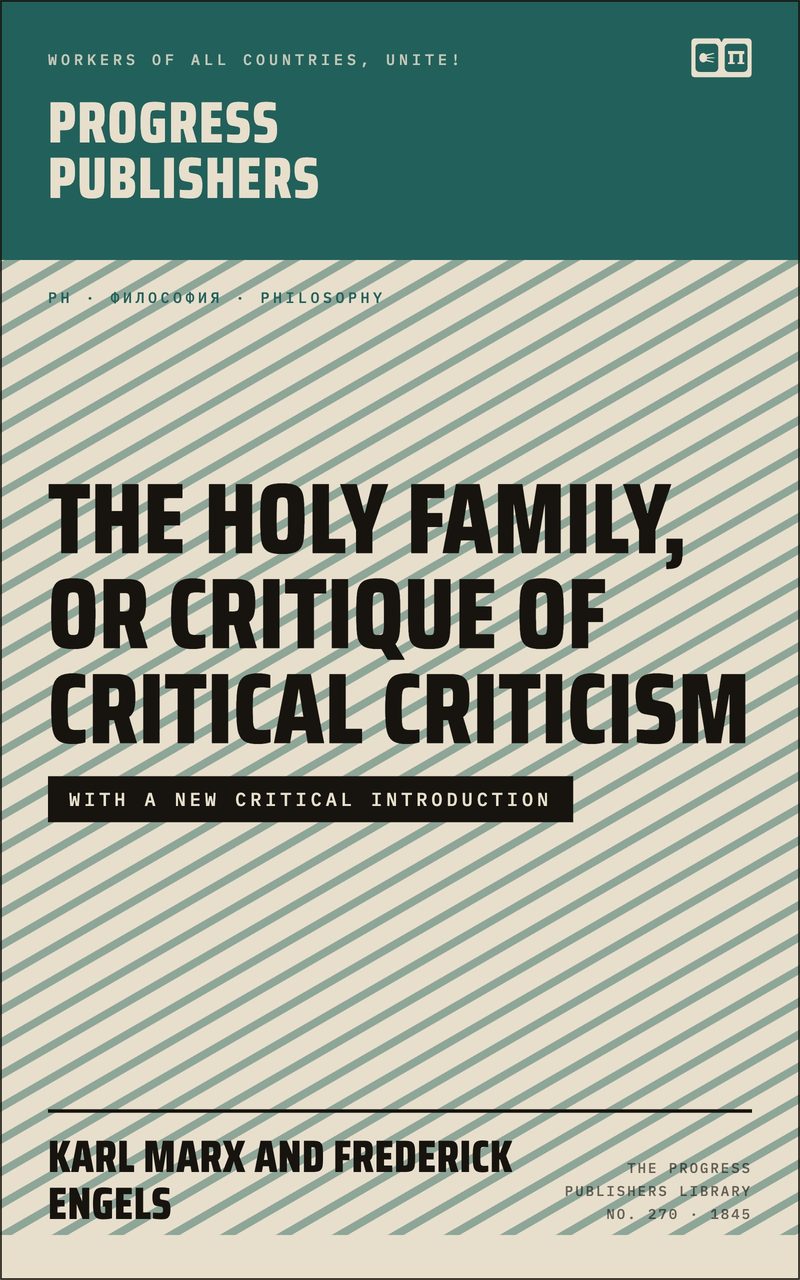
The Holy Family, or Critique of Critical Criticism
Buy
The critical introduction
Written for this edition and published free in Progress Quarterly, Volume I, Number 1.
Read it the whole numberThe title is a joke. "The Holy Family" was the mocking nickname Marx and Engels hung on Bruno Bauer and his circle of Berlin intellectuals - a self-anointed priesthood of "Critical Criticism" who had persuaded themselves that pure thought, carried on in a little review by a handful of initiates, was the real motor of history, and that the mass of ordinary human beings were so much inert matter waiting to be enlightened. Written in Paris in the autumn of 1844 and published in Frankfurt in February 1845, it is the two young men's first joint work and their first sustained act of demolition.
Its whole thrust is to bring philosophy down out of the clouds and stand it on the ground of real human activity. Against Bauer's cult of the disembodied Idea, Marx lays down a sentence that is the hinge of his entire life's work: "History does nothing ... it is man, real, living man who does all that, who possesses and fights." Ideas settle nothing by themselves - "Ideas can never lead beyond an old world order but only beyond the ideas of the old world order. Ideas cannot carry out anything at all." And here, for the first time, Marx names who will carry things out. The proletariat is driven to emancipation not by its ideals but by its situation: it "cannot abolish the conditions of its own life without abolishing all the inhuman conditions of life of society today which are summed up in its own situation". The question, pressed with a rigour that would define the tradition, is not what this or that worker imagines but "what the proletariat is, and what, in accordance with this being, it will historically be compelled to do".
A reader coming to it cold should be warned: this is not the lucid Marx of the Manifesto. Much of it is a line-by-line settling of scores with figures the twentieth century has entirely forgotten - Herr Faucher, Herr Jungnitz, Szeliga - whose names survive only because Marx thought them worth the ink. It is Marx and Engels in transit, still shaking off the Hegelian scaffolding, and the polemic is often buried under the rubble of the thing it demolishes.
The text is the Progress Publishers edition of 1975, translated from the German by Richard Dixon and Clemens Dutt and first issued in Moscow in 1956.
New critical introduction by Dmitry Chasovennikov.
| Series | The Progress Publishers Library |
| First published | 1845 |
| ISBN | 978-5-01-900258-0 |
| Pages | 277 |
| Language | English |
| Subject | Philosophy |
| Introduction By | Dmitry Chasovennikov |
| Translator | Richard Dixon |
| Translator | Clemens Dutt |