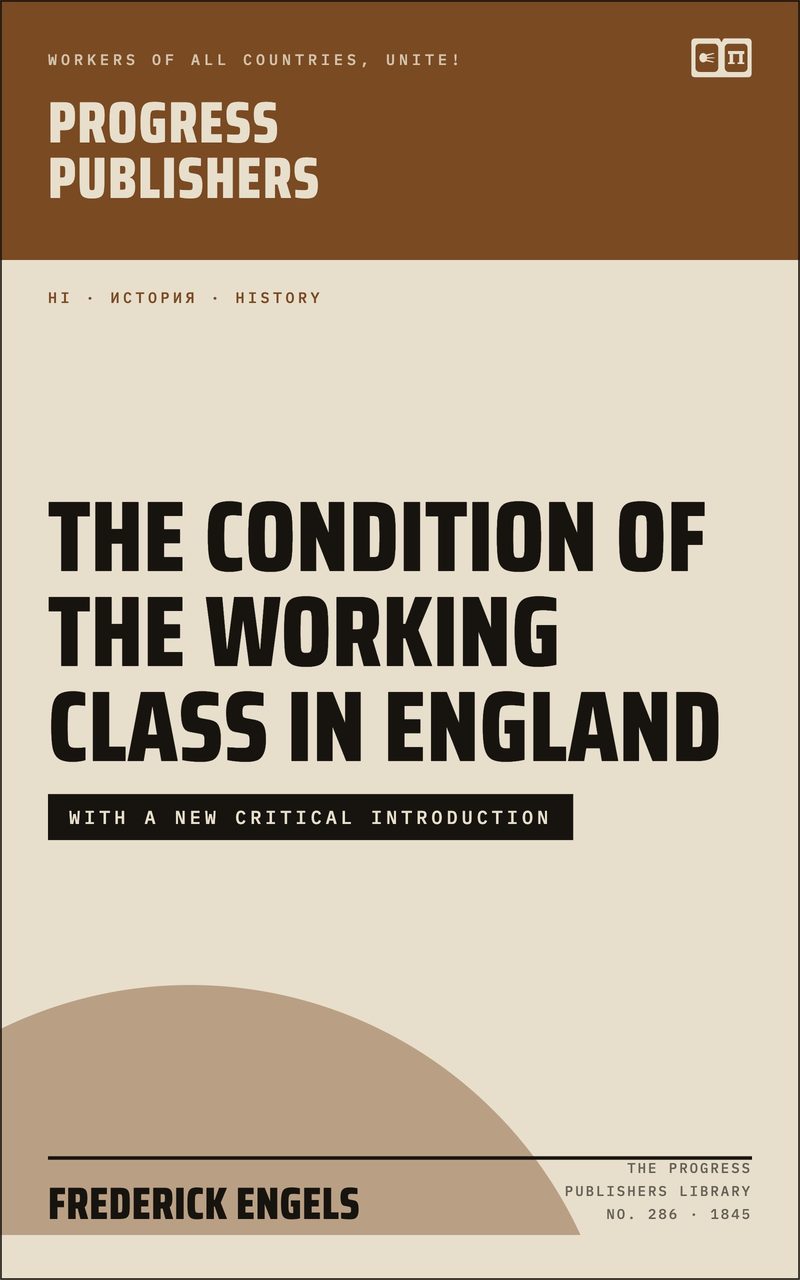
The Condition of the Working-Class in England
Buy
The critical introduction
Written for this edition and published free in Progress Quarterly, Volume I, Number 1.
Read it the whole numberFriedrich Engels was twenty-four when he finished this book, and he had done something no socialist writer had done before him: he had gone to look.
Sent by his father in late 1842 to the family firm of Ermen & Engels in Manchester, he spent twenty months in the world capital of the factory system not as a tourist of misery but as an investigator - walking the courts and cellars of the Old Town, reading the parliamentary blue books and the factory inspectors' reports, and, as he tells the English workers in his dedication, deliberately turning his back on his own class to do it. "I forsook the company and the dinner-parties, the port-wine and champagne of the middle-classes, and devoted my leisure-hours almost exclusively to the intercourse with plain Working-Men."
What the book does supremely well is refuse abstraction. Engels does not deduce the proletariat from a principle; he counts it, houses it, feeds it, sickens it and buries it - the mortality figures for the factory towns, the adulteration of bread and meat, the diseases bred in the cellar dwellings, the maiming of children in the mills. From the accumulated evidence he draws a charge that has never lost its force. When an individual kills we call it murder; but when society "places hundreds of proletarians in such a position that they inevitably meet a too early and an unnatural death", and permits those conditions to remain, "its deed is murder just as surely as the deed of the single individual; disguised, malicious murder, murder against which none can defend himself, which does not seem what it is, because no man sees the murderer." Social murder is Engels's permanent contribution, and it is an empirical concept, earned page by page from the evidence. Alongside it, years before Capital, he describes the reserve army of the unemployed.
This is the Progress Publishers reprint, following Engels's own authorised text and printing with it the prefaces of 1885 and 1892 in which the old Engels audits the young one - explaining why the imminent revolution he had predicted did not come, and conceding that the book "exhibits everywhere the traces of the descent of modern Socialism from one of its ancestors, German philosophy". The reader gets both the young revolutionary and his own most honest critic.
New critical introduction by Dmitry Chasovennikov.
| Series | The Progress Publishers Library |
| First published | 1845 |
| ISBN | 978-5-01-900242-9 |
| Pages | 381 |
| Language | English |
| Subject | History |
| Introduction By | Dmitry Chasovennikov |