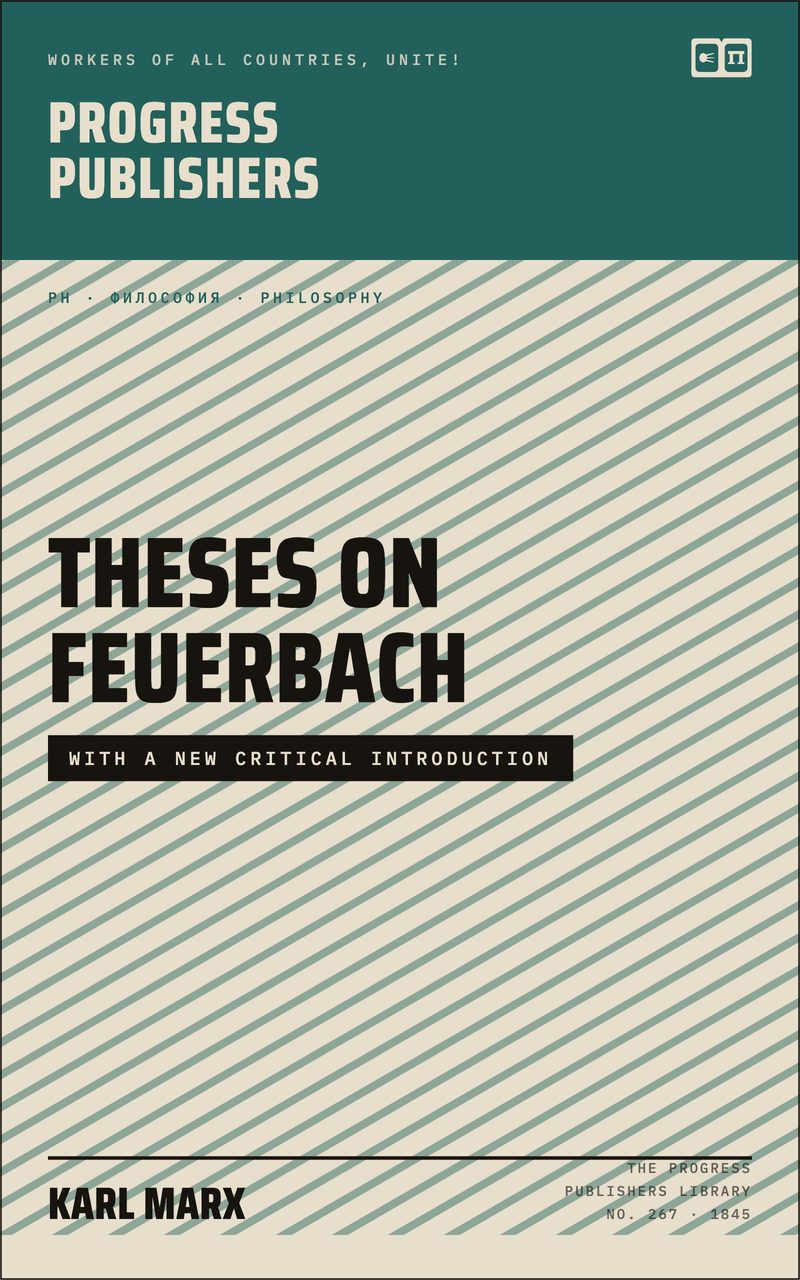
Theses on Feuerbach
Buy
The critical introduction
Written for this edition and published free in Progress Quarterly, Volume I, Number 1.
Read it the whole numberEleven paragraphs: the shortest famous text in the whole of Marxism, and among the most consequential.
Marx jotted them in a notebook in Brussels in the spring of 1845 under the plain heading "Concerning Feuerbach", and then forgot them. They were never meant for a reader. He was settling accounts with the philosopher who had freed him from Hegel - Ludwig Feuerbach, whose Essence of Christianity had dissolved God into a projection of human longing - and marking the point where he had to leave Feuerbach behind. The notes stayed in a drawer for forty-three years, until Engels found them after Marx's death and printed them, lightly edited, as an appendix to his own 1888 essay, calling them "the first document in which is deposited the brilliant germ of a new world outlook".
What they do in a page and a half is enormous. The break with the old materialism is total: its defect, Marx writes in the first thesis, is that reality "is conceived only in the form of the object ... but not as human sensuous activity, practice". From that single move everything follows - that "Social life is essentially practical"; that truth is not contemplated but proved in the doing; that the human essence "is no abstraction inherent in each single individual" but "the ensemble of the social relations", so that to change the relations is to change the human being. This is the founding gesture of a Marxism that is neither a mechanical materialism nor a dressed-up idealism, and it has fed everything alive in the tradition since. A century of readers - the Frankfurt School, Gramsci, Sartre, Althusser - has drawn opposite systems out of these same eleven paragraphs.
This edition follows the Progress Publishers Selected Works text, in the version Engels prepared, with italics and quotation marks restored from Marx's manuscript by the Soviet editors, and with the Institute of Marxism-Leninism's unusually candid note that Engels "made certain editorial changes to render the document, which Marx had not intended for publication, more comprehensible", and that the title itself was supplied by the Institute. Marx gave the notes no title at all.
New critical introduction by Dmitry Chasovennikov, on how much of the most quoted sentence in Marxism is Marx and how much is Engels.
| Series | The Progress Publishers Library |
| First published | 1845 |
| ISBN | 978-5-01-900266-5 |
| Pages | 6 |
| Language | English |
| Subject | Philosophy |
| Introduction By | Dmitry Chasovennikov |