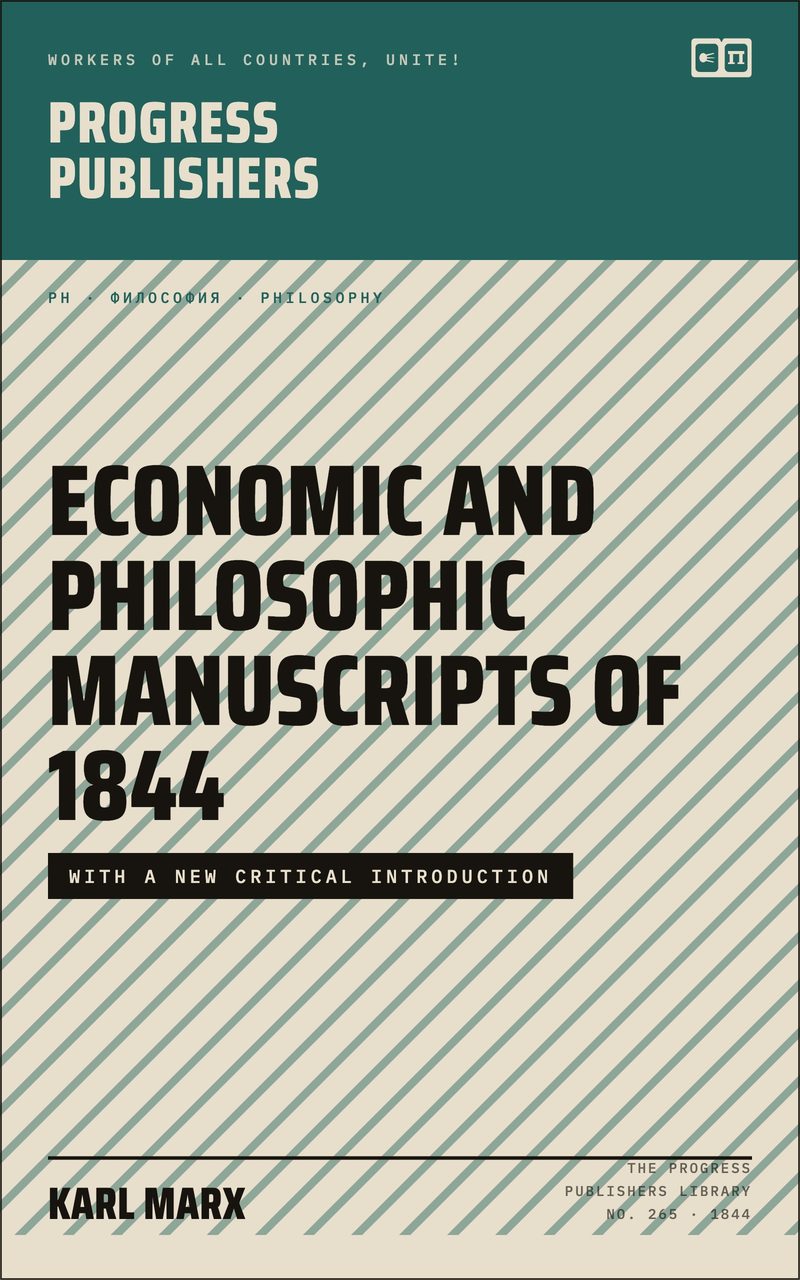
Economic and Philosophic Manuscripts of 1844
Buy
The critical introduction
Written for this edition and published free in Progress Quarterly, Volume I, Number 1.
Read it the whole numberMarx never published this book and never finished it. He wrote it in Paris in the spring and summer of 1844, at twenty-six, across three notebooks that break off in mid-sentence, cross out whole passages, and jump from wages to Hegel and back as the reading drove him. It sat in his papers until the Marx-Engels Institute in Moscow printed the German original in 1932, nearly half a century after his death.
What it does, and does so well that no later work of Marx's replaced it, is describe estranged labour. He starts from the categories of the economists but keeps asking the question they never ask: what does the wage-relation do to the human being who lives it? "The worker becomes all the poorer the more wealth he produces," he writes; "the devaluation of the world of men is in direct proportion to the increasing value of the world of things." He breaks the estrangement into layers - the worker separated from the product of his labour, from the act of labouring, from his own nature as a conscious and self-creating being, and through all of these from other people. It is the most influential single idea in the book, and the reason readers who never open Capital have read these pages.
Two further passages have never lost their force. There is the section on money, where Goethe's Faust and Shakespeare's Timon of Athens are called to testify that money is the alienated power of humanity, the visible god that turns loyalty into betrayal because it can buy them. And there is the confrontation with Hegel that closes the third manuscript, crediting him with grasping "the dialectic of negativity as the moving and generating principle" while charging him with making that whole drama happen inside thought rather than in the world.
This is the full Moscow working edition in Martin Milligan's translation, revised against Volume 3 of the Collected Works: Marx's own Preface, the three manuscripts with the Roman sheet-numbers of the original leaves reproduced in the margin so the reader can see how fragmentary the thing really is, Engels's 1843 Outlines of a Critique of Political Economy as an appendix - the piece that first turned Marx to economics - the notes of the Institute of Marxism-Leninism, and four indexes.
This edition carries a new critical introduction by Dmitry Chasovennikov on how a rough draft abandoned in a drawer became, in the twentieth century, the most dangerous thing in Marx's name that a bureaucratic state could be asked to print.
| Series | The Progress Publishers Library |
| First published | 1844 |
| ISBN | 978-5-01-900261-0 |
| Pages | 230 |
| Language | English |
| Subject | Philosophy |
| Introduction By | Dmitry Chasovennikov |
| Translator | Martin Milligan |