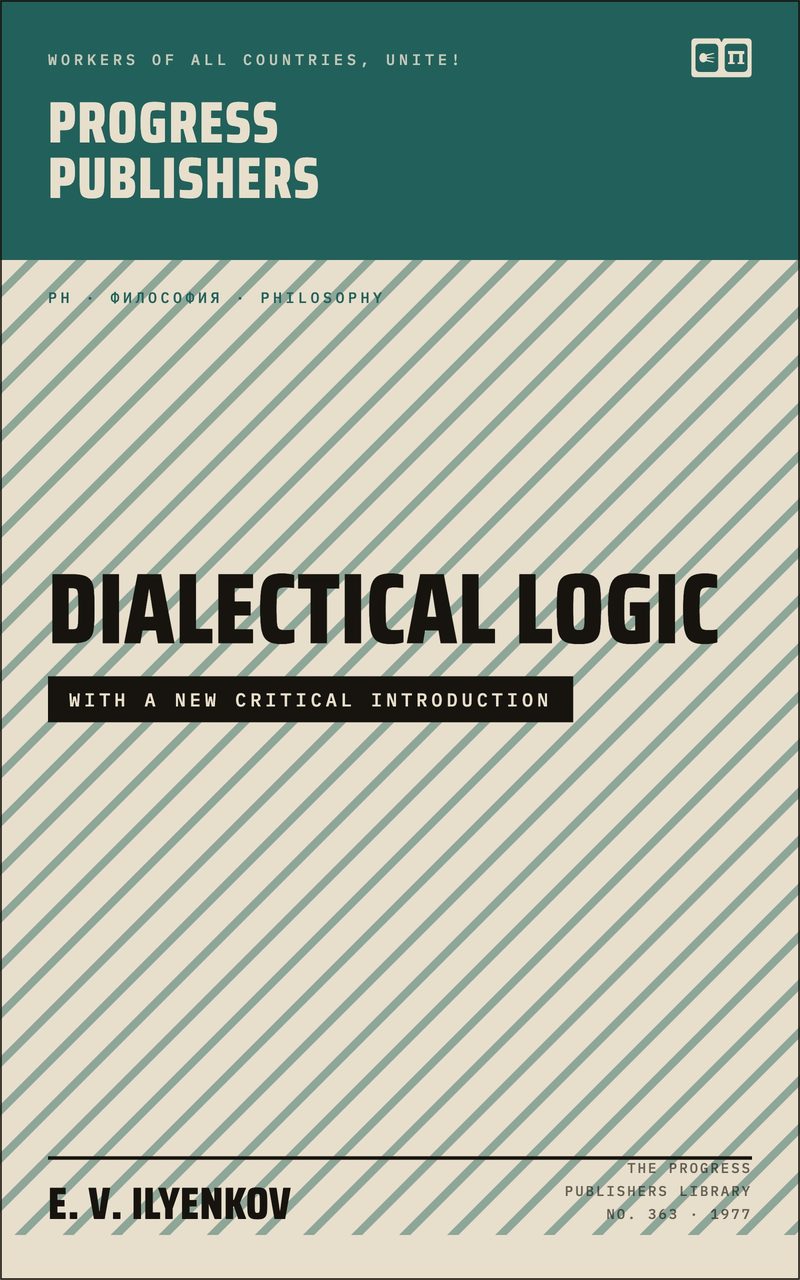
Dialectical Logic
Essays on Its History and Theory
Buy
The critical introduction
Written for this edition and published free in Progress Quarterly, Volume X, Number 3.
Read it the whole numberEvald Ilyenkov was the most original Soviet philosopher of his generation, and Dialectical Logic is his own summary of the case he spent his working life making. Its first part follows the problem of logic through Descartes and Spinoza, Leibniz, Kant, Fichte, Schelling and Hegel. Its second argues that logic, dialectics and the theory of knowledge are a single science, and that thought has to be studied in the practical activity of people who change the world rather than in the rules of correct inference alone.
The book never names Stalin, Zhdanov or a Party congress. It does set out, feature by feature, the account of dialectics that every Soviet student learned from the Short Course of 1938, and it calls the result a dead scheme, a sum of examples that proves nothing. Its insistence that contradiction is the real motor of thought cut directly against the official philosophy of the post-war years. Read with that in mind, it is one of the few Soviet texts that argued with the textbook from inside the textbook's own vocabulary.
Ilyenkov's hostility to formal logic is the book's weakest flank, and it is weighed here against the view, held by Trotsky and later by George Novack, that formal logic stands to dialectics as elementary mathematics stands to higher.
Progress Publishers, 1977. Translated by H. Campbell Creighton from the Russian edition of 1974.
With a new critical introduction.
| Series | The Progress Publishers Library |
| First published | 1977 |
| ISBN | 978-5-01-890003-0 |
| Pages | 372 |
| Language | English |
| Subject | Philosophy |
| Translator | H. Campbell Creighton |