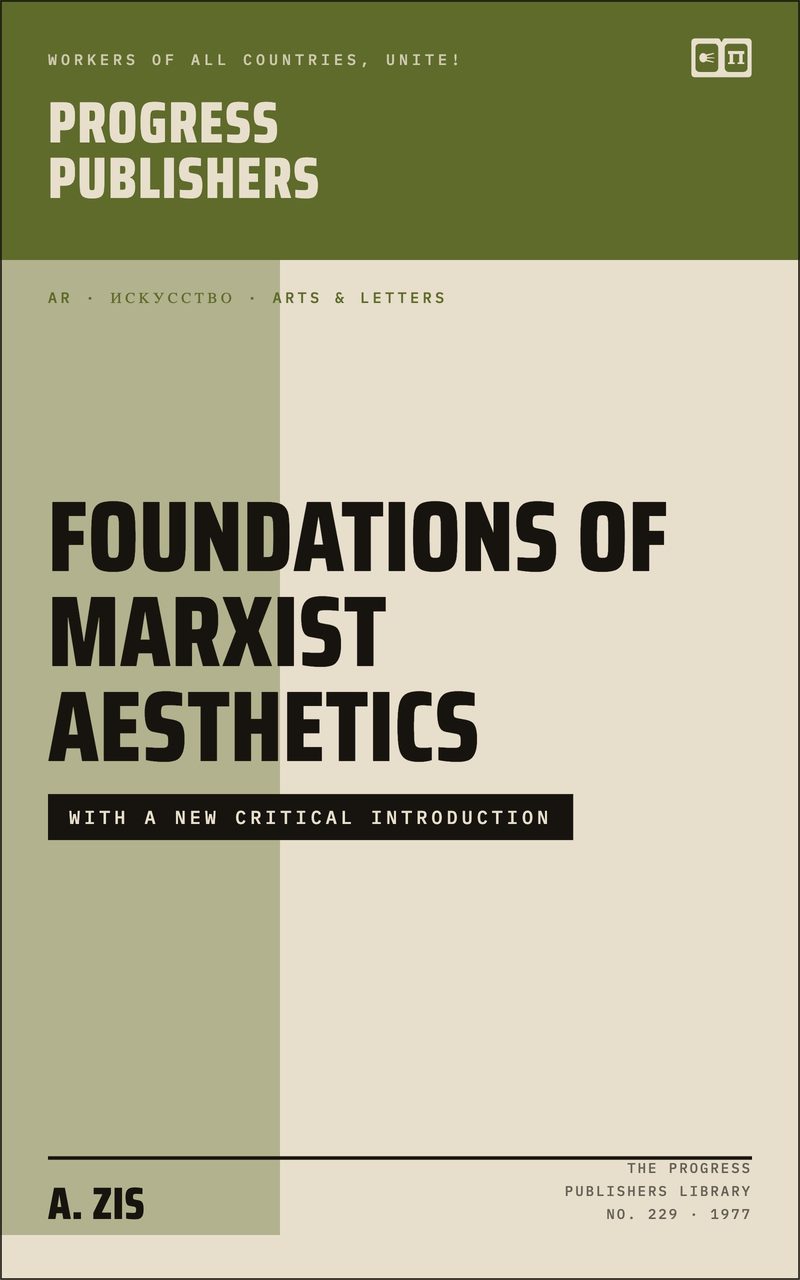
Foundations of Marxist Aesthetics
Buy
The critical introduction
Written for this edition and published free in Progress Quarterly, Volume V, Number 1.
Read it the whole numberA real book of philosophy, and it argues.
Avner Zis was a professor and a Doctor of Science in philosophy, and this runs to a hundred thousand words across five chapters - the nature of art, the image, content and form, the aesthetic categories, and creative method. He cites Aristotle, Lessing, Hegel, Plekhanov, Leonardo and Chekhov, and when he turns to opponents he names them and gives page references: Jacques Maritain, Nicolai Hartmann, I. A. Richards, papers read at the Seventh International Congress of Aesthetics at Bucharest in 1972. A reader expecting a pamphlet will be surprised. Much of it is the work of a man who has thought carefully about how music differs from painting and why a play is not a history textbook.
The preface does something unusual too. Zis states openly that the book is addressed to readers abroad, and then warns that while Soviet writers on aesthetics start from broadly similar premises, they differ in their approaches to questions still unresolved - and a footnote in the first chapter makes good on it, recording that some Soviet aestheticians reject his own view that art has a specific subject-matter. A book that admits its discipline contains open questions is not a catechism.
Its polemic tells you what it was written against: Ernst Fischer, author of The Necessity of Art, and Roger Garaudy, the French party's chief philosopher and the author of the realism-without-shores thesis, are named more often than anyone but Marx and Lenin.
New critical introduction by Dmitry Chasovennikov, on what the book does not say about why those two left their parties.
| Series | The Progress Publishers Library |
| First published | 1977 |
| ISBN | 978-5-01-900009-8 |
| Pages | 297 |
| Language | English |
| Subject | Arts & Letters |
| Introduction By | Dmitry Chasovennikov |
| Translator | Katharine Judelson |