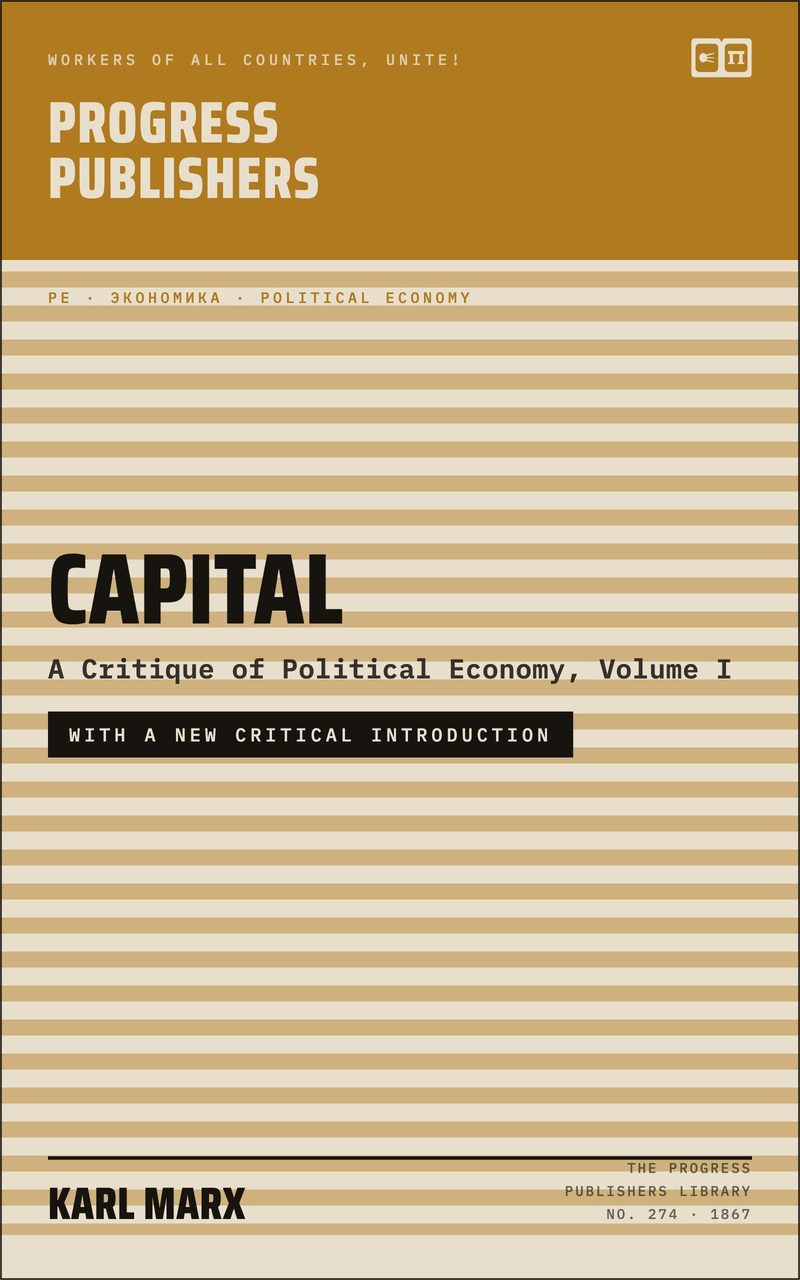
Capital: A Critique of Political Economy, Volume I
Buy
The critical introduction
Written for this edition and published free in Progress Quarterly, Volume III, Number 3.
Read it the whole numberNo book has been more revered and less read.
Capital was published in Hamburg in 1867, the only one of its three volumes Marx lived to see through the press. It was the fruit of a quarter of a century - the long years in the Reading Room of the British Museum, kept alive by Engels's money and broken by the deaths of his children - and Marx knew it was unfinished even as it appeared.
Volume One is the analysis of how capital produces itself: the commodity, value and money, the working day, machinery and large-scale industry, and the accumulation that made the modern world. It is the part of the design Marx polished to a high finish, and it can be read on its own.
What it does supremely it does from its first move. He begins not with the state or the market or the great men of commerce but with a single commodity, the cell-form of bourgeois wealth, and draws the whole system out of that unremarkable object.
The text is the English of 1887, translated by Samuel Moore and Edward Aveling and edited by Engels, who checked it against the later German editions and Anglicised Marx's examples himself. It is in a real sense Engels's English Capital as much as Marx's German one, and it carries the prefaces and afterwords - to the first German edition, to the French, to the second, third and fourth German, and to the English - in which the two men argued over how the book should be read.
New critical introduction by Dmitry Chasovennikov.
| Series | The Progress Publishers Library |
| First published | 1867 |
| ISBN | 978-5-01-900282-5 |
| Pages | 1062 |
| Language | English |
| Subject | Political Economy |
| Introduction By | Dmitry Chasovennikov |
| Translator | Samuel Moore |
| Translator | Edward Bibbins Aveling |