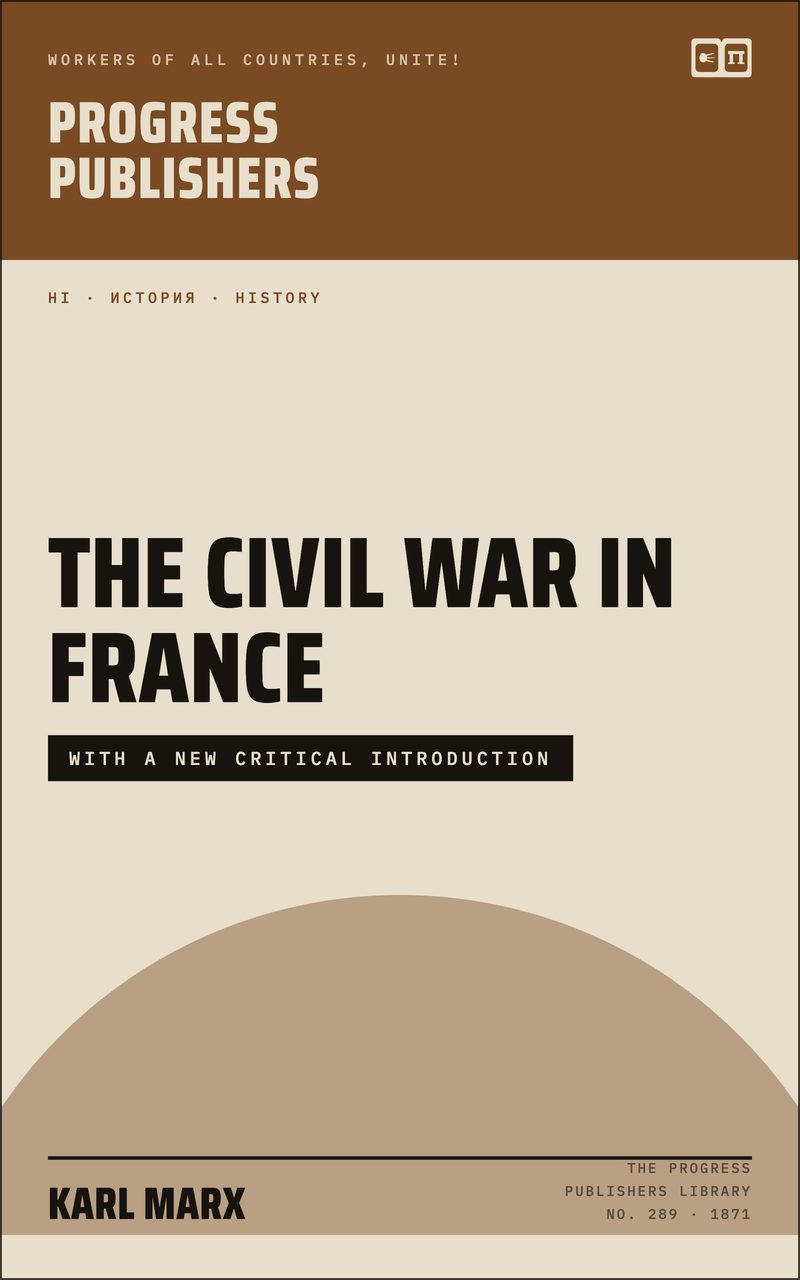
The Civil War in France
Buy
The critical introduction
Written for this edition and published free in Progress Quarterly, Volume I, Number 2.
Read it the whole numberThe Civil War in France is Marx's address to the General Council of the International Working Men's Association on the Paris Commune of 1871 - the seventy-two days in which the workers of a great city took the government into their own hands, and the two months in which a French army, with Prussian permission, shot them down. He wrote it in English, in white heat, in the days around the Commune's fall, and read it to the Council on 30 May 1871, two days after the last barricade.
It is the least abstract thing he ever wrote about the state. What Marx praised in the Commune was concrete and institutional. Its first act, Engels records in the 1891 Introduction printed here, was that "the Commune abolished conscription and the standing army, and declared the sole armed force to be the National Guard". Its officials were elected and subject to recall, and every servant of the Commune, high and low, drew a worker's pay: "the public service had to be done at workmen's wages". It made "cheap government, a reality, by destroying the two greatest sources of expenditure - the standing army and State functionarism."
From it Marx drew the lesson he thought decisive, the sentence Lenin would build a book upon: "the working class cannot simply lay hold of the ready-made state machinery, and wield it for its own purposes." The existing state - "the centralized State power, with its ubiquitous organs of standing army, police, bureaucracy, clergy, and judicature" - is not a neutral instrument to be captured. It has to be broken and replaced by something the Commune sketched in outline: a self-governing association of producers.
This is Marx at his most concrete and least doctrinaire, reading a workers' creation rather than lecturing it - so much so that he revised the Communist Manifesto in its light. The Commune's dead earned the sentence he gave them: "Working men's Paris, with its Commune, will be for ever celebrated as the glorious harbinger of a new society. Its martyrs are enshrined in the great heart of the working class."
With Engels's Introduction of 1891. New critical introduction by Dmitry Chasovennikov.
| Series | The Progress Publishers Library |
| First published | 1871 |
| ISBN | 978-5-01-900262-7 |
| Pages | 95 |
| Language | English |
| Subject | History |
| Introduction By | Dmitry Chasovennikov |