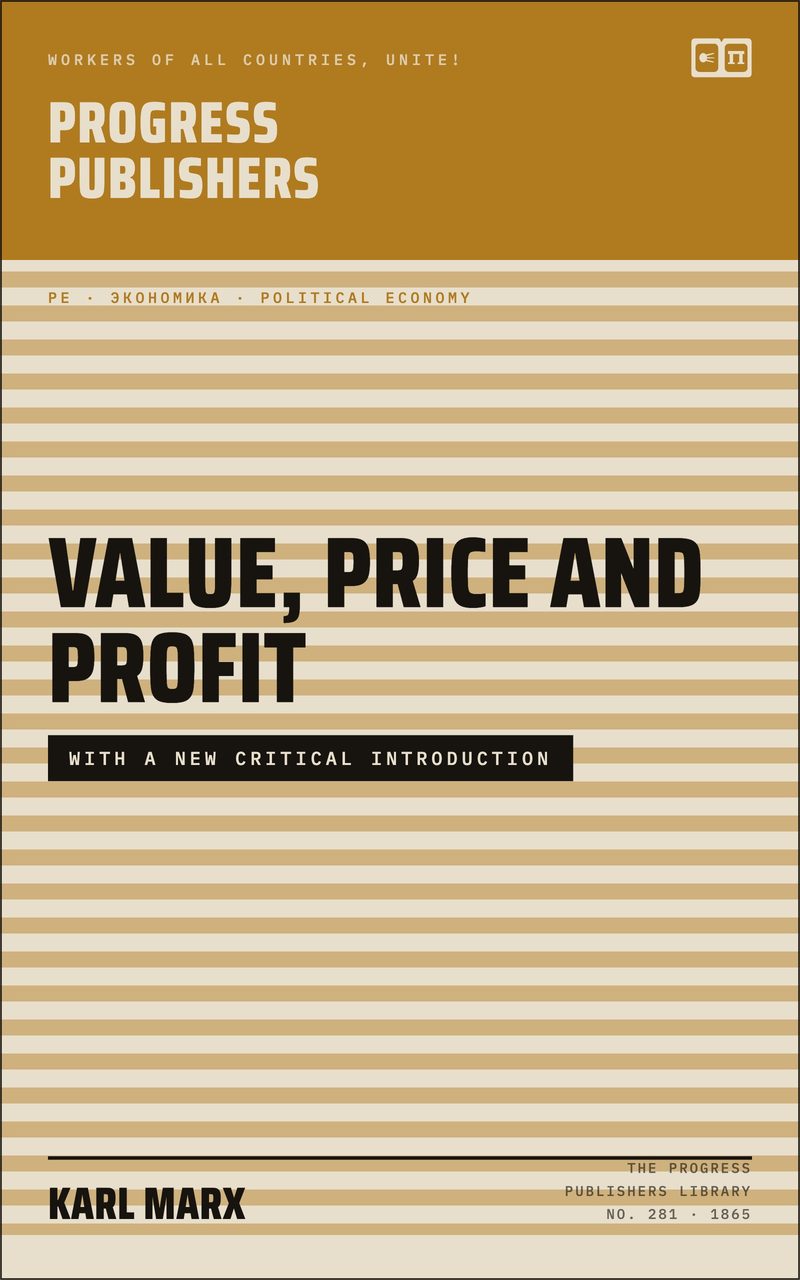
Value, Price and Profit
Buy
The critical introduction
Written for this edition and published free in Progress Quarterly, Volume I, Number 2.
Read it the whole numberIn the spring of 1865 a member of the General Council of the International Working Men's Association, John Weston - a follower of Robert Owen and a man of transparent good faith - put a case to his fellow councillors that must have alarmed every trade unionist present. A general rise in wages, Weston argued, could do the working class no good: employers would simply raise their prices to recover the cost, real wages would stand exactly where they had begun, and the unions were expending their strength on nothing.
Marx answered him in two sittings, on the 20th and 27th of June 1865, in English, before an audience of working men. He did not spare their patience - he opens by apologising for the "severe test" he is about to set it - but he wrote for them, not for economists, and the result is the most compact and approachable statement of his mature economics that he ever made. It was composed two years before the first volume of Capital appeared and, as the edition's own editors concede, it "set forth for the first time in public the basis of his theory of surplus value". For anyone who finds Capital forbidding, this is the way in.
Weston's fatalism was not an eccentricity, which is why Marx troubled to answer it at such length. It was a homespun version of the wage-fund theory of the orthodox economists - that the sum available for wages was fixed in advance, so that what one worker gained another must lose - and it had a radical twin in Ferdinand Lassalle's iron law of wages, which chained wages forever to bare subsistence. If either were true, the trade unions had no reason to exist and the young International no economic case to make. Marx's two evenings were, in that sense, a defence of the point of organising at all. His counsel at the close - that unions are "centres of resistance" which must not content themselves with fighting "the effects" and never the cause - is the part still most worth arguing with.
The text follows the edition Marx's daughter Eleanor published in 1898, keeping the chapter headings her husband Edward Aveling supplied for a manuscript Marx had left largely unbroken.
New critical introduction by Dmitry Chasovennikov.
| Series | The Progress Publishers Library |
| First published | 1865 |
| ISBN | 978-5-01-900267-2 |
| Pages | 70 |
| Language | English |
| Subject | Political Economy |
| Introduction By | Dmitry Chasovennikov |