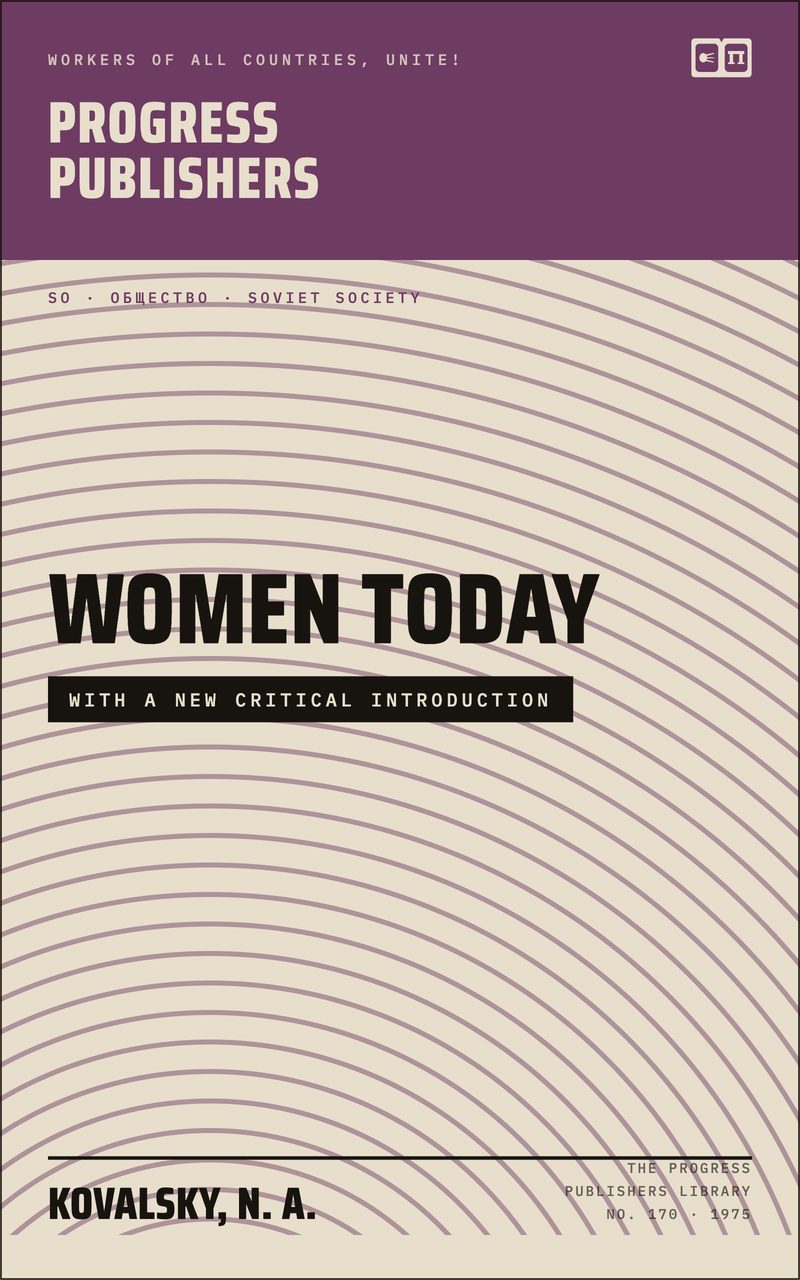
Women Today
Buy
The critical introduction
Written for this edition and published free in Progress Quarterly, Volume IV, Number 3.
Read it the whole numberCommissioned for International Women's Year, with a foreword by Valentina Nikolayeva-Tereshkova, chairman of the Soviet Women's Committee and the first woman to go into space. A World Conference was to meet in Mexico City that summer and a rival congress in Berlin that October; an English-language statement of the Soviet case was needed, ready for delegates, and this is it.
It is not the work of a single hand. Ten women are named on the title page, with N. A. Kovalsky as chief editor, and the structure is a four-part comparison: women in the USSR, in the other socialist countries, in the developed capitalist countries, and in the developing world. The chapters on the capitalist and developing countries read like the work of people who had done the reading - ILO conventions cited correctly, wage differentials country by country, nursery provision in Italy and West Germany, the difficulty of water-carrying for village women in Laos and Vietnam.
The account of the first Soviet decrees is accurate and should not be grudged: the 1917 prohibition of night work for women, maternity benefit for eight weeks before and after birth, equal remuneration for equal work, civil marriage on equal terms, and women's equality written into the 1918 Constitution. The 1975 material record is real in outline too - women 51 per cent of workers and office employees, 59 per cent of specialists with higher or secondary specialised education, 70 per cent of doctors, 71 per cent of teachers, 112 days of paid maternity leave with the job held for a further year, and eleven million children in creches and nursery schools.
New critical introduction by Dmitry Chasovennikov, on the comparison the book will not make.
| Series | The Progress Publishers Library |
| First published | 1975 |
| ISBN | 978-5-01-900186-6 |
| Pages | 332 |
| Language | English |
| Subject | Soviet Society |
| Introduction By | Dmitry Chasovennikov |