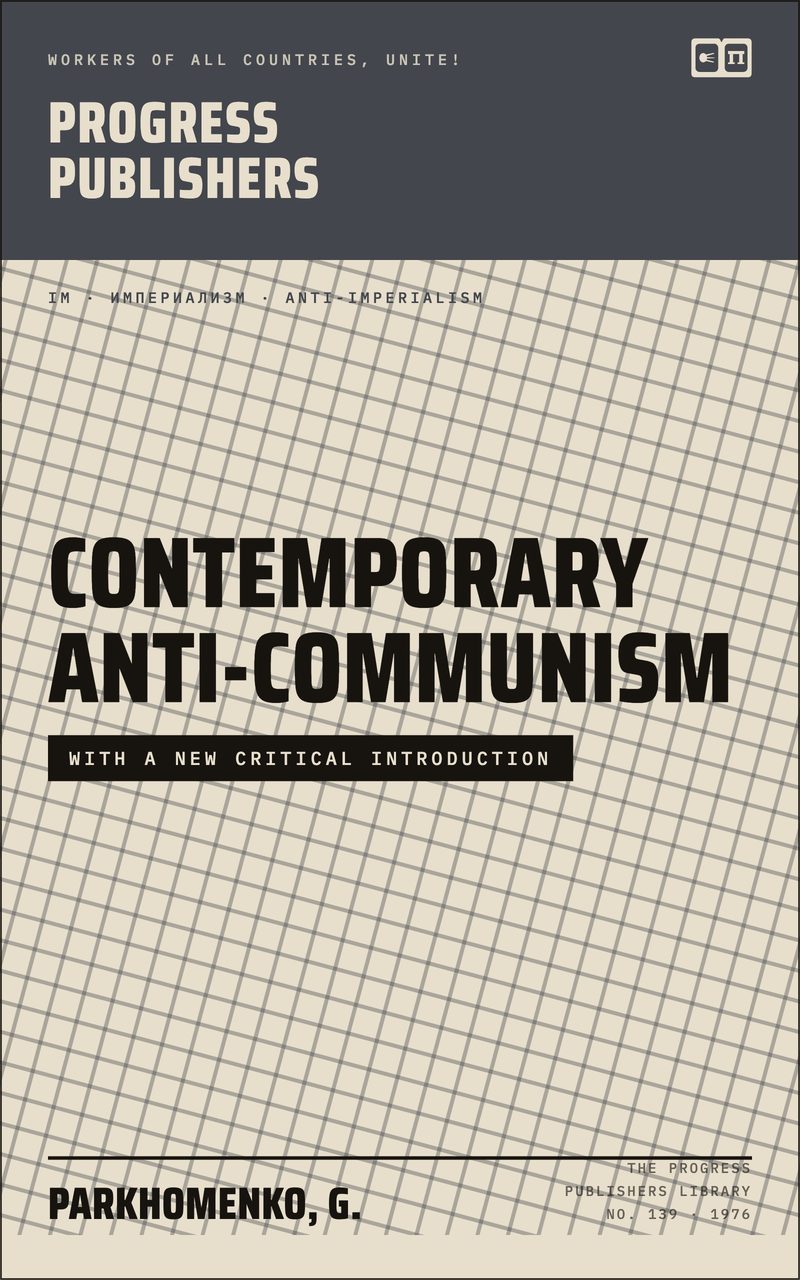
Contemporary Anti-Communism
Buy
The critical introduction
Written for this edition and published free in Progress Quarterly, Volume IV, Number 3.
Read it the whole numberA joint Soviet-East German survey of the institutions, arguments and money behind Western anti-communism, and a revealing document of how the category itself was used.
Twenty-one contributing authors are listed, among them E. Batalov, V. Mshvenieradze and Y. Zamoshkin on the Soviet side and G. Langendorf, A. Loesdau, U. Plener, O. Reinhold and J. Vogeler on the East German, with G. Parkhomenko editing the Russian text. Eight chapters run from imperialism's political strategy through the economics of socialism, communism studies in the West, ideological subversion, neocolonialism, opportunism in the working-class movement, and the propaganda of the American way of life.
Much of the reporting is accurate, and a reader who assumes such books simply invent their enemies will be corrected. Anti-communism was an organised industry with budgets and buildings, and the chapter cataloguing them is a real inventory: the Free Europe Committee and Radio Free Europe, the Radio Liberty Committee, the Hoover Institution at Stanford, Columbia's Research Institute on Communist Affairs under Brzezinski, the Russian Research Centre founded at Harvard in 1948 on Carnegie money, the Ford and Rockefeller foundations, the West German Ostforschung network.
The category's elasticity is on display in the same chapter, which files the Socialist International and the Fourth International alongside the Hoover Institution - an organisation of a few thousand cadre with no state, no intelligence service and no transmitter, placed in the same list without argument.
The evidence stops moving in 1973; Helsinki is absent.
New critical introduction by Dmitry Chasovennikov.
| Series | The Progress Publishers Library |
| First published | 1976 |
| ISBN | 978-5-01-900020-3 |
| Pages | 343 |
| Language | English |
| Subject | Anti-Imperialism |
| Introduction By | Dmitry Chasovennikov |