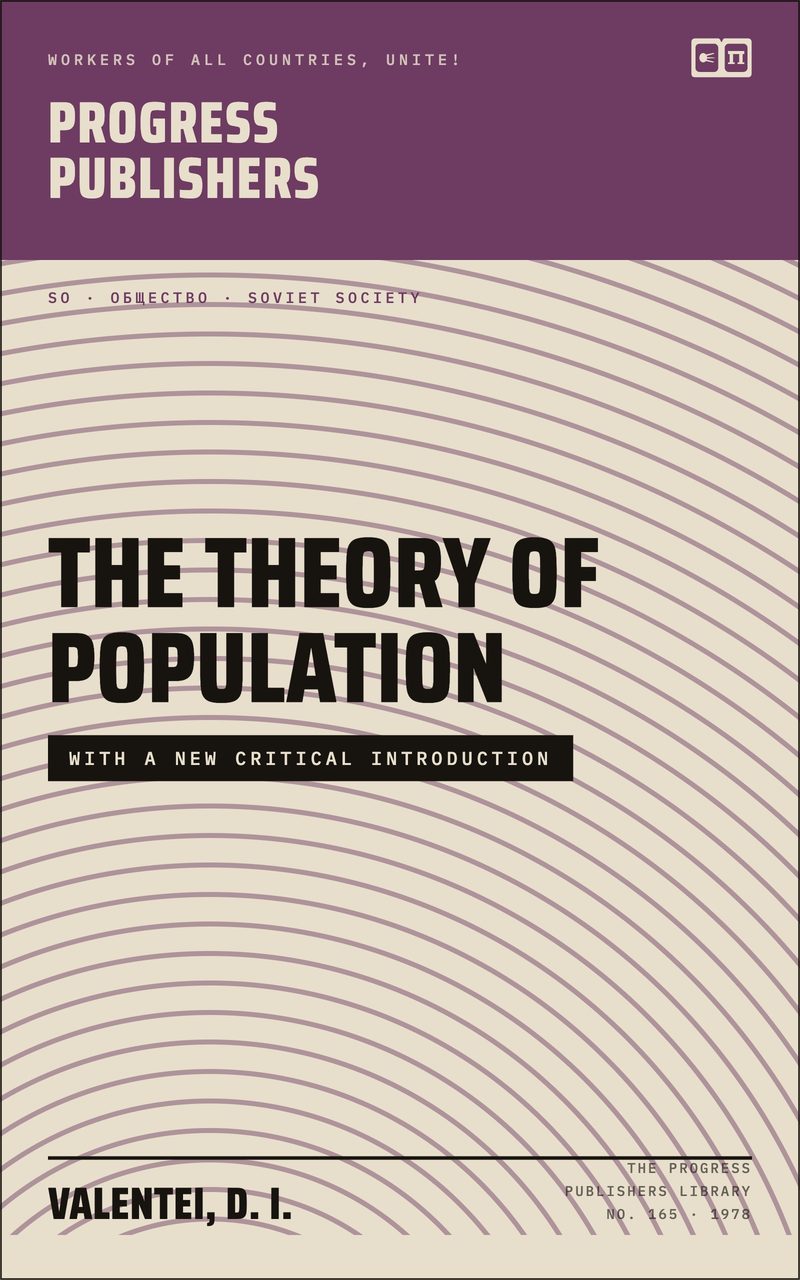
The Theory of Population
Buy
The critical introduction
Written for this edition and published free in Progress Quarterly, Volume V, Number 3.
Read it the whole numberThe flagship statement of a discipline the Soviet Union had until recently refused to let exist under its own name.
Produced under the Centre for Population Studies of the Economics Faculty of Moscow State University, with some thirty named contributors and edited by Professor D. I. Valentey, this is Soviet demography announcing that it has become a science - with its own chairs, its own specialities and its own forecasting brief. The foreword notes the recent institution of population economics and demography as recognised scientific specialities, which is the institutional fact the whole volume rests on.
At its centre is a genuine and defensible idea, and the book states it well: there is no natural law of population, no eternal ratio between mouths and food written into the human condition. Every form of society generates its own population dynamics out of its own mode of production, and Marx's formula - that every historic mode of production has its own laws of population, valid within its limits alone - stands at the head of the enterprise.
Its real antagonist is the Malthusian revival of the late 1960s: the population bomb, the Club of Rome, and the family-planning campaigns then being pressed on the decolonising world. Much of the book's best writing is aimed there, and the critique of neo-Malthusian argument is serious rather than dismissive.
The text is anchored in the mid-1970s, with statistical series running to 1970-71 and the Twenty-Fifth Congress of 1976 as its most recent political landmark.
Translated by Herbert C. Creighton.
New critical introduction by Dmitry Chasovennikov.
| Series | The Progress Publishers Library |
| First published | 1978 |
| ISBN | 978-5-01-900136-1 |
| Pages | 408 |
| Language | English |
| Subject | Soviet Society |
| Introduction By | Dmitry Chasovennikov |
| Translator | H. Campbell Creighton |