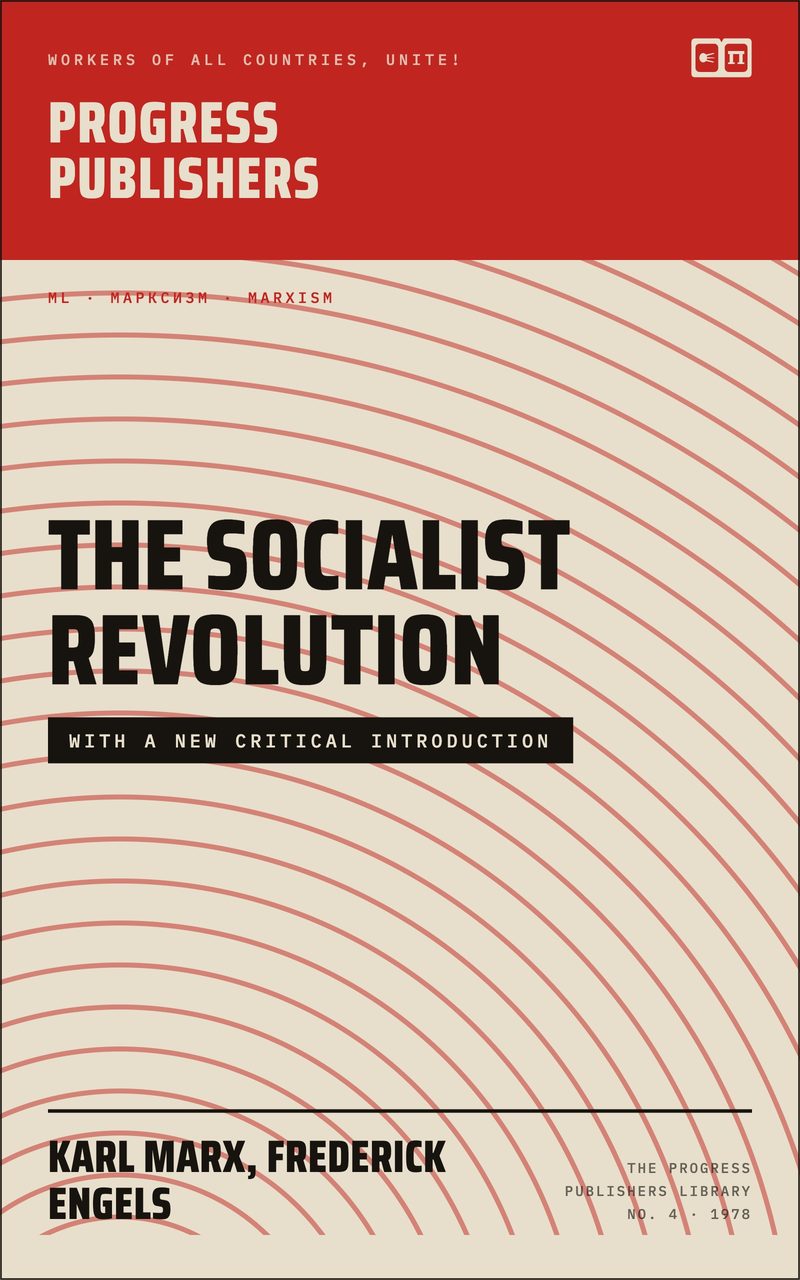
The Socialist Revolution
Buy
The critical introduction
Written for this edition and published free in Progress Quarterly, Volume V, Number 3.
Read it the whole numberNot a book Marx or Engels wrote but a book made out of them: some forty extracts cut from works spanning half a century, from the 1843 critique of Hegel's philosophy of law to Engels's introduction of 1895 to The Class Struggles in France, arranged to tell a single continuous story about how the working class comes to power.
The range is genuinely useful. Here between two covers are the young Marx of the Hegel critique, on theory becoming a material force once it grips the masses, and the old Engels of 1895, sixty pages and a lifetime later, coolly calculating the odds of street fighting against breech-loading rifles and railways. Here is The Holy Family, with its austere argument that the proletariat is revolutionary not because socialists idealise it but because of the conditions of its own life. Here are long stretches of The Civil War in France, Marx's defence of the Paris Commune. Here is the Critique of the Gotha Programme, entire enough to carry its hardest sentences. And here are letters - to Weydemeyer, Kugelmann, Bracke, Lafargue and Bernstein - in which the theory is worked out in private, under pressure, without the varnish of the published texts.
The centre of gravity is the cluster of texts from 1850 to 1875 in which the two moved from the general prophecy of the Manifesto to a concrete theory of proletarian power.
An anthology is an argument made with scissors, and this one closes its unsigned preface not on the barricade but on the Helsinki Final Act and the Twenty-Fifth Congress.
New critical introduction by Dmitry Chasovennikov.
| Series | The Progress Publishers Library |
| First published | 1978 |
| ISBN | 978-5-01-900157-6 |
| Pages | 354 |
| Language | English |
| Subject | Marxism |
| Introduction By | Dmitry Chasovennikov |