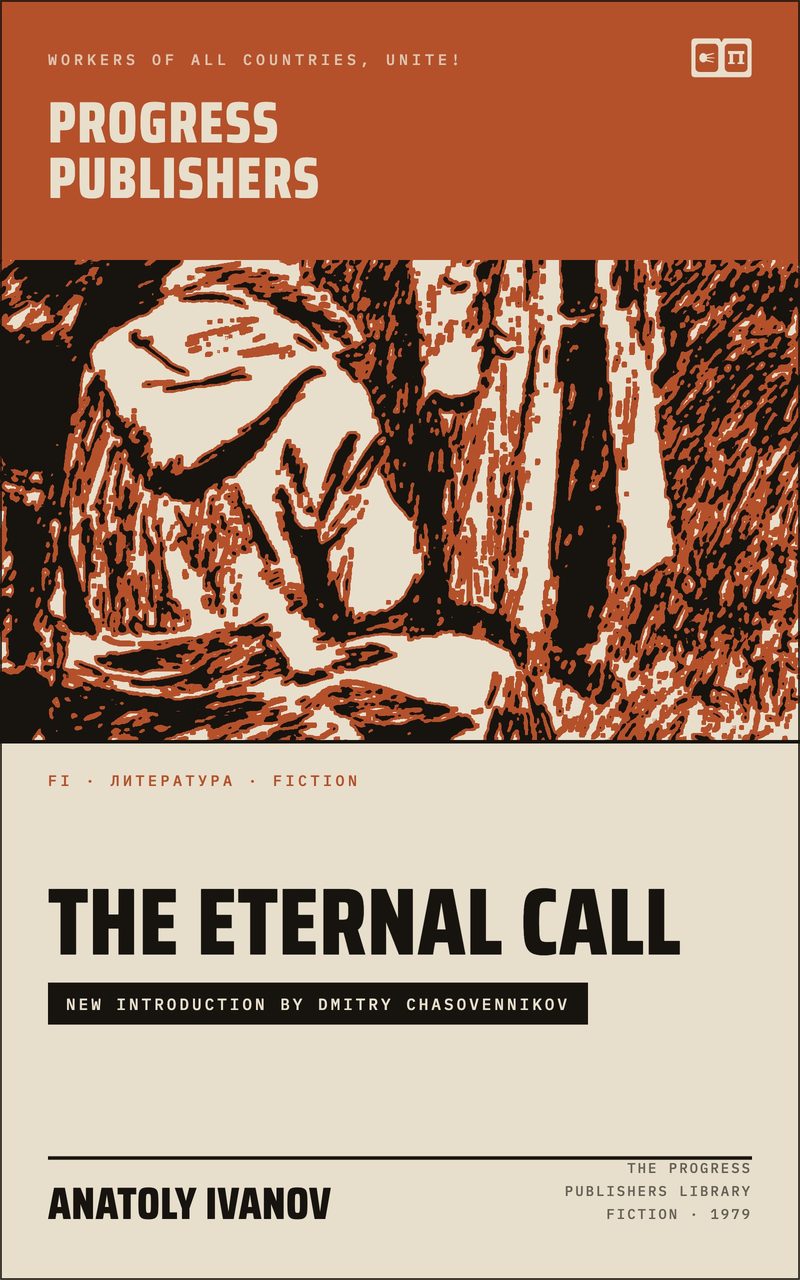
The Eternal Call
Buy
The critical introduction
Written for this edition and published free in Progress Quarterly, Volume X, Number 1.
Read it the whole numberThe novel opens in a police cell in Tomsk in 1908, and the first thing that happens is a man being rewarded for informing on his neighbours. The inspector sits in his undershirt drinking tea; the chief warden waits on him with a tea towel over his arm, which only heightens his resemblance to a tavern waiter. He wants a transfer to the Alexandrov Central Prison. "It's my cherished dream, sir. Ever since I was a boy." Diligence and faithful service, the inspector agrees, should be rewarded.
What follows is fifty years of a Siberian village across 266,000 words - and this volume is only half of it. The last line reads End of Book One.
This is the most-read novel in the series and the least like the others. It has no doctrine in it, and that is what should be noticed. Its foreword tells you what replaced the doctrine: the people, the soil, Siberia, a struggle for land. Its author edited Molodaya Gvardiya, the journal where that replacement was worked out for two decades, and which was still, in 1987, the only magazine in the country openly resisting the criticism of Stalin.
A tradition that wants to understand how the Soviet Union ended has more to learn from the success of this novel than from any number of dissident memoirs.
Progress Publishers, Soviet Authors Library, 1979. Translated by Fainna Glagoleva, illustrated by Peter Pinkisevich.
New critical introduction by Dmitry Chasovennikov.
| Series | The Progress Publishers Library |
| First published | 1979 |
| ISBN | 978-5-01-900334-1 |
| Pages | 770 |
| Language | English |
| Subject | Fiction |
| Introduction By | Dmitry Chasovennikov |