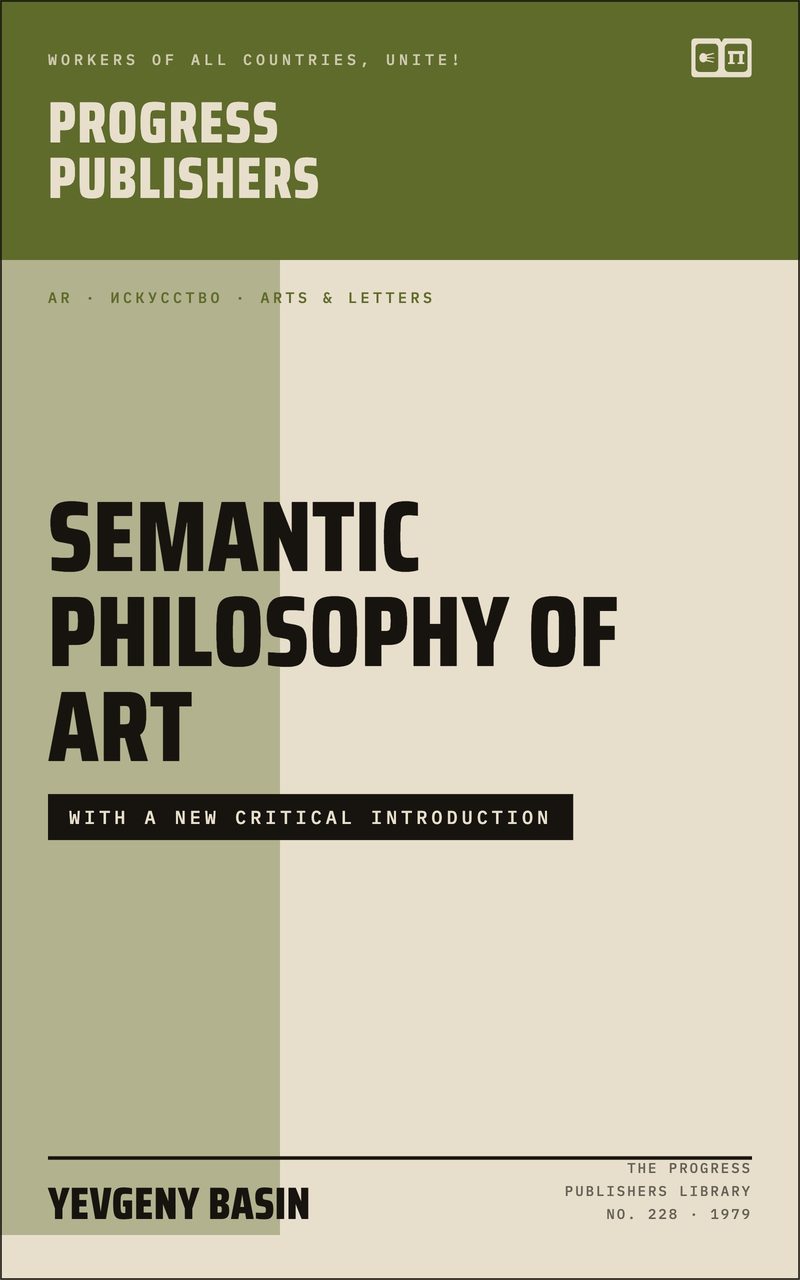
Semantic Philosophy of Art
Buy
The critical introduction
Written for this edition and published free in Progress Quarterly, Volume VI, Number 1.
Read it the whole numberThe most Western-facing book in the Progress aesthetics list, and the most disconcerting to read against the grain, because it does almost nothing a reader trained on the rest of the catalogue expects.
It is a book-length critique of twentieth-century Anglo-American and European theories of art as language, symbol and sign: the neo-positivist aesthetics of I. A. Richards, the analytic aesthetics descended from the later Wittgenstein, the neo-Hegelian expression theory of Croce and Collingwood, Whitehead on symbolism, Cassirer's symbolic forms, Susanne Langer's presentational symbol, Peirce's semiotics and Charles Morris's behaviourist theory of signs.
And it reads them - not through Soviet intermediaries or digests but in their own editions, in four languages, with the apparatus of a working historian of philosophy. The polemical frame is entirely orthodox; the scholarship underneath it is real, and the two have to be held together to read the book honestly.
For anyone interested in how the semiotic and analytic turn in aesthetics looked from outside the Anglo-American academy, by someone who had done the primary reading, there is nothing else like it in English.
The manuscript is an early-1970s Russian text carried into English at the end of the decade, and the lag shows in a field that was moving fast: the reception of Nelson Goodman's Languages of Art is absent, and structuralism enters as a movement still felt to be current.
Translated by Christopher English.
New critical introduction by Dmitry Chasovennikov.
| Series | The Progress Publishers Library |
| First published | 1979 |
| ISBN | 978-5-01-900189-7 |
| Pages | 248 |
| Language | English |
| Subject | Arts & Letters |
| Introduction By | Dmitry Chasovennikov |
| Translator | Christopher English |