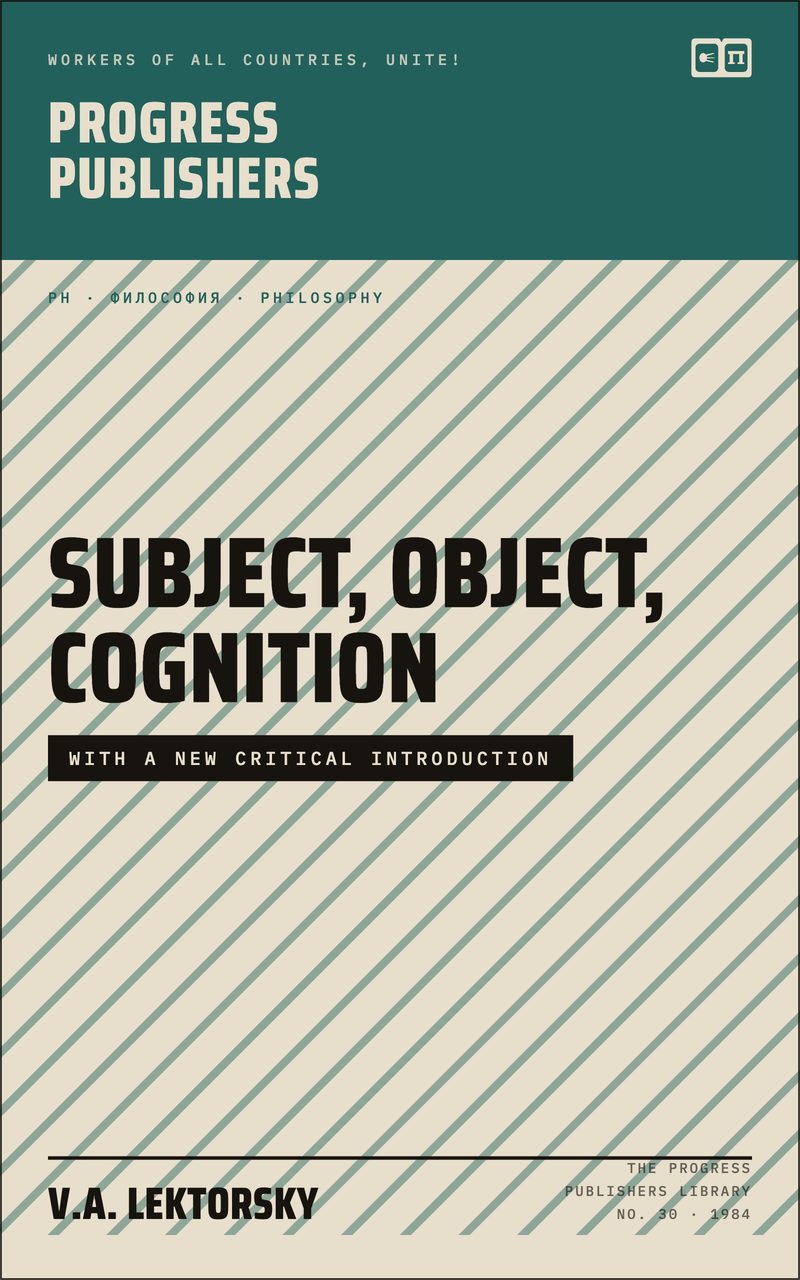
Subject, Object, Cognition
Buy
The critical introduction
Written for this edition and published free in Progress Quarterly, Volume VIII, Number 2.
Read it the whole numberOne of the best philosophy books Progress printed, and it declares its difference on the first page.
The preface is addressed not to a Soviet study circle but to the reader abroad, and its complaint is that this reader does not always realise how far Western epistemology's newest preoccupations - the historical development of knowledge, the socio-cultural conditioning of science, the realist interpretation of scientific theories - are also the central concerns of the Marxist study of cognition. What follows is an attempt to prove the claim on the opponent's own ground.
Bridgman, Kuhn, Quine, Popper, Piaget, Chomsky, the Sapir-Whorf hypothesis, intuitionist mathematics and the measurement problem in quantum mechanics are not paraded as errors to be denounced but worked through at length by a man who has plainly read them and can follow their arguments.
Vladislav Lektorsky was no functionary. He was among the senior epistemologists of the Institute of Philosophy of the Academy of Sciences, and his subject here - the relation between the knowing subject and the object known, and what it means to treat that relation as historically and socially constituted rather than fixed - is argued as a live problem.
The preface is signed Moscow, November 1982, the month Brezhnev died, and the bibliography thins around 1980. A book of the stagnation, written when the political surface of Soviet life was at its most frozen, which sits oddly and interestingly beside the intellectual openness of its contents.
New critical introduction by Dmitry Chasovennikov.
| Series | The Progress Publishers Library |
| First published | 1984 |
| ISBN | 978-5-01-900171-2 |
| Pages | 279 |
| Language | English |
| Subject | Philosophy |
| Introduction By | Dmitry Chasovennikov |
| Translator | Sergei Syrovatkin |