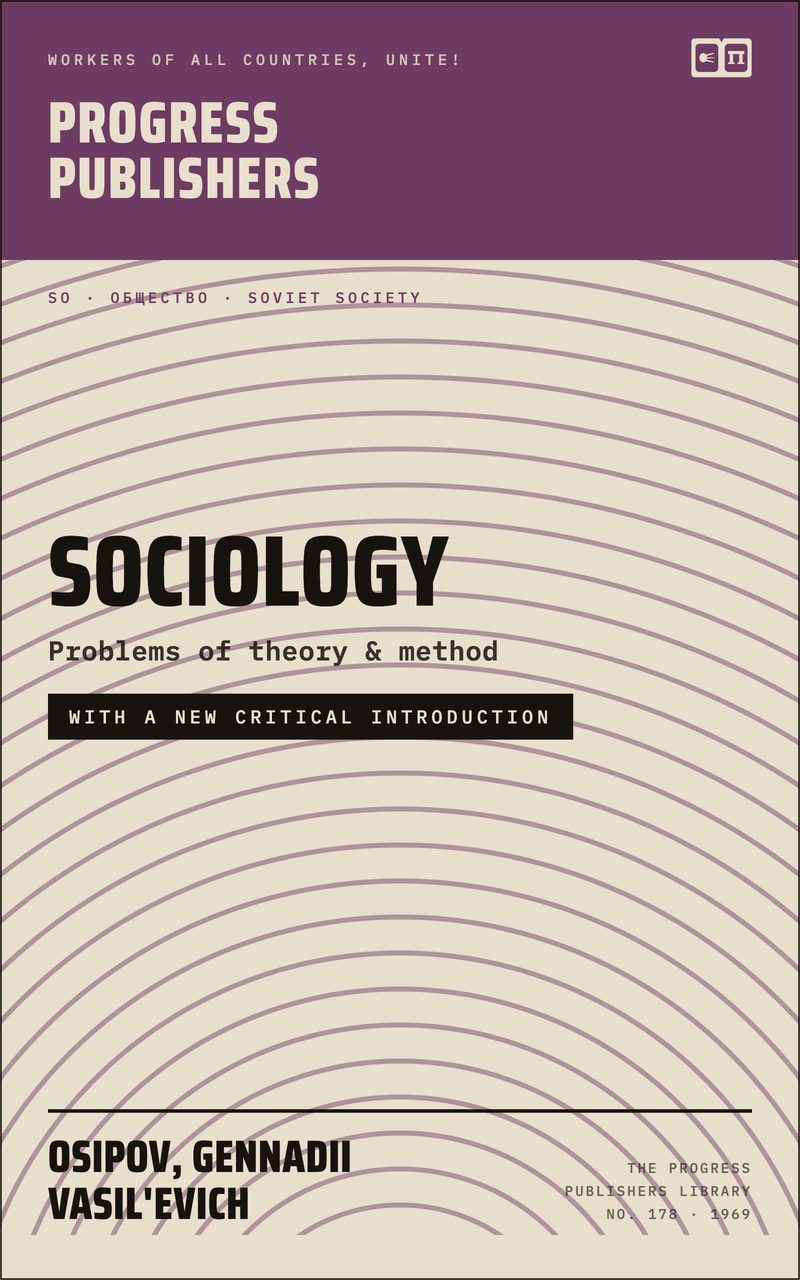
Sociology: Problems of theory and method
Buy
The critical introduction
Written for this edition and published free in Progress Quarterly, Volume II, Number 1.
Read it the whole numberThis is a book of sociology written in a country that had spent nearly forty years insisting sociology did not exist.
Under Stalin the word itself was an accusation: sociology was a bourgeois pseudo-science, a Western fraud dressed up as neutral inquiry, and the men who had practised it in the 1920s were scattered, silenced or shot. Historical materialism, it was held, already contained everything a science of society could contain; to want more was to doubt the sufficiency of Marxism-Leninism, which was to doubt the Party.
What you are holding is one of the first English-language monuments to the reversal of that verdict - the moment, in the decade after the Twentieth Congress, when a discipline that had been abolished was quietly readmitted. Gennady Osipov (1929-2021) was one of the two or three men who did the readmitting. He helped found the Soviet Sociological Association in 1968 and remained the discipline's leading institution-builder in Russia to the end of his life.
For once the date on the spine is close to the date of the thought: the bibliography runs current to 1969, and there is no earlier Russian edition lurking behind it. This is a book of the late Thaw, setting out what a Marxist sociology would be - its object, its relation to historical materialism, its methods of concrete social research - and arguing, carefully, for the right to collect data about a society rather than deduce it.
The empirical sociology Osipov helped bring back outlived the state that licensed it.
Translated by David Myshne and edited by Jim Riordan. New critical introduction by Dmitry Chasovennikov.
| Series | The Progress Publishers Library |
| First published | 1969 |
| ISBN | 978-5-01-900105-7 |
| Pages | 191 |
| Language | English |
| Subject | Soviet Society |
| Introduction By | Dmitry Chasovennikov |
| Translator | David A Myshne |