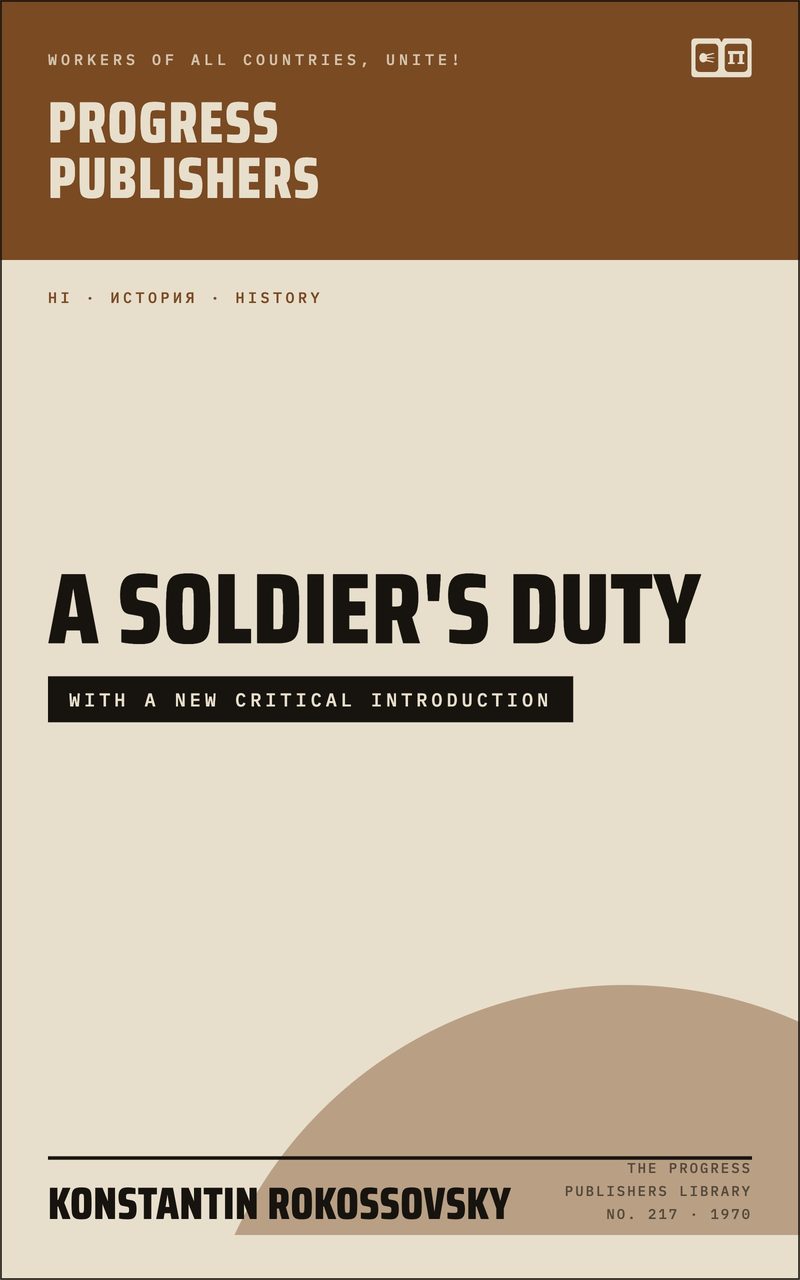
A Soldier's Duty
Buy
The critical introduction
Written for this edition and published free in Progress Quarterly, Volume II, Number 2.
Read it the whole number"In the spring of 1940, after a holiday with my family in Sochi, on the Black Sea coast, I had an invitation from Marshal Semyon Timoshenko."
So opens the war memoir of Konstantin Rokossovsky - one of the two or three finest field commanders the Soviet Union produced, the general who held the line before Moscow, closed the ring at Stalingrad, broke the German army in Byelorussia and took the surrender of Field Marshal Paulus. The sentence is warm, domestic and unremarkable: a soldier back from leave, summoned by an old comrade to resume his career.
What the operational chapters contain is a real contribution to the history of the war, made by a man of evident courage and professional judgement. Rokossovsky is precise about the fighting, generous to subordinates, and frank about mistakes in a way that was not required of him - on the defence of Moscow, on the encirclement at Stalingrad, and on Operation Bagration, the 1944 offensive that destroyed Army Group Centre and which he had to argue for against Stalin personally.
The Russian original, Soldatsky dolg, was published by the Soviet military publishing house in 1968, the year Rokossovsky died. Progress issued this English translation in 1970 for export: the memoir of a Marshal of the Soviet Union, offered to the world as first-hand testimony of how the war was won. It is testimony, and much of it is true and valuable. It was also written and cleared under the constraints of the late 1960s, when the Great Patriotic War had hardened into the central legitimating myth of the Soviet state.
Translated by Vladimir Talmy. New critical introduction by Dmitry Chasovennikov.
| Series | The Progress Publishers Library |
| First published | 1970 |
| ISBN | 978-5-01-900233-7 |
| Pages | 358 |
| Language | English |
| Subject | History |
| Introduction By | Dmitry Chasovennikov |
| Translator | Vladimir Talmy |