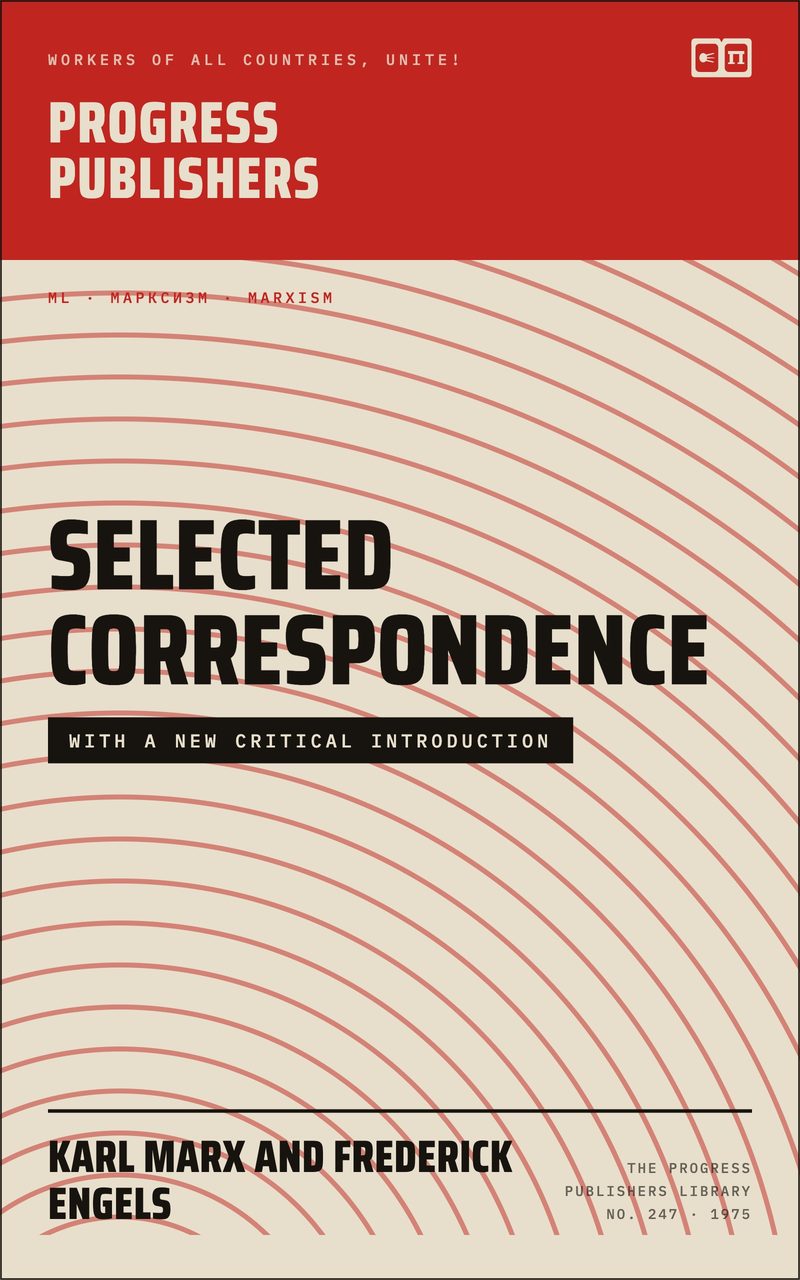
Selected Correspondence
Buy
The critical introduction
Written for this edition and published free in Progress Quarterly, Volume IV, Number 2.
Read it the whole numberEvery finished book is an argument in its Sunday clothes. Correspondence is the argument in shirtsleeves - thought caught in the act, before it has decided what it wants to say.
Here are Marx and Engels not lecturing the world but writing to each other and to their friends across half a century, from Engels's first letter of autumn 1844 to the last Engels wrote a few months before his death in 1895. They argue over proofs and rent theory and the state of the stock exchange, complain about money and printers, size up men and movements, and again and again work out in the margins of a private letter ideas that would only later harden into doctrine.
The glory of the collection is the handful of letters Engels wrote in his last years - to Joseph Bloch, to Conrad Schmidt, to Franz Mehring, to Borgius - watching a younger generation turn his and Marx's work into a crude machine and trying to pull the emergency brake. The letter to Bloch of September 1890 is the essential one: neither he nor Marx ever claimed more than that production and reproduction of real life is the ultimately determining factor, and anyone who twists that into the economic factor being the only one has turned the proposition into an absurdity. Law, politics, philosophy and religion act on the course of the struggle too, and people make their own history, in circumstances not of their choosing, out of innumerable intersecting forces.
265 letters selected from a surviving correspondence of several thousand, with substantial explanatory notes, a name index identifying every obscure figure, and a bibliography.
Translated by I. Lasker, edited by S. W. Ryazanskaya.
New critical introduction by Dmitry Chasovennikov, on what a selection selects.
| Series | The Progress Publishers Library |
| First published | 1975 |
| ISBN | 978-5-01-900256-6 |
| Pages | 672 |
| Language | English |
| Subject | Marxism |
| Introduction By | Dmitry Chasovennikov |
| Translator | I. Lasker |