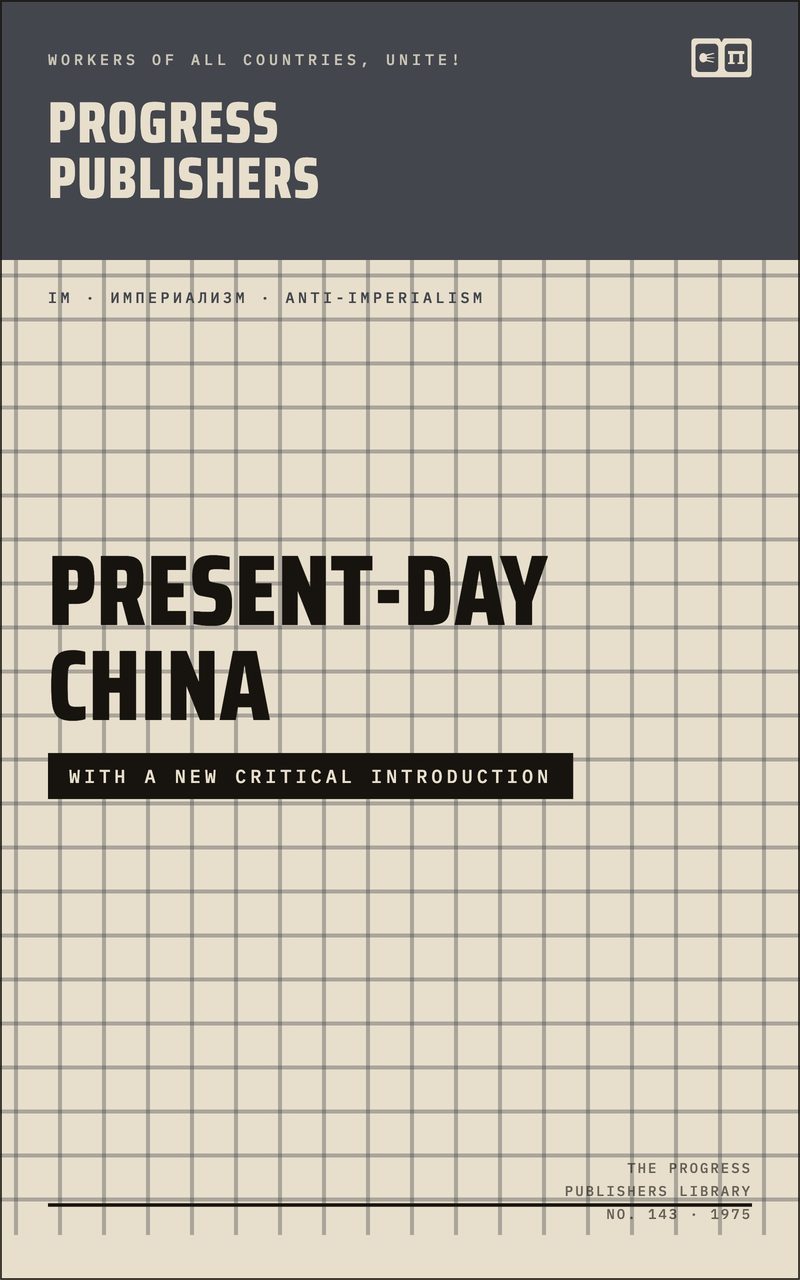
Present-Day China
Buy
The critical introduction
Written for this edition and published free in Progress Quarterly, Volume IV, Number 3.
Read it the whole numberA multi-country symposium on the socio-economic system of the People's Republic of China, assembled at the height of the Sino-Soviet quarrel and unusual for showing its working across several national academies rather than one.
The lead contribution is by M. I. Sladkovsky, director of the Institute of the Far East and the senior Soviet sinologist of his generation, on present-day China's socio-economic system - a long study that goes back to Sun Yat-sen, the 1924 Kuomintang manifesto and the revolution of 1925-27 in order to explain what the People's Republic inherited. Around it are contributions from Hungary on the state of Hungarian research into Chinese development, from the German Democratic Republic on the two spheres of the Chinese economy, and from further Soviet specialists including E. A. Konovalov on the socio-economic aspects of the population problem.
The comparative structure is the point. Each contributor reports what the researchers in his own country had established and where they thought the difficulties lay, with the sources named, so that a reader can see the state of socialist-bloc scholarship on China as it stood rather than a single official line handed down.
For students of the Sino-Soviet split, of Chinese economic history, or of how the socialist states organised their expertise about one another, this is a substantial and openly sourced body of material.
Translated by Galina Sdobnikova.
New critical introduction by Dmitry Chasovennikov.
| Series | The Progress Publishers Library |
| First published | 1975 |
| ISBN | 978-5-01-900114-9 |
| Pages | 248 |
| Language | English |
| Subject | Anti-Imperialism |
| Introduction By | Dmitry Chasovennikov |
| Translator | Galina Sdobnikova |