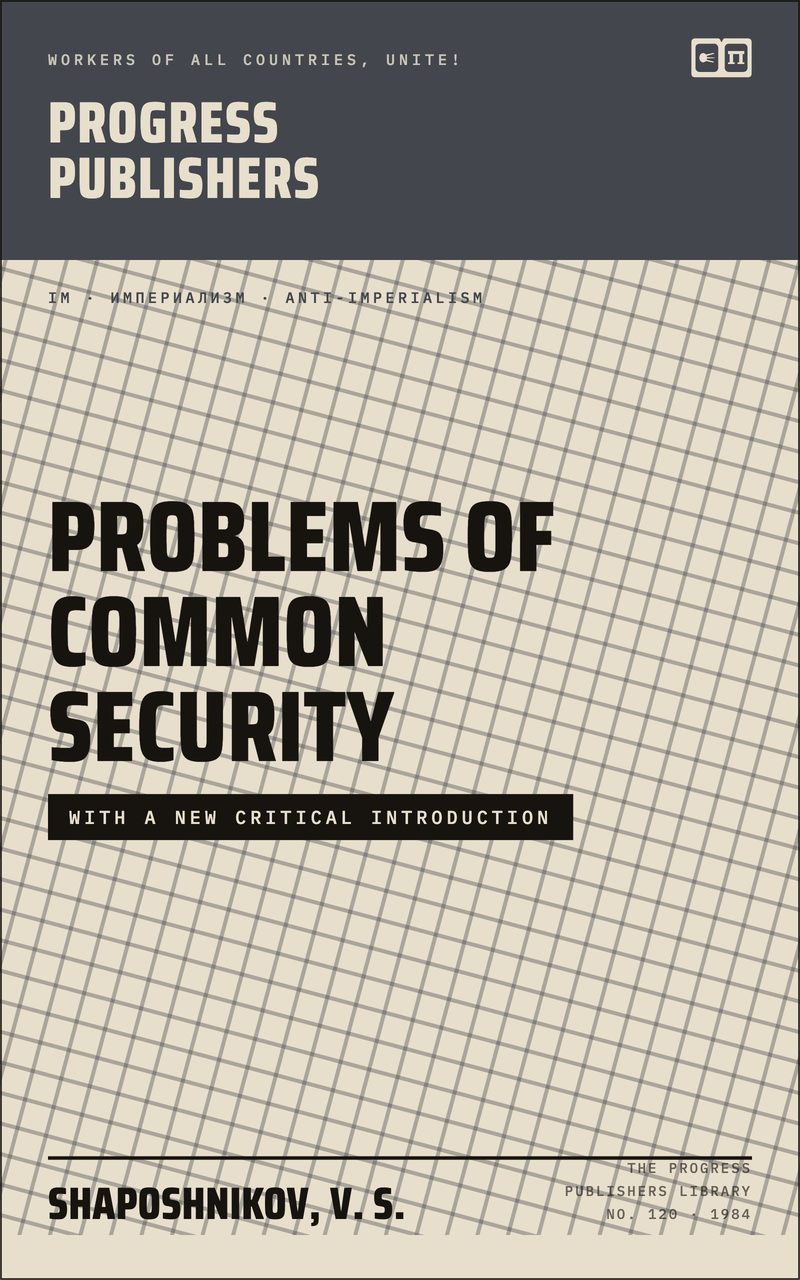
Problems of Common Security
Buy
The critical introduction
Written for this edition and published free in Progress Quarterly, Volume VIII, Number 1.
Read it the whole numberTwenty-six specialists wrote the twenty-six chapters of this book, and they closed their manuscripts into the most dangerous winter of the second Cold War.
Its subject is common security: the proposition that in the nuclear age safety cannot be achieved against an adversary but only with one. The chapters work through the strategic balance, the intermediate-range weapons in Europe, the militarisation of space, chemical and conventional arms, confidence-building measures, and the machinery of negotiation.
It is not the work of a single scholar. The title page credits the Scientific Research Council on Peace and Disarmament and the Soviet Peace Fund, and the editorial board is a roster of the Soviet foreign-policy establishment: Georgi Arbatov, who ran the Institute for the USA and Canada and briefed general secretaries; Yevgeny Primakov; Vladimir Petrovsky, later a deputy foreign minister; Valentin Falin of the Central Committee's international department; and Oleg Bykov. These are the men who manufactured Soviet arms-control policy, writing under their own names for export.
The intended reader is the Western peace movement - the millions who filled the squares of Bonn, London and Amsterdam in the autumn of 1983 to stop the Pershings. It is a diplomatic instrument dressed as a scholarly symposium, and much of it deserves a hearing.
For once the spine is right. The preface quotes Chernenko a fortnight after he became General Secretary, describes the Soviet counter-deployment at the end of 1983, and names the invasion of Grenada as fresh.
New critical introduction by Dmitry Chasovennikov.
| Series | The Progress Publishers Library |
| First published | 1984 |
| ISBN | 978-5-01-900115-6 |
| Pages | 453 |
| Language | English |
| Subject | Anti-Imperialism |
| Introduction By | Dmitry Chasovennikov |