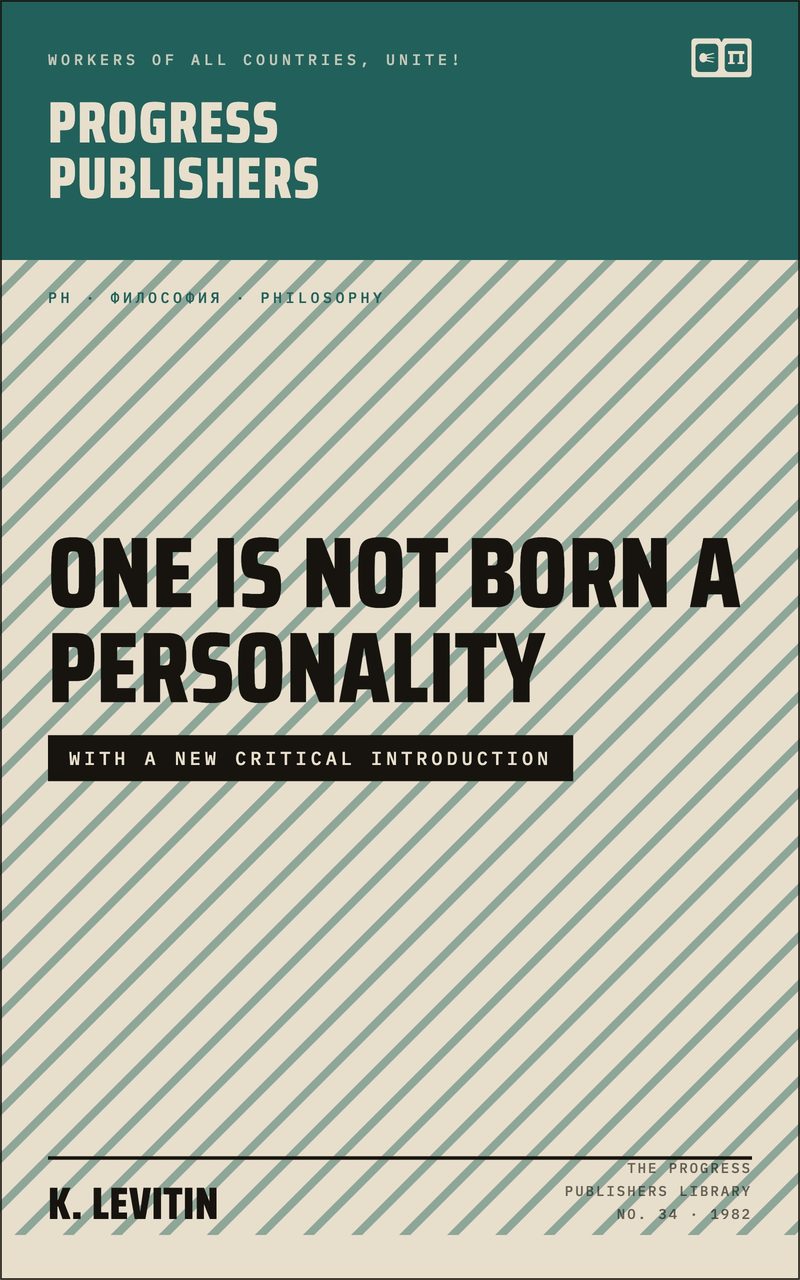
One Is Not Born a Personality
Buy
The critical introduction
Written for this edition and published free in Progress Quarterly, Volume VII, Number 2.
Read it the whole numberOpen this at almost any page and you find a scene rather than a doctrine. A journalist takes the long detour through Zagorsk, where deaf, dumb and blind children are learning to hold a spoon. An old neurologist thinks aloud about the brain while a tape recorder turns. A young teacher about to take her first class admits she is frightened, because of what she might make of them. Escher's impossible staircases sit between the chapters.
Karl Levitin was a science journalist rather than a psychologist, and this is what a gifted reporter made of a decade spent among the people who built Soviet psychology. It is a warm, deliberately unsystematic portrait of a genuinely first-rate scientific tradition - the school of Vygotsky, Luria and Leontiev, and the generation that followed them - and the science in it is real, humane and in places permanent.
Its occasion was an ending. Levitin signs off from Moscow in 1980, prompted by a symposium at which, as he puts it, some very familiar and necessary voices were conspicuously absent: Luria and Leontiev had both died in the late 1970s. The book reads exactly like what it is, an elegy and a stock-taking written just after the founding generation passed, at the moment the West was beginning to catch up - the Harvard selection of Vygotsky had appeared in 1978 and the rediscovery was under way.
Edited by the psychologist Vasili Davydov, himself one of its subjects, with a preface by Vladimir Zinchenko.
New critical introduction by Dmitry Chasovennikov, on what the book will not say about what the state did to these scientists.
| Series | The Progress Publishers Library |
| First published | 1982 |
| ISBN | 978-5-01-900067-8 |
| Pages | 322 |
| Language | English |
| Subject | Philosophy |
| Introduction By | Dmitry Chasovennikov |
| Translator | Yevgeni Filippov |