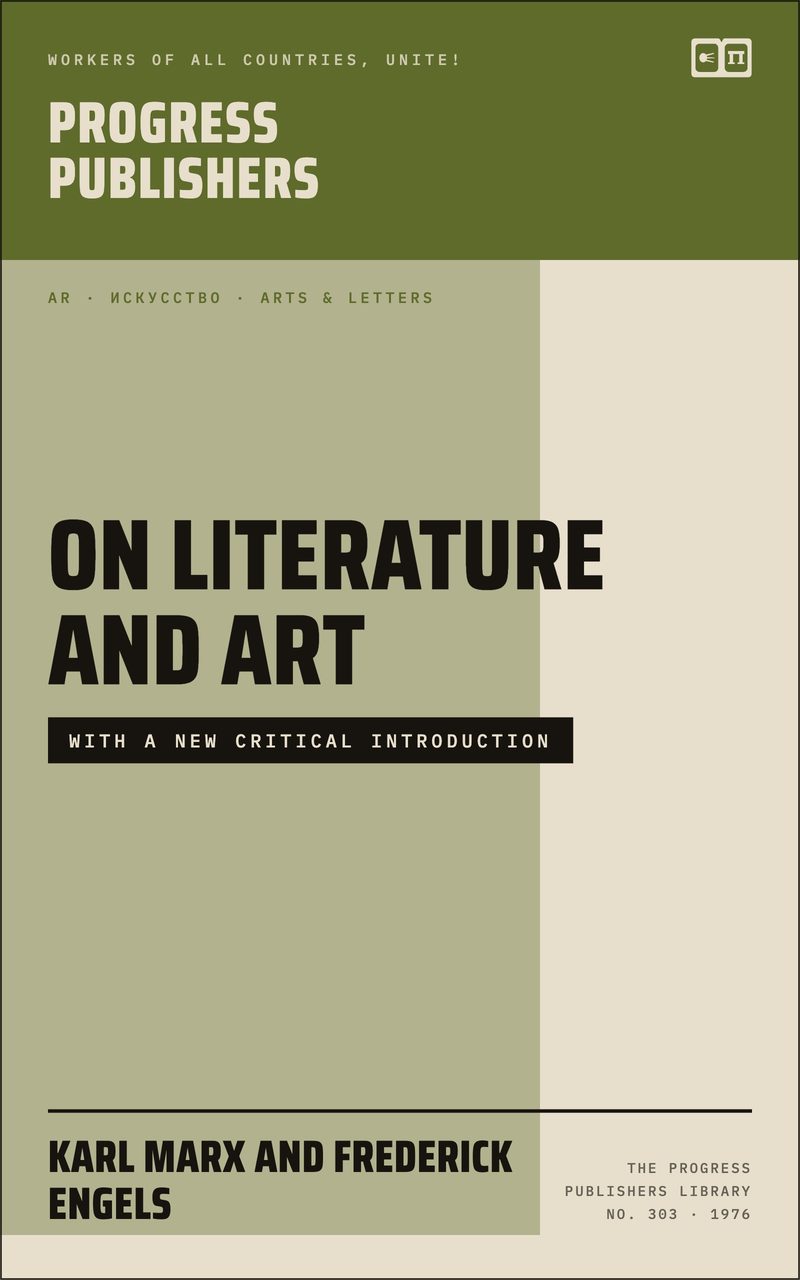
On Literature and Art
Buy
The critical introduction
Written for this edition and published free in Progress Quarterly, Volume V, Number 1.
Read it the whole numberMarx and Engels never wrote a book on art. What they left is scattered - a letter to a young novelist, a paragraph in the drafts of Capital, an aside on Greek mythology, a review, a note in the margin of a friend's play - and this volume is built out of those fragments, compiled from two earlier Soviet collections with the headings supplied by the editors.
Read for themselves, the fragments are far subtler than the frame around them, and remarkably little of the reductive Marxism later built in their name is actually present. Marx, drafting his introduction of 1857, stops in genuine puzzlement before Greek art: why should work rooted in a vanished society still move us? His answer refuses any mechanical link between base and superstructure. Art does not rise and fall in step with the mode of production; it can outlive its own economic ground.
The same independence governs Engels's two famous letters, both printed here. To Margaret Harkness he lays down the principle that would scandalise every later commissar - that the more the author's opinions stay hidden, the better for the work of art - and proves it from Balzac, a Legitimist whose sympathies lay with the doomed aristocracy and whose novels nonetheless record the bourgeoisie's victory against everything their author wished. To Minna Kautsky he is equally plain: he is not against partisan writing as such, but the purpose must emerge from the situation and the action rather than being pointed out.
What emerges is an aesthetics of realism over doctrine: generous, anti-didactic, and suspicious of art that serves its conclusions on a platter.
New critical introduction by Dmitry Chasovennikov.
| Series | The Progress Publishers Library |
| First published | 1976 |
| ISBN | 978-5-01-900254-2 |
| Pages | 417 |
| Language | English |
| Subject | Arts & Letters |
| Introduction By | Dmitry Chasovennikov |