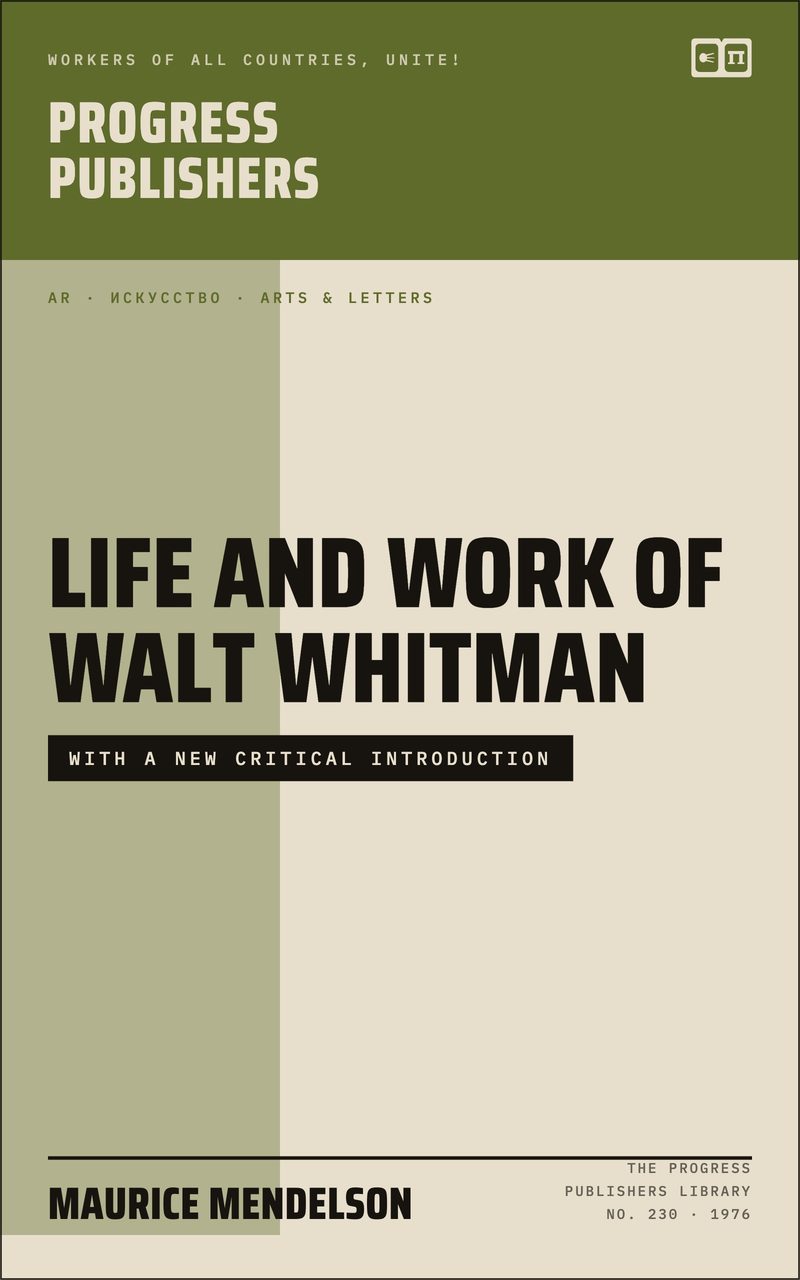
Life and Work of Walt Whitman
Buy
The critical introduction
Written for this edition and published free in Progress Quarterly, Volume V, Number 1.
Read it the whole numberTwo decades of work on one poet, by a scholar who spent his career on him.
Maurice Mendelson submitted a doctoral dissertation on Whitman in Moscow in 1956, wrote the foreword to a Soviet Whitman selection in 1954, and marked the centenary with articles in Pravda and Oktyabr in 1955. This is the fruit of that long attention, and it shows on every page.
He works from the documents. He uses Whitman's Brooklyn Eagle journalism at length and in detail - the editorship of 1846 to 1848, the leading article on slavers and the slave trade, the Wilmot Proviso fight, the paper's own claim to have been the first Democratic paper to raise the question decisively, the dismissal by the owner and the rival paper's account of it, in which the editor had kicked a well-known politician down the stairs. He uses the earliest surviving notebook, identified by the Eagle office address on its flyleaf, and quotes its aphorisms directly. He uses a Library of Congress manuscript to date the founding of the Brooklyn Freeman, and Whitman's own notes there on Russian history and economics.
The argument it leaves in a reader's hands is that America's greatest democratic poet is better loved abroad than at home, and Mendelson assembles his supporting cast with care - Elizabeth Gurley Flynn's copy of Leaves of Grass passed around a women's prison, Gus Hall discovering Whitman in Leavenworth.
Behind the 1976 imprint is a Nauka book of 1969, itself a revision of 1965.
New critical introduction by Dmitry Chasovennikov.
| Series | The Progress Publishers Library |
| First published | 1976 |
| ISBN | 978-5-01-900076-0 |
| Pages | 347 |
| Language | English |
| Subject | Arts & Letters |
| Introduction By | Dmitry Chasovennikov |
| Translator | Andrew Bromfield |