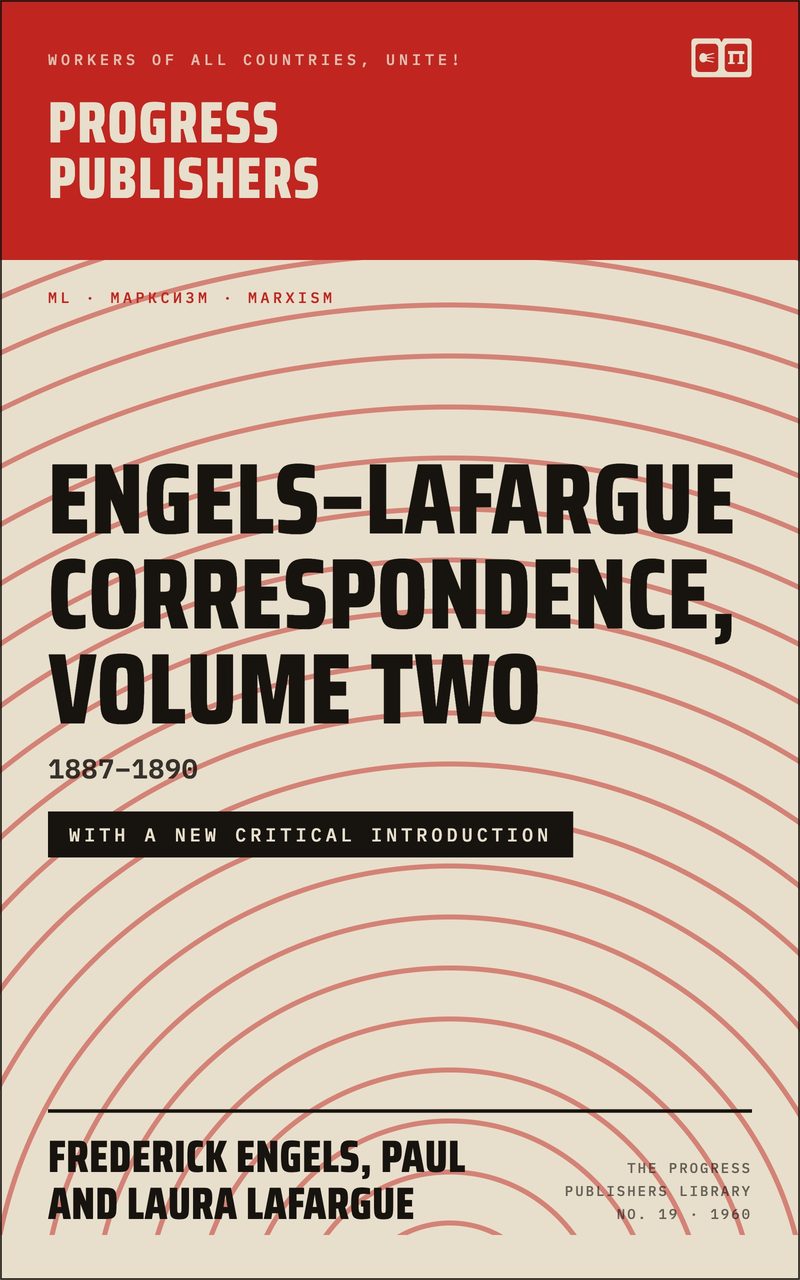
Engels–Lafargue Correspondence, Volume Two (1887–1890)
Buy
The critical introduction
Written for this edition and published free in Progress Quarterly, Volume I, Number 4.
Read it the whole numberThese are the hinge years, and that is what makes this the most consequential of the three volumes.
When the correspondence opens in 1887 the workers' movement is a scatter of national parties, sects and trade-union federations with no common instrument; the First International is fifteen years dead. When it closes in 1890 the Second International exists, its founding congress has met in Paris in July 1889, and the first international May Day has been called. Almost every letter here is, at some level, about building that instrument - and about the squalid, exhausting, indispensable manoeuvre it took to build it.
Engels is in London, in his late sixties, correcting the manuscript of the third volume of Capital and running an international by post. Paul and Laura Lafargue are in and around Paris, in the thick of the French party's war with its rivals. The letters carry the congress politics in real time: which faction will convene the congress, who will be admitted, what the mandates are worth, how to outflank the Possibilists without splitting the movement. It is the finest close-up available of how an international was actually assembled, as opposed to how it was later described.
Translated by Yvonne Kapp from the French edition compiled and annotated by Emile Bottigelli, and published in Moscow by the Foreign Languages Publishing House - the export house then in the act of being folded into Progress Publishers.
Volume Two of three. New critical introduction by Dmitry Chasovennikov.
| Series | The Progress Publishers Library |
| First published | 1960 |
| ISBN | 978-5-01-900237-5 |
| Pages | 408 |
| Language | English |
| Subject | Marxism |
| Introduction By | Dmitry Chasovennikov |
| Translator | Yvonne Kapp |