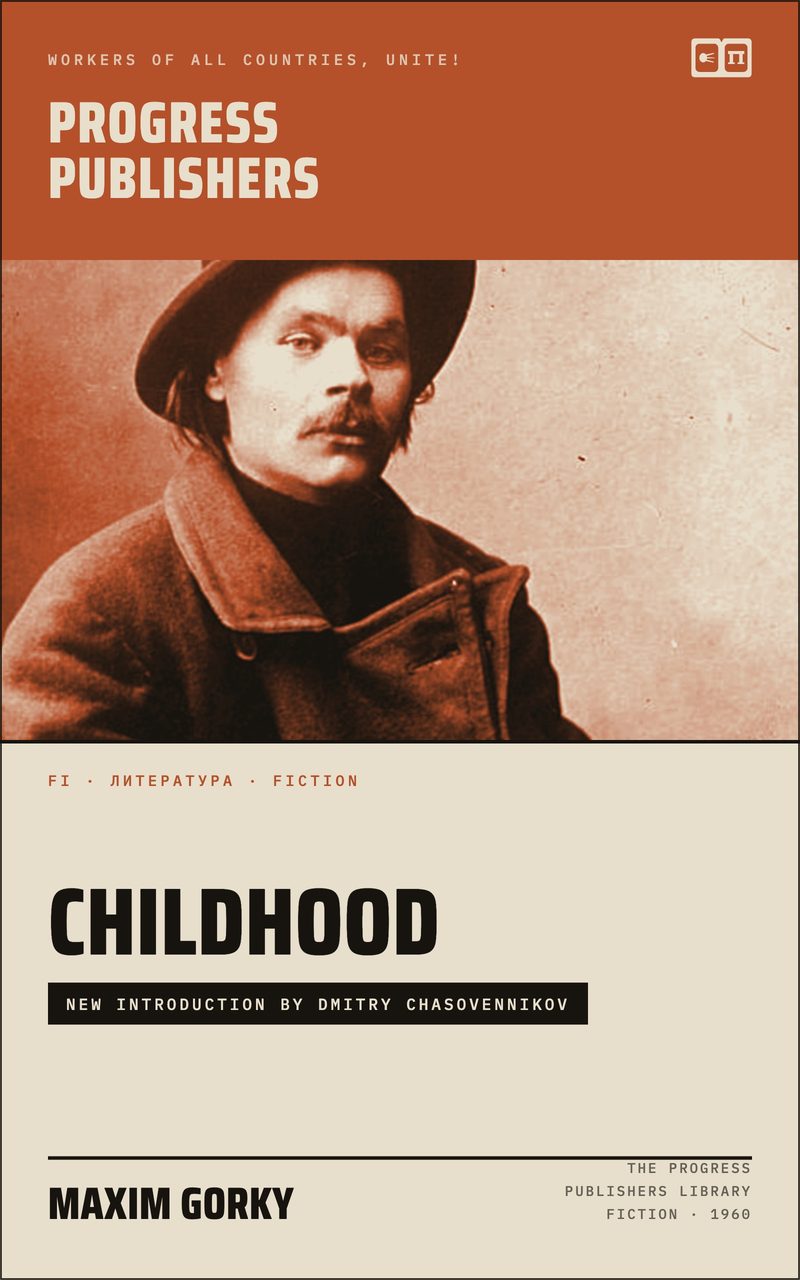
Childhood
Buy
The critical introduction
Written for this edition and published free in Progress Quarterly, Volume IX, Number 3.
Read it the whole numberThe book begins with a corpse on a floor, described by a small boy who does not yet know what he is looking at. His father lies dressed in white, copper coins on his eyes. His mother kneels in a red skirt, combing back the dead man's hair "with the black comb I had used as a saw to cut through the rind of watermelons".
The comb tells you what kind of writer this is. A boy of four does not register a death; he registers that the object being used on his father is the one he used on watermelons. Nothing is explained and nothing is softened.
A widowed mother brings her son to her father's house in Nizhni Novgorod in the 1870s, and the house destroys nearly everyone in it. Grandfather Kashirin is a dyer and former barge-hauler, small, red-haired, violent and devout, who beats the children until they lose consciousness. Money is the household's only subject. It ends with a boy of eleven turned out into the world, in a sentence flat as a plank.
Gorky presided over the congress that made socialist realism binding on every Soviet writer. Childhood obeys none of it: written twenty years earlier, it has no positive hero, no Party, no forward-looking resolution and no lesson.
Foreign Languages Publishing House, Moscow, 1960, in the Library of Selected Soviet Literature. Translated by Margaret Wettlin, an American who went to the USSR for a year in 1932 and stayed nearly fifty.
New critical introduction by Dmitry Chasovennikov.
| Series | The Progress Publishers Library |
| First published | 1960 |
| ISBN | 978-5-01-900320-4 |
| Pages | 394 |
| Language | English |
| Subject | Fiction |
| Introduction By | Dmitry Chasovennikov |