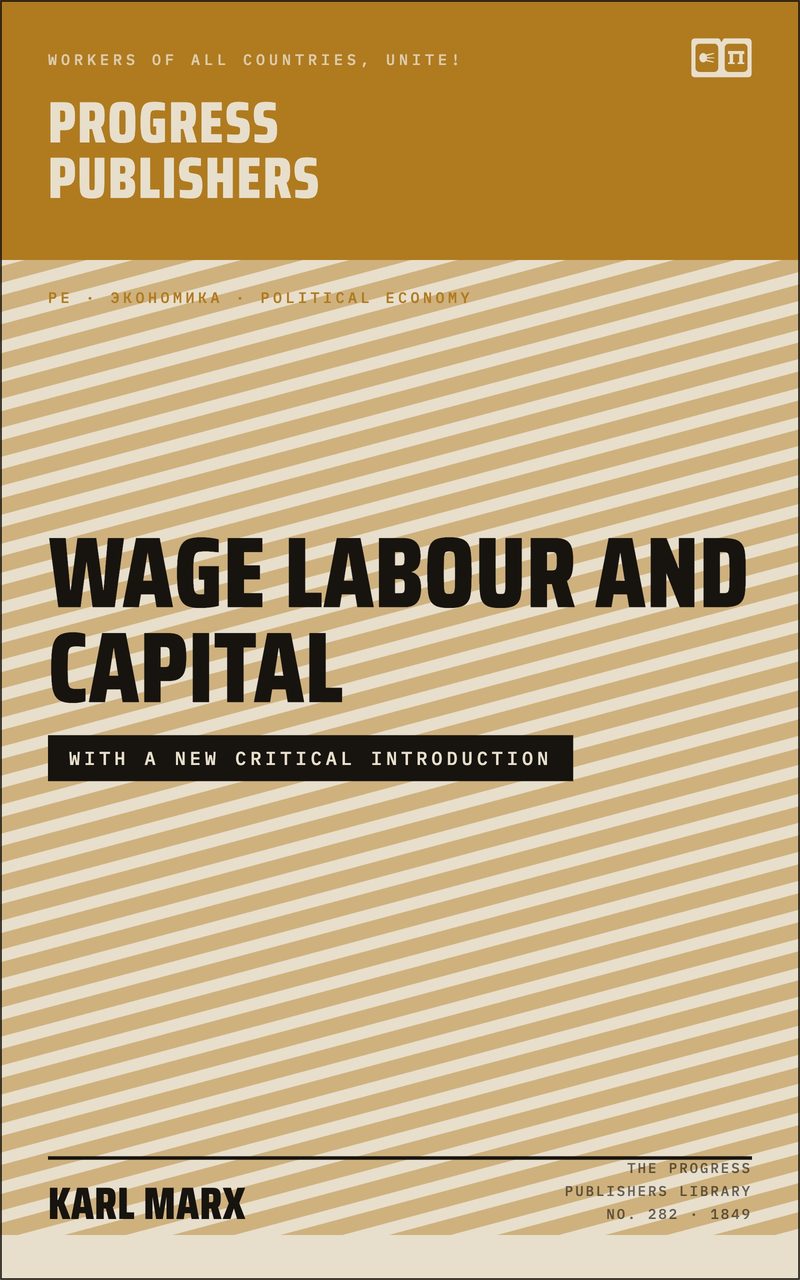
Wage Labour and Capital
Buy
The critical introduction
Written for this edition and published free in Progress Quarterly, Volume I, Number 1.
Read it the whole numberIn April 1849 the Neue Rheinische Zeitung, the Cologne daily Marx edited through the revolution, began printing a series of leading articles under the title Wage Labour and Capital. They were drawn from lectures he had given two years earlier to the German Workers' Society in Brussels, and they were meant to give ordinary readers, in plain language, the economics underneath the political battles then raging across Europe.
The series was never finished. In May the counter-revolution closed in - the Russians invaded Hungary, risings broke out from Dresden to Baden, and the paper was suppressed on the 19th. The words "To be continued" at the foot of the last instalment were never made good. What survives is a fragment, and it is the most lucid short account of the wage relation Marx ever wrote, broken off exactly where it was about to turn from description to consequence.
It comes with a complication printed at its own head, and this edition does not hide it. The text is not what Marx wrote in 1849 but the version Engels prepared in 1891, eight years after Marx's death, for a mass pamphlet "to be circulated in not less than 10,000 copies". Engels says so himself, with a frankness the later custodians of the canon rarely matched: "I therefore tell the reader beforehand, this is not the pamphlet as Marx wrote it in 1849 but approximately as he would have written it in 1891." He explains the change too: "My alterations all turn on one point. According to the original, the worker sells his labour to the capitalist for wages; according to the present text he sells his labour power." That distinction - between labour, the activity, and labour-power, the capacity to work that is actually sold - is the hinge of Capital, and Engels quietly brought the young text into line with it, in the open.
The relation the pamphlet describes has not aged. Most people alive still live by selling their capacity to work, by the hour or the piece, to those who own the place they work in, and the reciprocal bind Marx names - that "capital presupposes wage labour; wage labour presupposes capital" - frames every argument now being had about work, wages and automation.
Progress Publishers, Selected Works, Volume One. New critical introduction by Dmitry Chasovennikov.
| Series | The Progress Publishers Library |
| First published | 1849 |
| ISBN | 978-5-01-900268-9 |
| Pages | 51 |
| Language | English |
| Subject | Political Economy |
| Introduction By | Dmitry Chasovennikov |