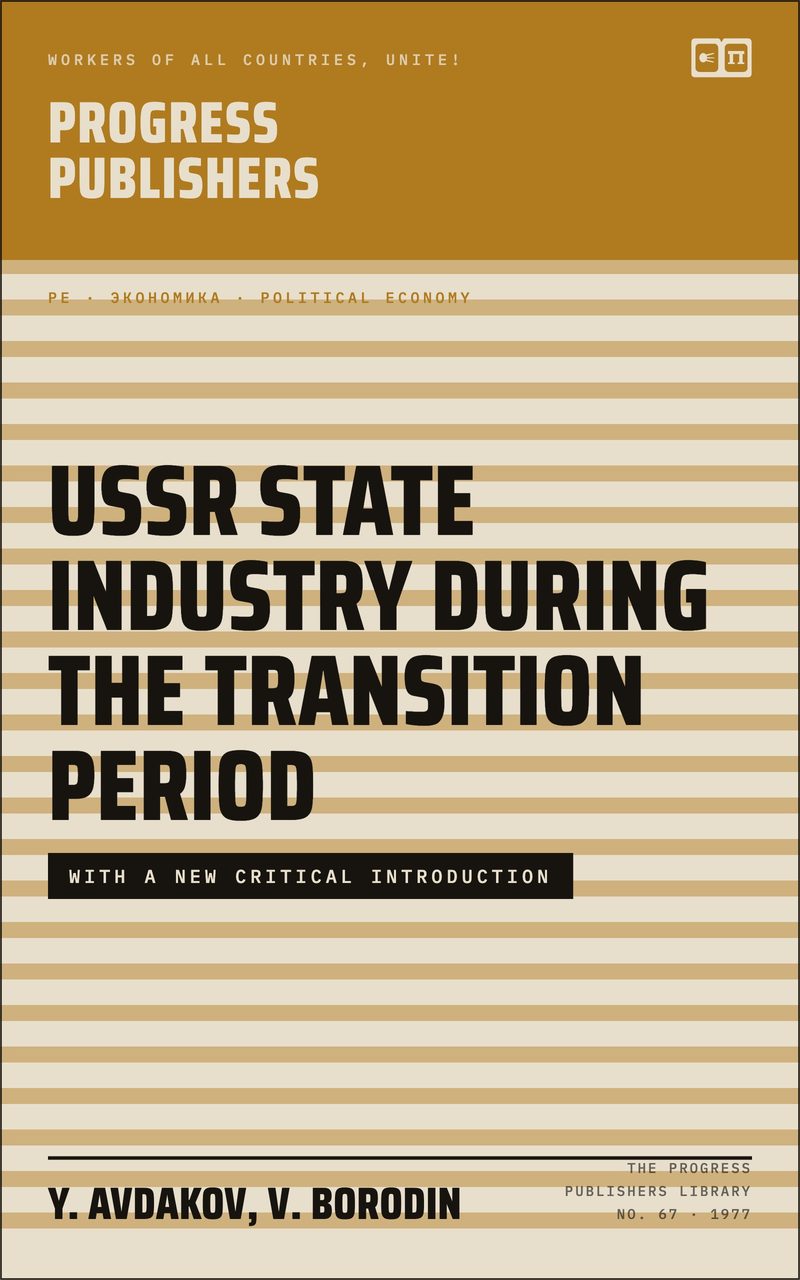
USSR State Industry During the Transition Period
Buy
The critical introduction
Written for this edition and published free in Progress Quarterly, Volume V, Number 2.
Read it the whole numberA close study of how the Soviet state built the machinery to run its factories, from the October Revolution to the abolition of the Supreme Economic Council in January 1932.
It follows the offices, statutes and reorganisations: the Supreme Economic Council and its chief committees, the trusts, the syndicates, the credit reform, and the shift from economic councils to branch People's Commissariats. It is drawn from documents in the Central State Archive of the USSR National Economy and the Central State Archive of the October Revolution, and much of what it reconstructs from them is available in English almost nowhere else.
The authors are candid about why they wrote it, and it is not for the Western reader's benefit. They open by insisting the 1920s are not only of historical interest, because critics abroad had claimed the Soviet idea of production amalgamations was borrowed from the capitalist corporation. The tell is that word. In 1973 the Soviet government had reorganised industry around exactly such bodies, and this history is written to give that reform a native pedigree - to show the large multi-plant association was present at the creation rather than imported.
So it is genuine archival scholarship pressed into service as a genealogy, and a reader who wants to use it has to hold both facts at once. As a technical account of Soviet industrial administration in its formative decade, from the files, it has few rivals in English.
Translated by Jane Sayer.
New critical introduction by Dmitry Chasovennikov, on the argument the administrative surface is designed not to show.
| Series | The Progress Publishers Library |
| First published | 1977 |
| ISBN | 978-5-01-900170-5 |
| Pages | 299 |
| Language | English |
| Subject | Political Economy |
| Introduction By | Dmitry Chasovennikov |
| Translator | Jane Sayer |