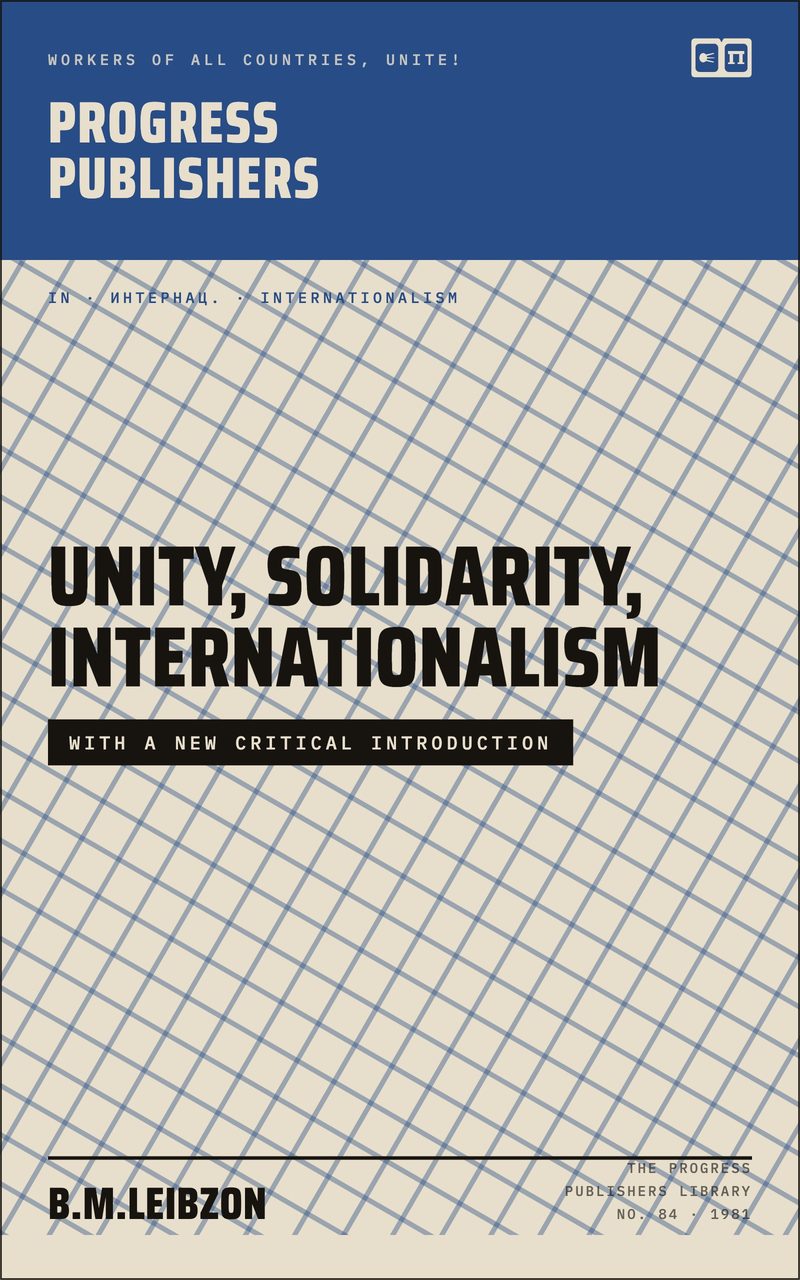
Unity, Solidarity, Internationalism
Buy
The critical introduction
Written for this edition and published free in Progress Quarterly, Volume VI, Number 3.
Read it the whole numberThe movement's official historian writing the official history of its cohesion, for export.
Boris Leibzon was a professor at the Moscow Academy of Social Sciences - the Central Committee's own graduate institution - and a Comintern historian working from party archives. His subject here is how the world communist movement holds together: the theory and practice of unity between parties, the meaning of solidarity, and the content of internationalism in a movement that had long since stopped being one thing.
Its value is as the fullest statement of the Soviet position on that question at the end of the period: what a fraternal party owed to the others, on what terms disagreement was legitimate, and where the line fell between a national road and a breach. The materials are the international conferences, the Berlin gathering of European parties in 1976, and the documents of the parties themselves.
The dating repays attention and the introduction sets it out. The text is substantially a 1979 manuscript: thirty-five of its sources are datelined 1979, the last world event it narrates is China's attack on Vietnam in February 1979, and only a handful of later citations appear. Two show that a hand passed over it afterwards - Tito is introduced as the late Tito, and he died in May 1980, while the Twenty-Sixth Congress references could not have been added before late February 1981.
So it was revised twice after the Gdansk shipyard gates closed.
New critical introduction by Dmitry Chasovennikov.
| Series | The Progress Publishers Library |
| First published | 1981 |
| ISBN | 978-5-01-900013-5 |
| Pages | 375 |
| Language | English |
| Subject | Internationalism |
| Introduction By | Dmitry Chasovennikov |
| Translator | Galina Sdobnikova |