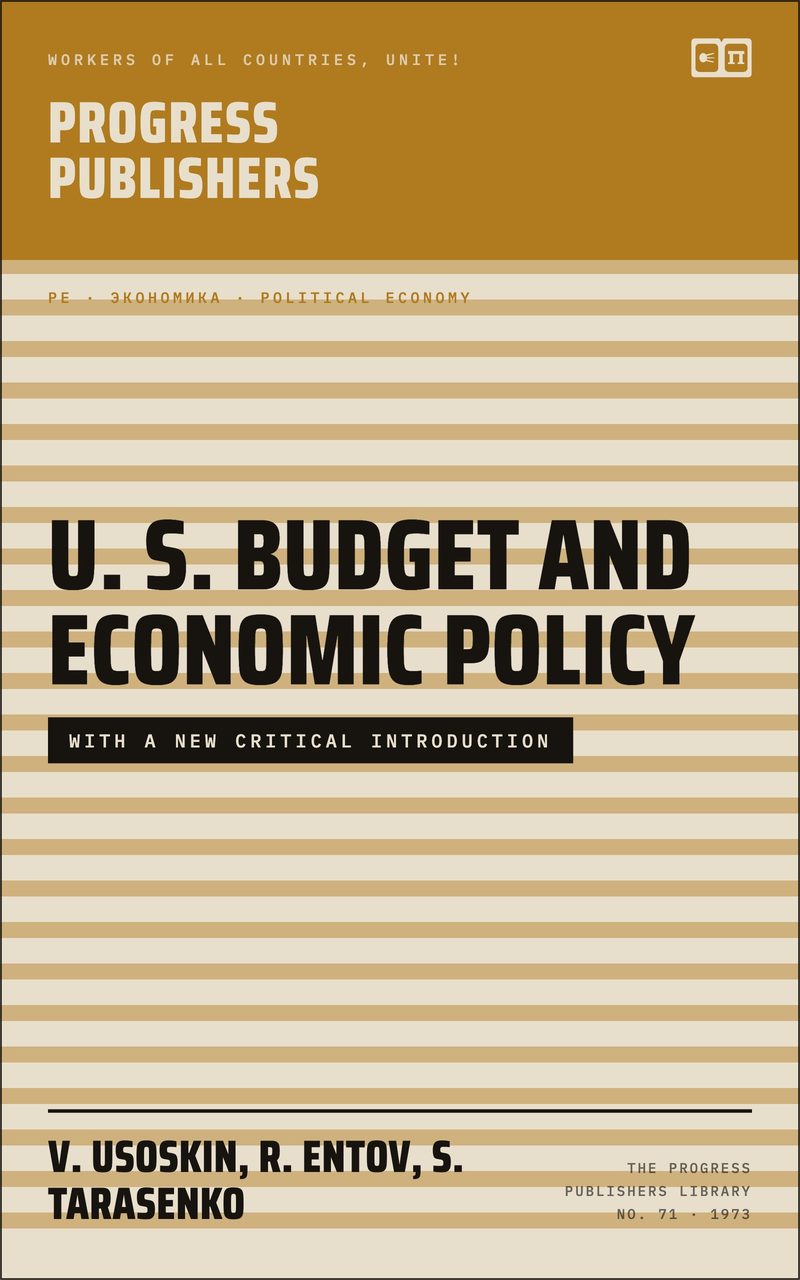
U. S. Budget and Economic Policy
Buy
The critical introduction
Written for this edition and published free in Progress Quarterly, Volume III, Number 4.
Read it the whole numberThree Soviet economists on how the world's richest state raises and spends its money - and they had plainly read almost everything the Americans themselves had published on the question.
V. Usoskin, R. Entov and S. Tarasenko worked in the tradition of Soviet scholarship that took capitalism seriously enough to master its own literature. Their two hundred pages rest on the Economic Report of the President, the annual Budget Message, the Statistical Abstract of the United States, the hearings of Congressional committees, and the academic public-finance writing of Richard Musgrave, Murray Weidenbaum, Robert Haveman and their contemporaries. On its own subject a great deal of it is simply correct, and documented from sources a reader can go and check.
For once the date can be trusted, and the date is the point. The text closes on the news of early 1973, working through the Presidential Budget Message submitted that January, welcoming the Paris accords on Vietnam and the SALT I agreements. It was finished at the exact hinge of postwar economic history and it knows it. The animating subject, over and above the tax tables, is the crisis of the dollar: the flight from it in 1970-71, the shift of holdings into foreign central banks, and the twin deficits dragging the monetary order down. Nixon had closed the gold window in August 1971; by March 1973, as this went to press, the fixed-rate system was gone for good.
The two strongest chapters give the book its edge: the anatomy of military spending, which takes Eisenhower's own coinage seriously, and the class distribution of the tax burden.
Translated by Leo Lempert. New critical introduction by Dmitry Chasovennikov.
| Series | The Progress Publishers Library |
| First published | 1973 |
| ISBN | 978-5-01-900166-8 |
| Pages | 201 |
| Language | English |
| Subject | Political Economy |
| Introduction By | Dmitry Chasovennikov |
| Translator | Leo Lempert |