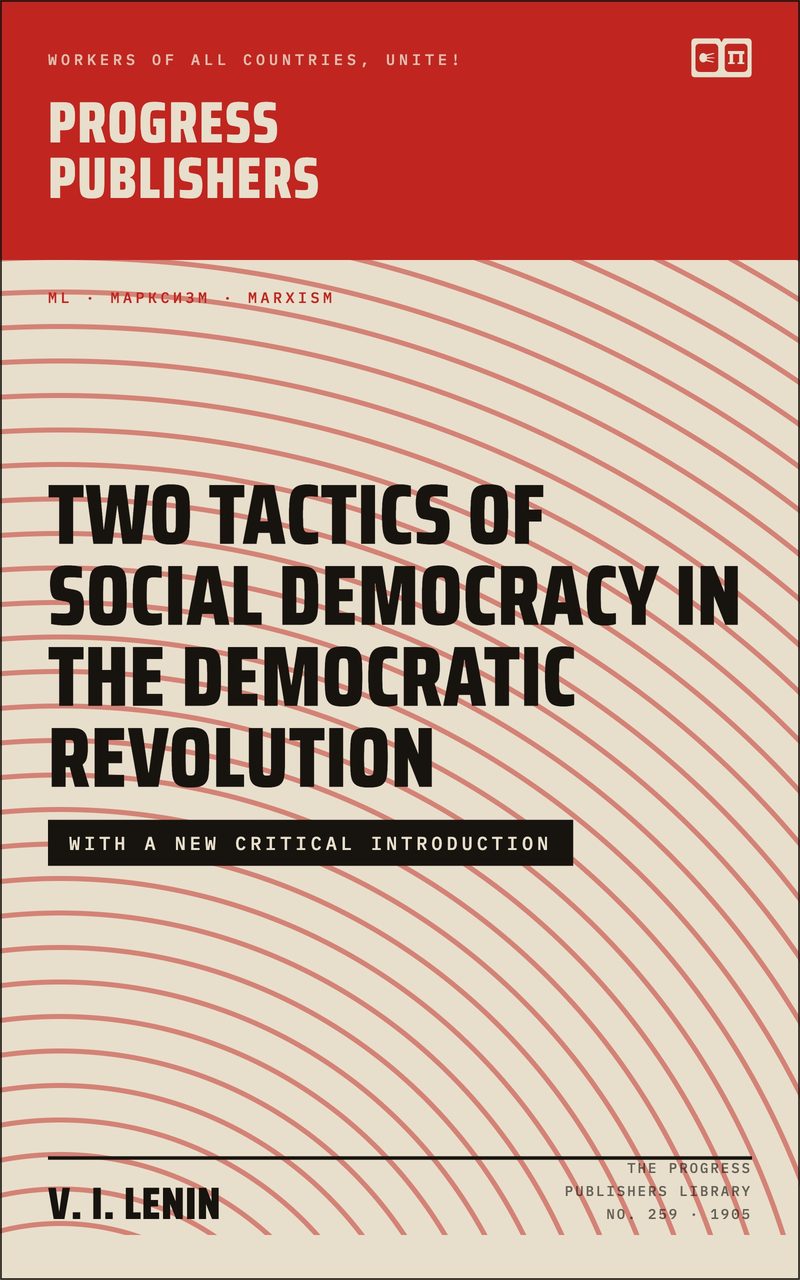
Two Tactics of Social-Democracy in the Democratic Revolution
Buy
The critical introduction
Written for this edition and published free in Progress Quarterly, Volume VII, Number 3.
Read it the whole numberLenin wrote this in the middle of a revolution, and it reads like it.
It was drafted in June and July 1905 in Geneva exile while Russia burned: Bloody Sunday in January had shattered the myth of the good Tsar, strikes and peasant risings were spreading, and the battleship Potemkin mutinied in the very weeks he was correcting proofs.
Its occasion was a quarrel inside a broken party. The Social-Democrats had split in 1903, and in spring 1905 the two halves met separately - the Bolsheviks at their Third Congress in London, the Mensheviks at a rival conference in Geneva - and passed opposing resolutions on the same question: what should Marxists do in a revolution that was, on any orthodox reckoning, a bourgeois one? Much of the book is a line-by-line comparison of those two sets of resolutions.
Beneath the exegesis lies the argument that would define Bolshevism. The Mensheviks reasoned from the textbook: if the revolution is bourgeois-democratic then the bourgeoisie must lead it, and the workers' party should stay in opposition and wait for a later, separate socialist revolution. Lenin's answer was that this handed the revolution to a class that did not want it - the Russian liberal bourgeoisie being tied by a thousand threads to the landlords and the throne, and certain to betray the moment its own narrow interests were met.
Translated by Abraham Fineberg and Julius Katzer.
New critical introduction by Dmitry Chasovennikov.
| Series | The Progress Publishers Library |
| First published | 1905 |
| ISBN | 978-5-01-900291-7 |
| Pages | 143 |
| Language | English |
| Subject | Marxism |
| Introduction By | Dmitry Chasovennikov |
| Translator | Abraham Fineberg |
| Translator | Julius Katzer |