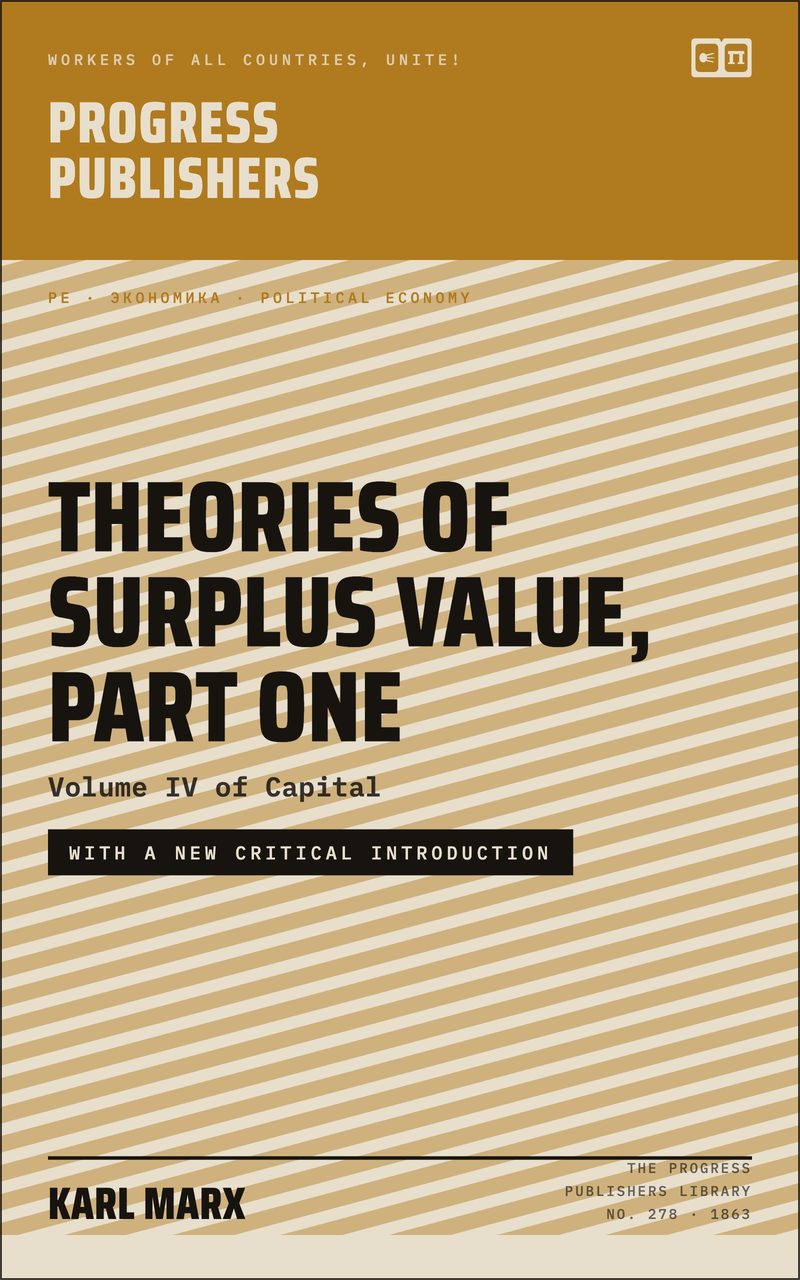
Theories of Surplus-Value, Part One (Volume IV of Capital)
Buy
The critical introduction
Written for this edition and published free in Progress Quarterly, Volume III, Number 1.
Read it the whole numberThe first of the three volumes of what Marx meant to be the concluding, historical part of Capital.
Between January 1862 and July 1863, in the middle of the vast manuscript from which his whole great work would later be quarried, he filled notebook after notebook with a critical history of the theory at the centre of his own: the theory of surplus value, and where the extra wealth of capitalist society actually comes from. He did not live to shape it into a book. What he left was the longest and most fully worked-out section of the 1861-63 draft, and it slept in his papers for forty years until Karl Kautsky published it between 1905 and 1910, fixing it in the tradition as the fourth volume of Capital.
This edition is not Kautsky's but a re-ordering of the notebooks meant to follow Marx's own plan more faithfully. Being the opening volume, it carries the general preface and Marx's own contents list for the manuscript - the map of the whole work.
Part One takes the history from the Physiocrats, the eighteenth-century French school who first looked for the origin of surplus in production rather than in sharp dealing at exchange, through Adam Smith, whose honesty Marx admired even where he thought him wrong.
Translated by Emile Burns, edited by S. Ryazanskaya.
Part One of three. New critical introduction by Dmitry Chasovennikov.
| Series | The Progress Publishers Library |
| First published | 1863 |
| ISBN | 978-5-01-900286-3 |
| Pages | 510 |
| Language | English |
| Subject | Political Economy |
| Introduction By | Dmitry Chasovennikov |
| Translator | Emile Burns |