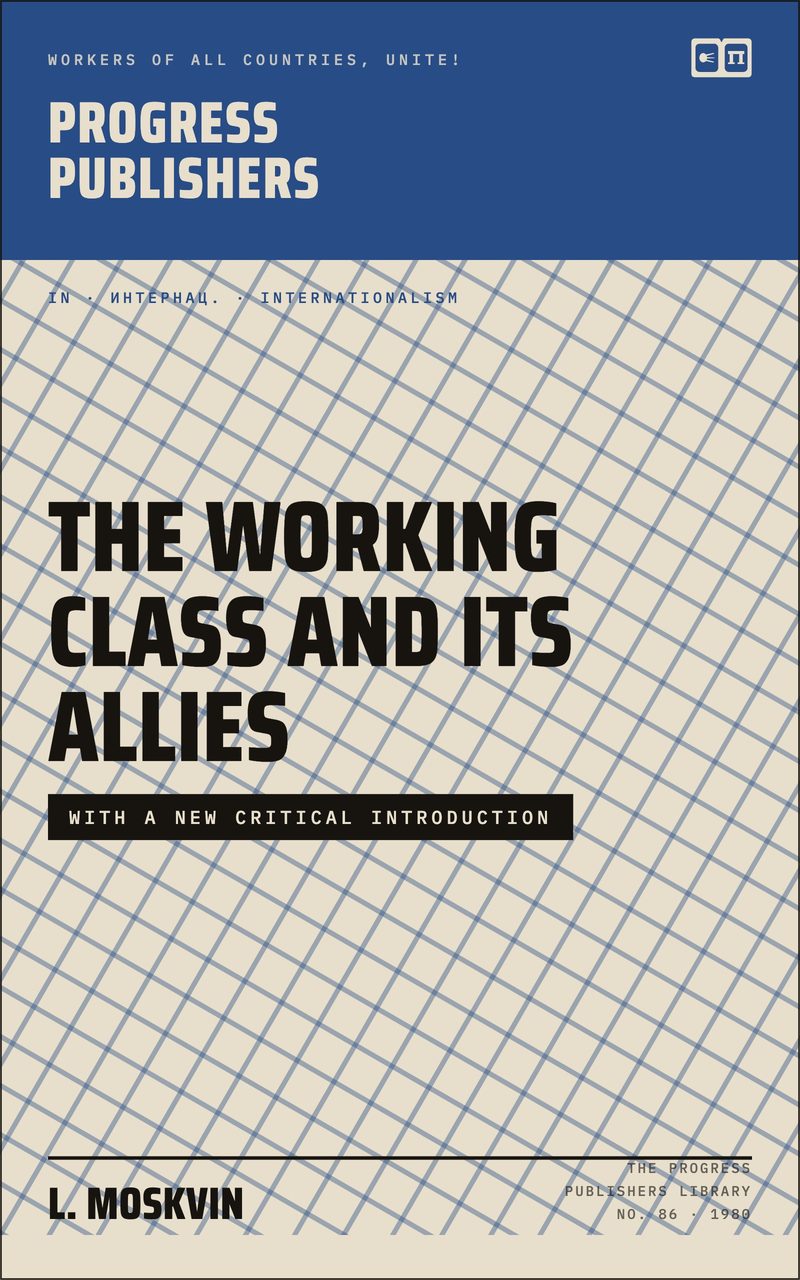
The Working Class and Its Allies
Buy
The critical introduction
Written for this edition and published free in Progress Quarterly, Volume VI, Number 2.
Read it the whole numberA book about who the workers may march with, and on whose authority.
Its subject is the oldest strategic question in Marxism - the doctrine of class alliances - and its answer is the official Soviet one of the moment: the working class is the leading force of every progressive coalition, the peasantry and the non-proletarian strata are its allies, and the whole is held together by a party speaking in the working class's name.
Moskvin sets the doctrine out accurately and with a mass of contemporary fact. The core proposition is a real one: that the proletariat cannot emancipate itself alone, being a minority even in developed countries, and triumphs only by leading the scattered and backward sections of the working and exploited population - a formulation he takes, genuinely, from Lenin at the First Congress of the Communist International. Around it he builds the classical apparatus of the worker-peasant alliance, the anti-monopoly coalition and the united front.
Its occasion is the crisis of Eurocommunism. In the years around 1979 the Italian, Spanish and French parties were loudly asserting their independence from Moscow, their acceptance of parliamentary roads and civil liberties, and their distance from the Soviet model. This is the answer: a theoretical reassertion that whatever national roads the Western parties take, the leading role of the working class - and of the party that embodies it - is not negotiable.
Genuinely contemporary rather than a reprint: its latest events are the French elections of March 1978 and the American farmers' tractor march on Washington in February 1979.
New critical introduction by Dmitry Chasovennikov.
| Series | The Progress Publishers Library |
| First published | 1980 |
| ISBN | 978-5-01-900139-2 |
| Pages | 283 |
| Language | English |
| Subject | Internationalism |
| Introduction By | Dmitry Chasovennikov |
| Translator | Nicholas Bobrov |