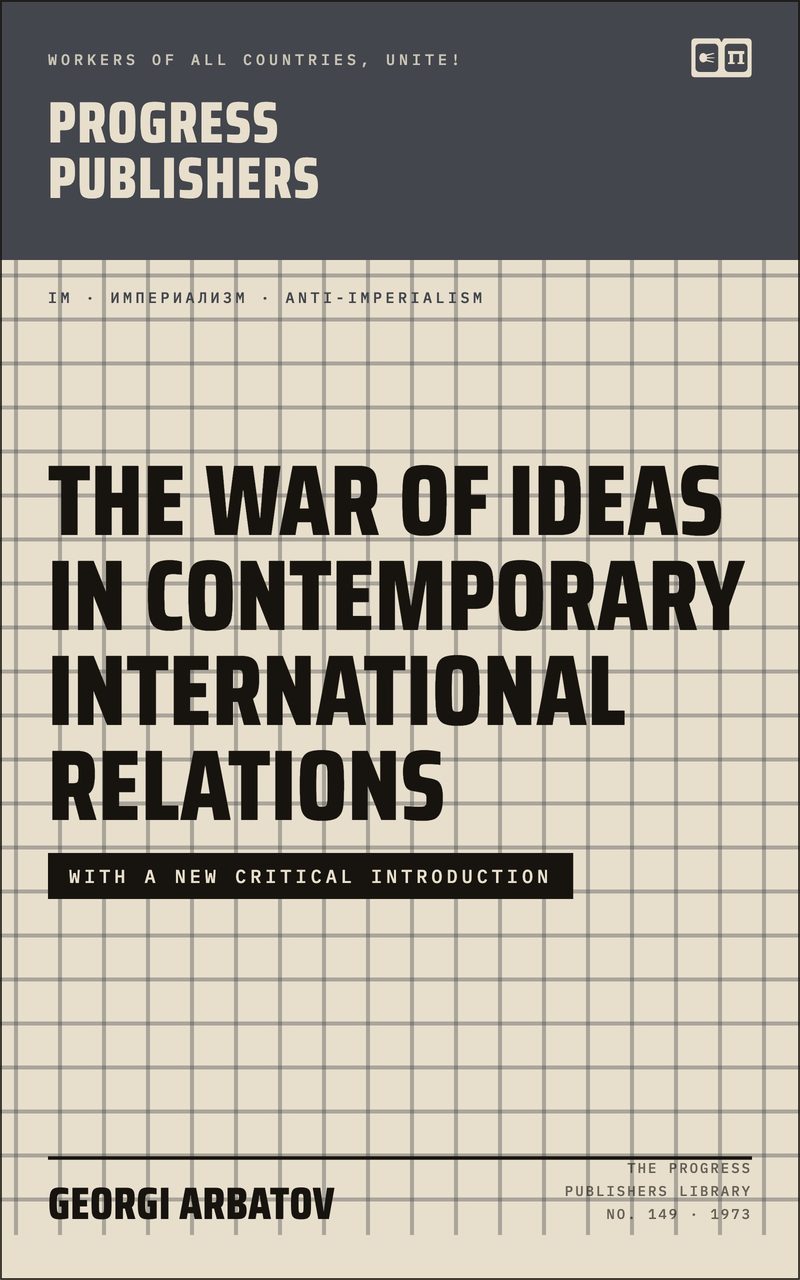
The War of Ideas in Contemporary International Relations
Buy
The critical introduction
Written for this edition and published free in Progress Quarterly, Volume III, Number 3.
Read it the whole numberOne section heading explains why this book is worth reading: peaceful coexistence, it argues, is not possible in ideology. That proposition was Soviet state doctrine at the exact moment the Soviet state was signing agreements with Richard Nixon, and Georgi Arbatov's task was to explain why the two were not in contradiction. He performs it with unusual clarity, and in doing so sets out more plainly than most Soviet writers dared what detente was permitted to cover and what it was not.
The volume tells you nothing about its author, which is part of the design. Arbatov had founded the Institute of the USA and Canada of the Academy of Sciences in 1967 and directed it for nearly thirty years; he sat on the Central Committee, advised Brezhnev and later Gorbachev, and was among the very few Soviet officials dealing continuously and directly with the American political establishment. A reader in 1973 would have had no way of knowing that the author of this paperback was one of the architects of the policy it defends.
Much of the scholarship holds. The chapter on the Western propaganda machine surveys real institutions doing real things, assembled from American and West German sources any reader could check: the Free Europe Committee and the fiction of its charitable funding, the scale of the Munich operation, Radio Liberty broadcasting in seventeen languages of the peoples of the USSR, and the Congress for Cultural Freedom as a deniable instrument of state.
The Russian edition closed in autumn 1970; the English carries a new author's note built around the Twenty-Fourth Congress and the Moscow summit.
Translated by David Skvirsky. New critical introduction by Dmitry Chasovennikov.
| Series | The Progress Publishers Library |
| First published | 1973 |
| ISBN | 978-5-01-900048-7 |
| Pages | 317 |
| Language | English |
| Subject | Anti-Imperialism |
| Introduction By | Dmitry Chasovennikov |
| Translator | David Skvirsky |