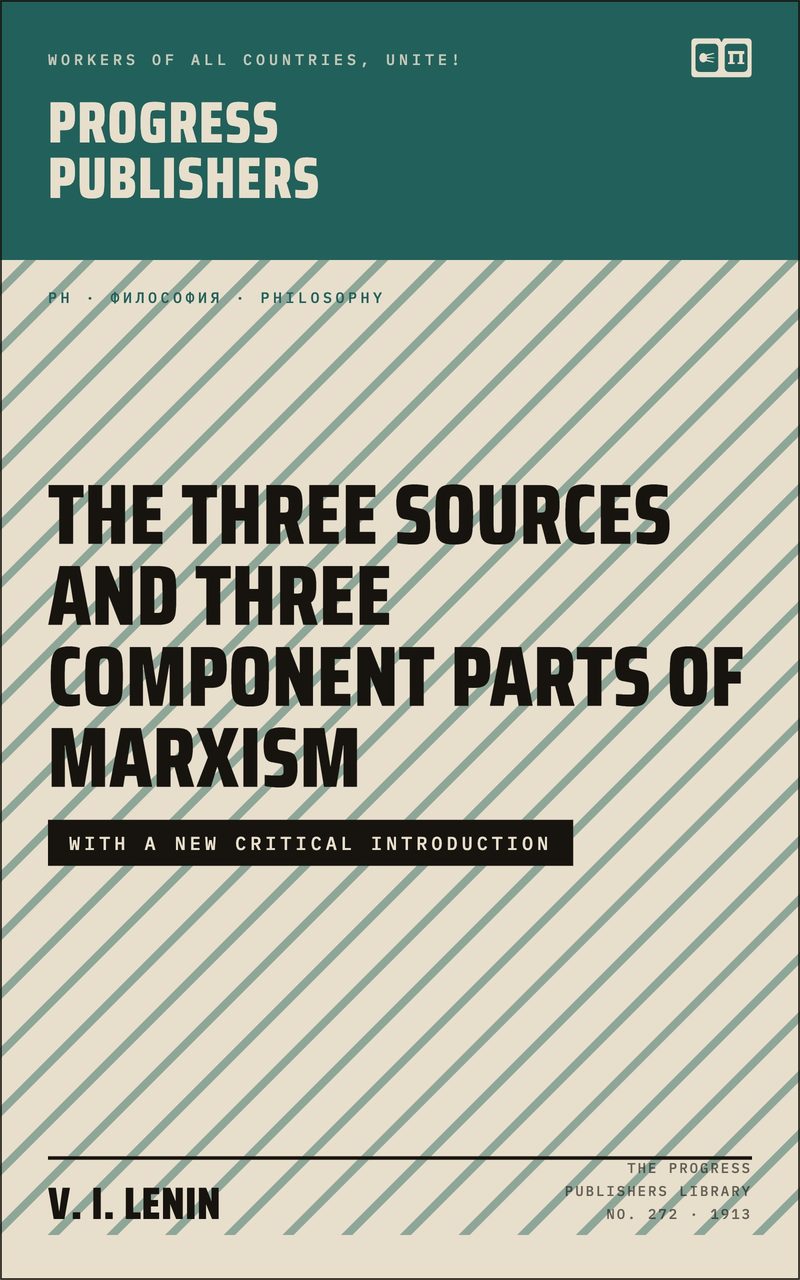
The Three Sources and Three Component Parts of Marxism
Buy
The critical introduction
Written for this edition and published free in Progress Quarterly, Volume I, Number 2.
Read it the whole numberLenin wrote this short article in the spring of 1913 for Prosveshcheniye - "Enlightenment", the Bolsheviks' legal theoretical monthly, published openly in St Petersburg under the eyes of the tsarist censor. March 1913 was the thirtieth anniversary of Marx's death, and the piece is a commemorative primer: a little under two thousand words meant to tell a worker-reader, plainly and quickly, what Marxism is and where it came from.
Its argument is announced in the title. Marxism has three sources and three component parts: German classical philosophy, English political economy and French socialism, which Marx transformed, respectively, into dialectical and historical materialism, the theory of surplus value, and the doctrine of the class struggle. The whole essay elaborates that single tripartite scheme, and it does it with a clarity that has made it, for a century, the first thing many readers were ever given on the subject.
It is not a treatise and should not be read as one. What survives the diagram is the claim underneath it: that Marxism is the "legitimate successor" to the best that philosophy, political economy and socialism had produced - an argument for keeping the doors open rather than bolting them, and for a doctrine that stays alive only so long as it remains the heir of the best thought of its time.
The text follows Collected Works Volume 19, translated from the Russian by George Hanna and edited by Robert Daglish.
New critical introduction by Dmitry Chasovennikov.
| Series | The Progress Publishers Library |
| First published | 1913 |
| ISBN | 978-5-01-900278-8 |
| Pages | 9 |
| Language | English |
| Subject | Philosophy |
| Introduction By | Dmitry Chasovennikov |
| Translator | George Hanna |