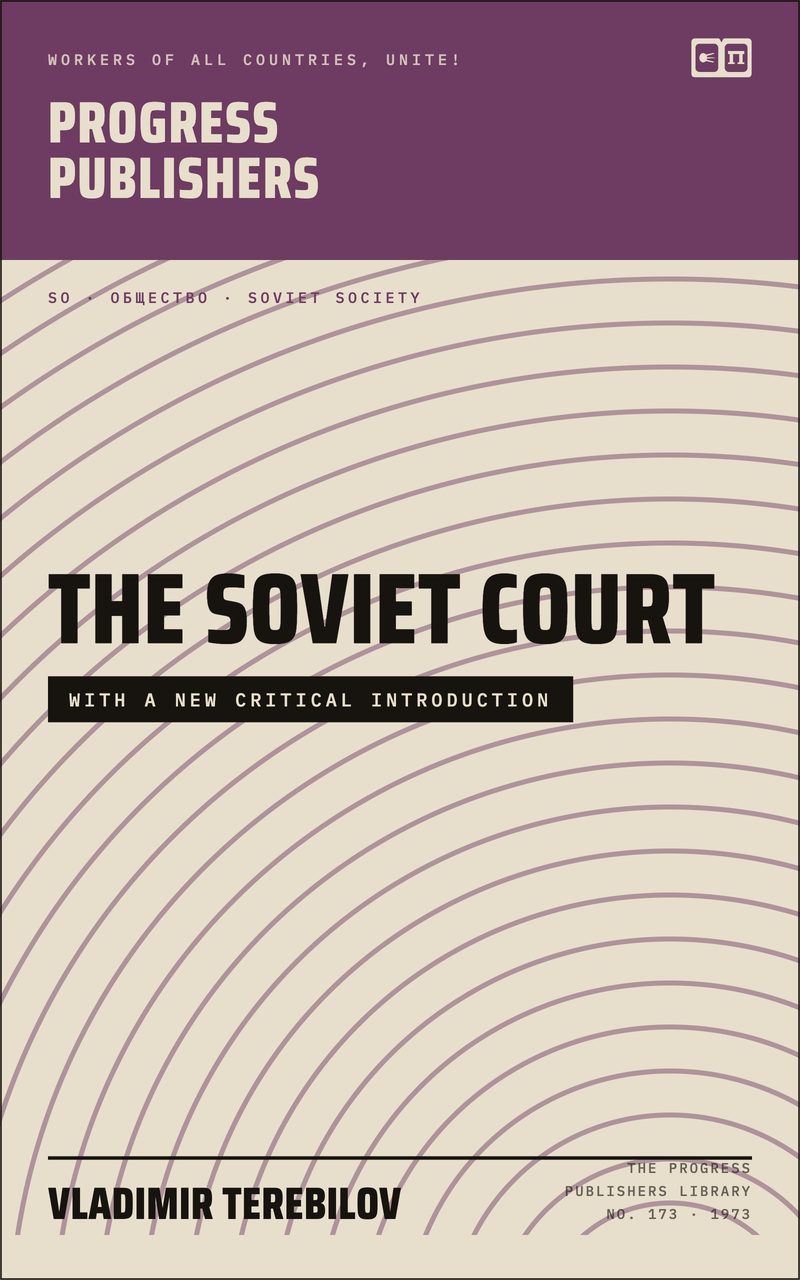
The Soviet Court
Buy
The critical introduction
Written for this edition and published free in Progress Quarterly, Volume III, Number 3.
Read it the whole numberMost books about a legal system are written by observers. This one was written by the man in charge of it.
Vladimir Terebilov - born in Petrograd in 1916, a law graduate of Leningrad University in 1939, a soldier through the siege, afterwards an official of the Procurator's Office and the Supreme Court - had been Minister of Justice of the USSR since 1970 when this appeared. He would hold the post until 1984 and then chair the Supreme Court of the USSR until 1989. This is not a study of the Soviet court. It is the ministry's account of itself, issued in English for readers who would never see a Soviet courtroom.
As such it is a genuinely useful document. It sets out the structure of the system in operating detail: the People's Courts and the election of people's judges and lay assessors, the regional and republican courts, the Supreme Court of the USSR and its supervisory powers, the Procuracy, the bar and the college of advocates, civil and criminal procedure, the comrades' courts and the people's volunteer squads. The back cover invites the reader to compare what is described against the Universal Declaration of Human Rights, which tells you exactly what the book was commissioned to answer.
Nothing else in English states the official position at this length or with this authority, and the authority is the point: this is not a scholar's reconstruction but the minister's own description of the machinery he ran.
Translated by Murad Saifulin.
New critical introduction by Dmitry Chasovennikov, on what a Minister of Justice writing in 1973 found it possible to say about the 1930s, and about the trials going on as the book went to press.
| Series | The Progress Publishers Library |
| First published | 1973 |
| ISBN | 978-5-01-900135-4 |
| Pages | 181 |
| Language | English |
| Subject | Soviet Society |
| Introduction By | Dmitry Chasovennikov |
| Translator | Murad Saifulin |