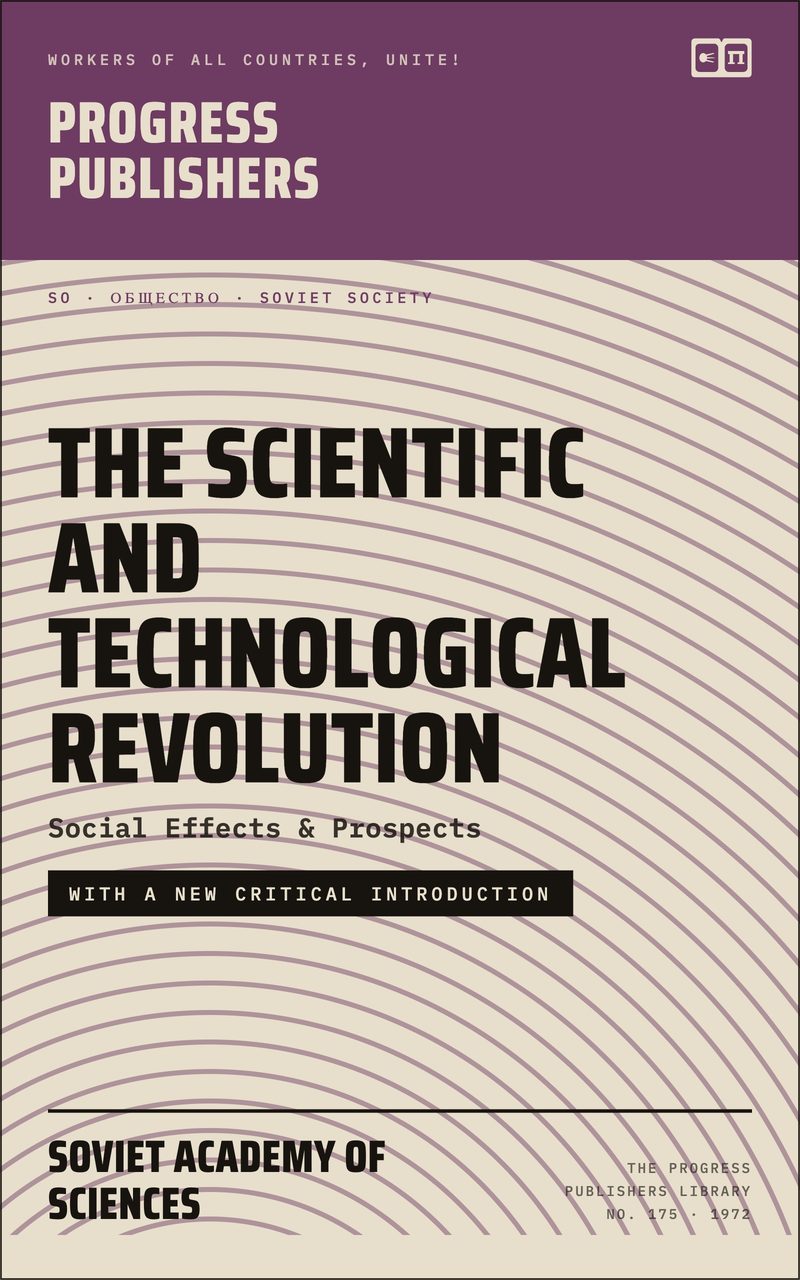
The Scientific and Technological Revolution
Social Effects and Prospects
Buy
The critical introduction
Written for this edition and published free in Progress Quarterly, Volume III, Number 2.
Read it the whole numberThe Soviet Union announcing, in sixteen voices, that it had understood the future better than the country that was building it.
The subject is the scientific and technological revolution - the NTR, the flagship concept of Soviet ideology in the 1970s - and the claim that its social benefits could be gathered in fully only under socialism. The contributors are not obscure. The opening chapter is by M. Millionshchikov, vice-president of the USSR Academy of Sciences. N. Semyonov, a Nobel laureate in chemistry, writes on dialectics and scientific discovery. The chapter on planning is by N. Baibakov, chairman of the State Planning Committee - the man who actually ran the Soviet economy, writing in defence of the way he ran it. Around them are economists, philosophers and sociologists of rank, arguing a single thesis from a dozen angles, with several chapters given to the effects of the revolution on capitalist society and the developing countries, and to a critique of Western theories of convergence and of Marcuse.
For once the spine tells the truth. The horizon closes at the Twenty-Fourth Congress of March-April 1971 and the Ninth Five-Year Plan adopted there, quoted as the newest word. The animating formula is Brezhnev's own charge to that congress: to fuse the achievements of the scientific and technical revolution with the advantages of the socialist economic system. That sentence is the commission, and this book is its elaboration for export.
Prepared jointly by the Academy of Sciences editorial board of Social Sciences Today and Progress Publishers. Edited by Robert Daglish.
New critical introduction by Dmitry Chasovennikov.
| Series | The Progress Publishers Library |
| First published | 1972 |
| ISBN | 978-5-01-900163-7 |
| Pages | 278 |
| Language | English |
| Subject | Soviet Society |
| Introduction By | Dmitry Chasovennikov |