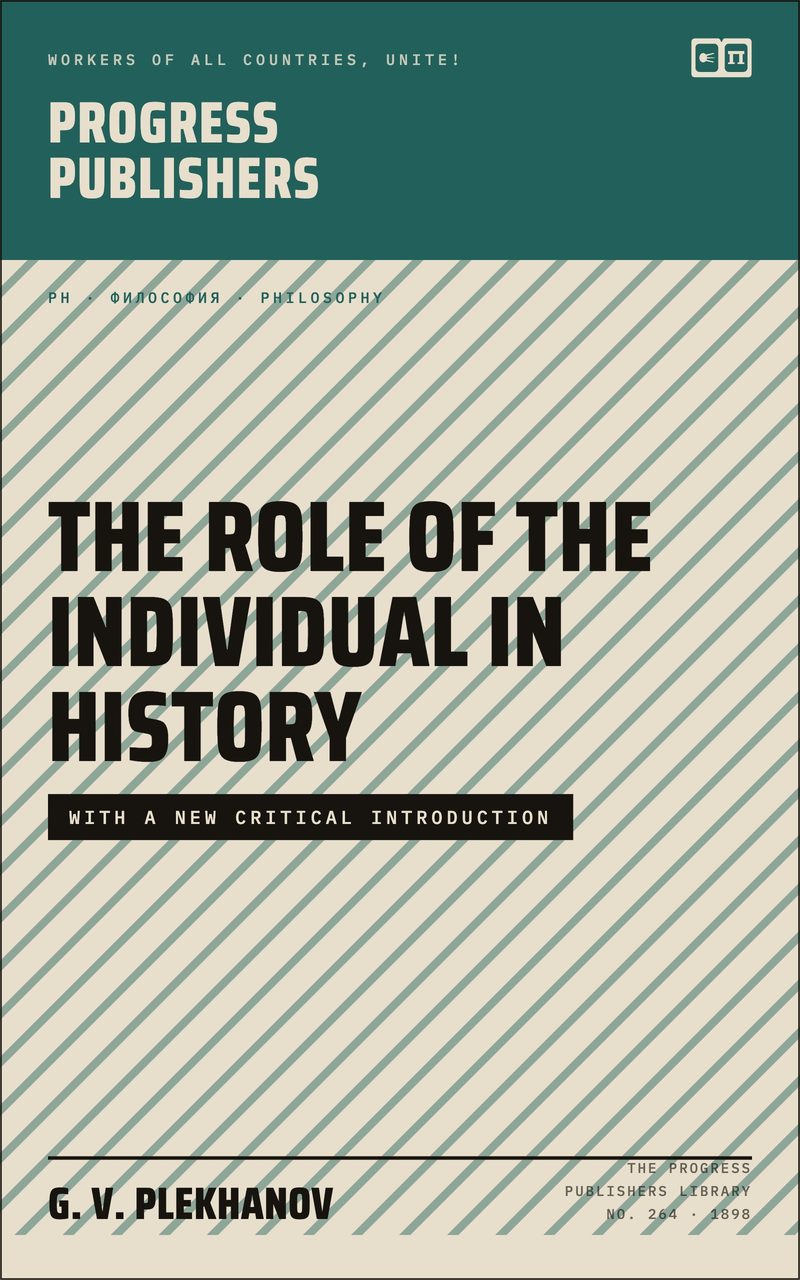
The Role of the Individual in History
Buy
The critical introduction
Written for this edition and published free in Progress Quarterly, Volume VI, Number 4.
Read it the whole numberPlekhanov's answer to a question the Populist subjectivists had botched and their positivist opponents had answered by abolishing it: if history is governed by law, what is left for the great man to do?
He refuses both exits. Against the subjectivists, who made critically thinking individuals a free-standing force pulling history along, and against the mechanists who reduced the individual to a negligible quantity, he argues that the great man is great because he possesses qualities making him the most capable of serving the great social needs of his time - needs created by general causes he did not make. Circumstances determine what can be done; the individual determines much about how, when, and at what cost.
The essay is short, lucid and unusually well furnished with examples, ranging across the French Revolution, Napoleon, Peter the Great and the accidents of battle, and it remains the clearest statement of the problem in the Marxist tradition.
It is also the piece by which Plekhanov is best known in English, and the reason he was called the father of Russian Marxism: whatever became of his politics after 1903, the philosophical work stood, and Lenin insisted it be republished and studied.
Written in 1898.
New critical introduction by Dmitry Chasovennikov.
| Series | The Progress Publishers Library |
| First published | 1898 |
| ISBN | 978-5-01-900279-5 |
| Pages | 52 |
| Language | English |
| Subject | Philosophy |
| Introduction By | Dmitry Chasovennikov |
| Translator | Julius Katzer |