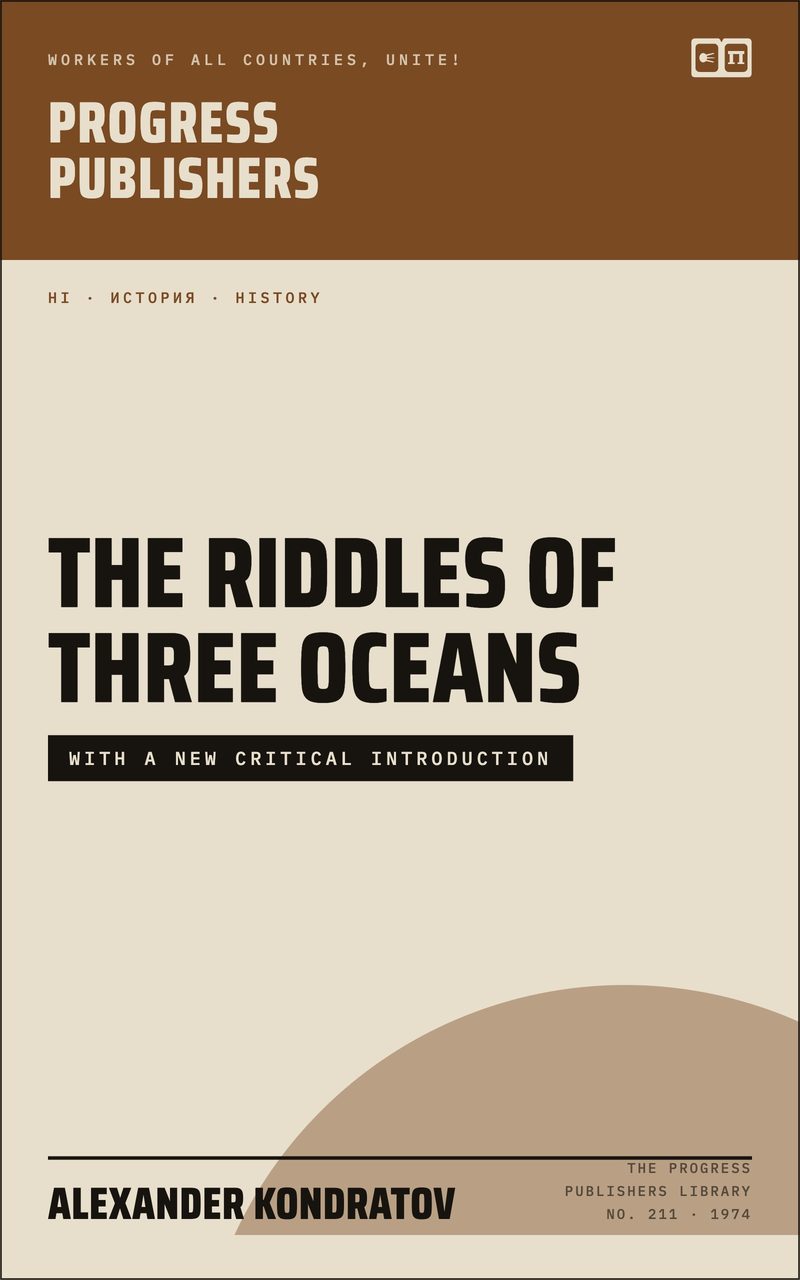
The Riddles of Three Oceans
Buy
The critical introduction
Written for this edition and published free in Progress Quarterly, Volume IV, Number 1.
Read it the whole numberSix hundred stone giants stand on a treeless speck of the South Pacific smaller than many airfields, some twenty metres tall, crowned with cylinders of red rock weighing thirty tons, carved and hauled and raised by a people who had no metal, no draught animals and no hoists. Nobody can read the wooden tablets they left behind.
That is where this book opens, and the question Alexander Kondratov builds it around is the one Easter Island has always provoked: how did so much civilisation come to rest on so little land? Could there have been more land once - a Pacific continent, now on the ocean floor, of which the island is a surviving crumb? From there the book fans out across all three great oceans and every science that might bear on the problem: geology, oceanography, archaeology, comparative linguistics, and the study of where animals and plants are found and how they got there.
It is, at bottom, a book about lost continents - Atlantis, Lemuria, a sunken Pacific land - written by a man determined to treat them as scientific problems rather than romances. Kondratov was a Leningrad linguist and biologist who had worked on the computer-assisted decipherment of ancient scripts, including the writing of the Indus Valley, and the long central section on the Dravidian problem and the fall of Mohenjo-Daro is written from inside that work rather than cribbed from it.
The foreword is by Stanislav Kalesnik, long the president of the Geographical Society of the USSR, and it makes a promise the book keeps: the author does not try to impose his hypotheses on the reader.
Translated by Leonard Stoklitsky. New critical introduction by Dmitry Chasovennikov.
| Series | The Progress Publishers Library |
| First published | 1974 |
| ISBN | 978-5-01-900155-2 |
| Pages | 267 |
| Language | English |
| Subject | History |
| Introduction By | Dmitry Chasovennikov |
| Translator | Leonard Stoklitsky |