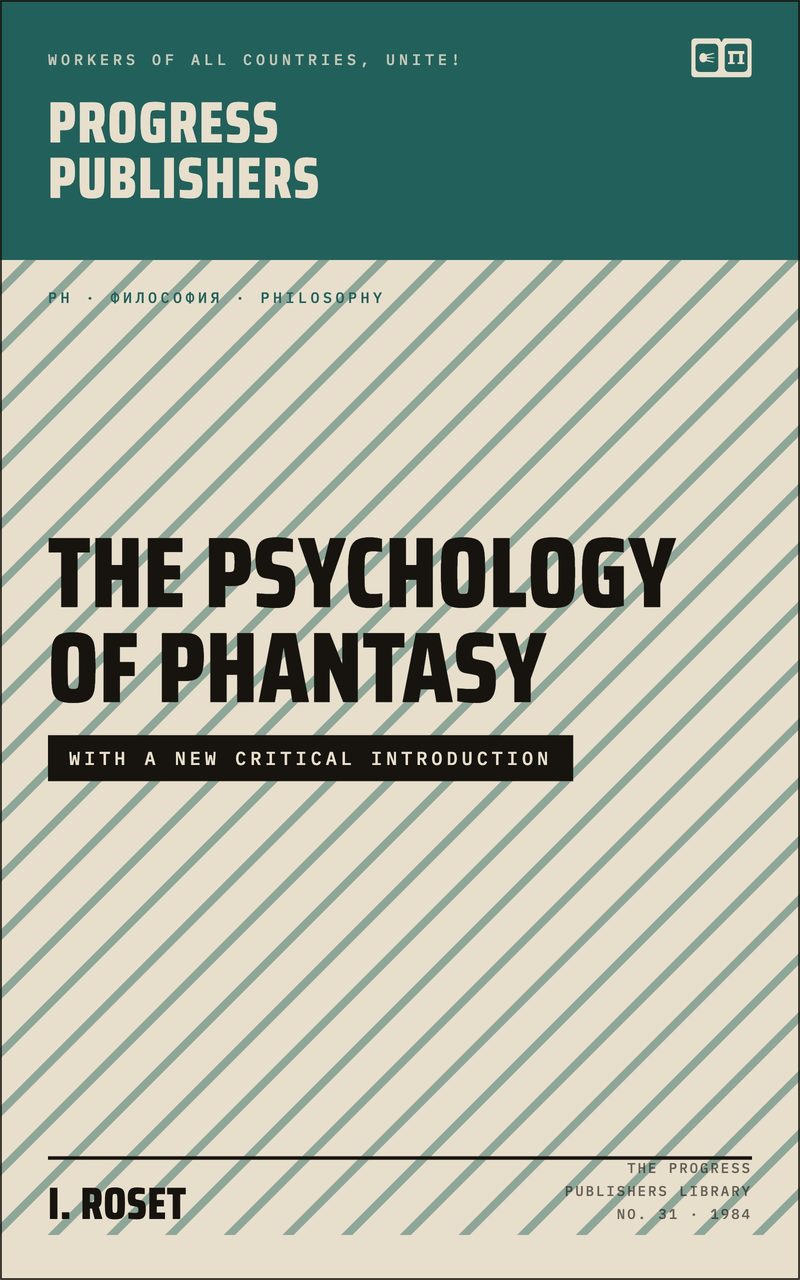
The Psychology of Phantasy
Buy
The critical introduction
Written for this edition and published free in Progress Quarterly, Volume VIII, Number 1.
Read it the whole numberThe title needs translating before the book can be read. Phantasy here has nothing to do with fairies or escapism: it is a stiff rendering of the Russian fantaziya, which means simply the imagination.
Roset's subject is the creative act - the mental operation by which a person produces something that was not there before: a new image, an unforeseen solution, a metaphor, a scientific hypothesis, a child's invented word. Read the title as The Psychology of Imagination and the book comes into focus as what it is, a full-dress scientific monograph on how invention actually works.
He was a working academic psychologist rather than an apparatus functionary, publishing through Byelorussian and all-Union scientific channels, and the book carries a bibliography of nearly three hundred items, the great majority of them Western. He is well read in the creativity research of the 1950s to 1970s and sharp about its weaknesses, describing that boom as already spent and dissipated into a saturated market of recipes for stimulating creativity.
There is no politics in it at all - no congress, no five-year plan, no living Soviet name. Its date shows only in the age of its sources and in the Cold War geometry of its argument about where imagination is free and where it is not.
A manuscript of the late 1970s in a 1984 jacket: the bibliography thins in the early seventies and effectively stops at 1979.
New critical introduction by Dmitry Chasovennikov.
| Series | The Progress Publishers Library |
| First published | 1984 |
| ISBN | 978-5-01-900063-0 |
| Pages | 246 |
| Language | English |
| Subject | Philosophy |
| Introduction By | Dmitry Chasovennikov |
| Translator | Sergei Savchenko |
| Translator | Alexander Parnakh |