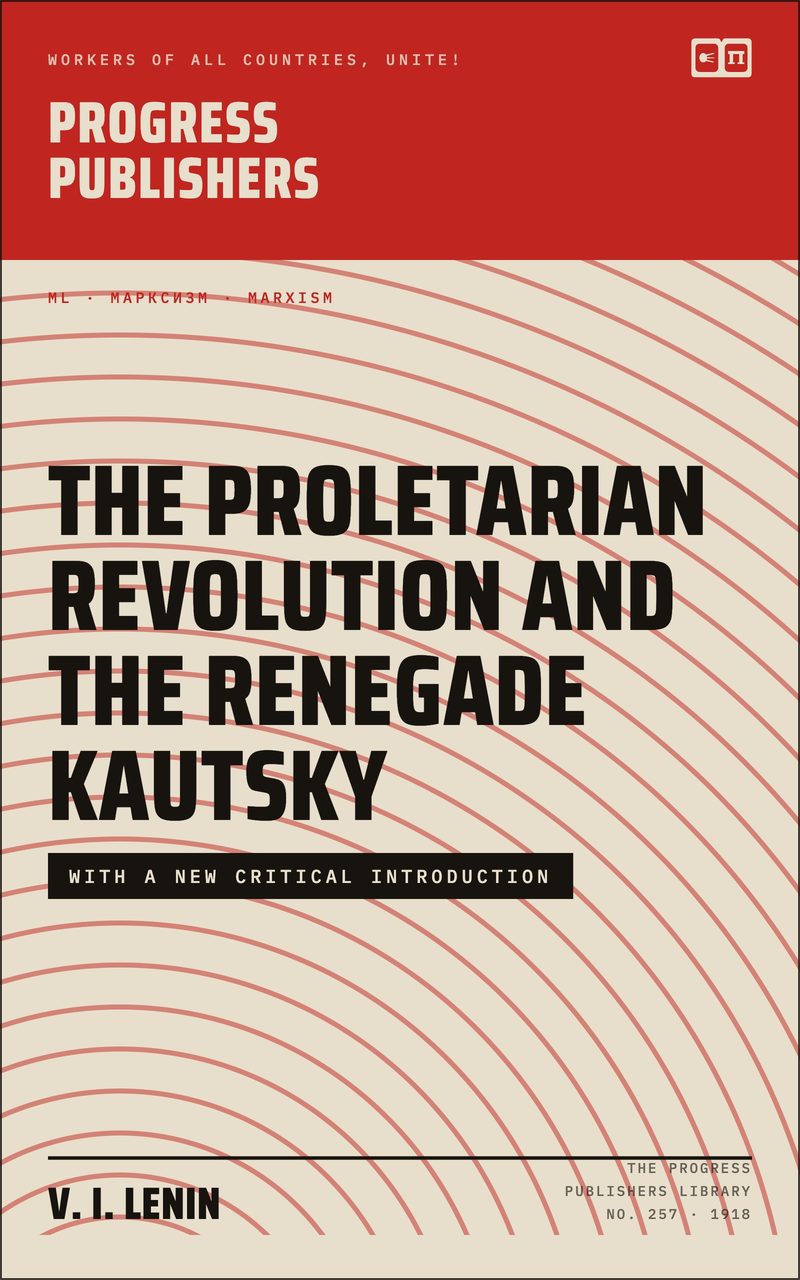
The Proletarian Revolution and the Renegade Kautsky
Buy
The critical introduction
Written for this edition and published free in Progress Quarterly, Volume VIII, Number 4.
Read it the whole numberA book written in anger, and the anger was earned.
Lenin composed it in October and November 1918, in the worst months of the civil war, with a Socialist-Revolutionary's bullets still lodged in his body - Fanny Kaplan had shot him on 30 August - while the young Soviet republic fought for its life against White armies, famine and the intervention of a dozen foreign states. He wrote it after reading Karl Kautsky's pamphlet on the dictatorship of the proletariat, which charged the Bolsheviks with strangling democracy in the name of socialism.
Kautsky had been for a generation the Pope of Marxism, the guardian of the doctrine after Engels's death. In August 1914 that authority collapsed: the German Social-Democratic Party voted the Kaiser his war credits, and Kautsky supplied the theology for the surrender. To Lenin he was a renegade, and when the deserter began lecturing the republic that had actually made a revolution, Lenin answered with the whole weight of Marx behind him.
The answer holds up on its central point. Kautsky's master-category of pure democracy is a fiction: democracy always has a class content, and the parliamentary republic he idealised is, for the propertyless, formally equal and materially rigged at every turn by money, the press and the courts.
Translated by Jim Riordan.
New critical introduction by Dmitry Chasovennikov.
| Series | The Progress Publishers Library |
| First published | 1918 |
| ISBN | 978-5-01-900290-0 |
| Pages | 117 |
| Language | English |
| Subject | Marxism |
| Introduction By | Dmitry Chasovennikov |
| Translator | Jim Riordan |