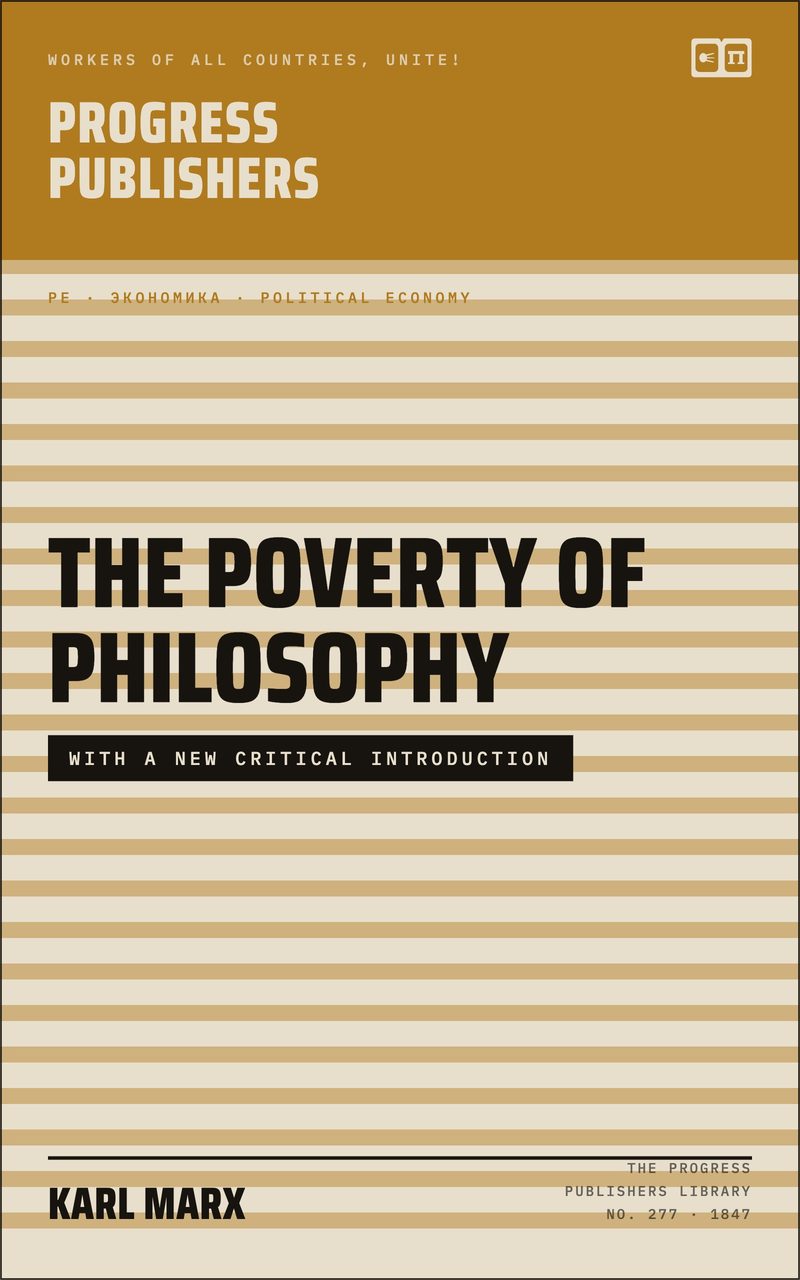
The Poverty of Philosophy
Buy
The critical introduction
Written for this edition and published free in Progress Quarterly, Volume I, Number 1.
Read it the whole numberMarx wrote this book in French, in a hurry, and in anger. In 1846 Pierre-Joseph Proudhon - the most famous socialist in France, the man who had declared that property was theft - published a fat two-volume work called The System of Economic Contradictions, or the Philosophy of Poverty. Marx read it, decided it was a disaster dressed up as a discovery, and answered it the next winter with a book whose title simply turned Proudhon's upside down. It came out in Brussels and Paris in July 1847, was never reprinted in French in Marx's lifetime, and was for decades among the least read things he wrote. It is also, as Engels kept insisting, the place where the mature Marx first shows his face in public - a year before the Communist Manifesto, and twenty years before Capital.
What the book does supremely is method, and the method is stated in a single sentence that has never been bettered. Against Proudhon, who treated the categories of economics as eternal ideas descending in a Hegelian order, Marx puts the categories back on the ground they grew from. "The hand-mill gives you society with the feudal lord; the steam-mill, society with the industrial capitalist," he writes, and then draws the general conclusion: "The same men who establish their social relations in conformity with their material productivity, produce also principles, ideas and categories, in conformity with their social relations. Thus these ideas, these categories, are as little eternal as the relations they express. They are historical and transitory products." That is the materialist conception of history three years before Marx would use the phrase, delivered as a hammer-blow in the middle of a book review.
This is the Moscow text: the Progress Publishers edition, made from the French of 1847 with the corrections Marx pencilled into a copy in 1876 and the further corrections Engels made for the first German edition of 1885, for which he also wrote the two prefaces printed here. Around the two chapters it gathers Marx's own foreword and four appendices - the letter to Annenkov of December 1846, which sketches the whole argument in advance; the 1865 letter to Schweitzer taking the measure of Proudhon after his death; an excerpt from A Contribution to the Critique of Political Economy; and the 1848 Brussels speech On the Question of Free Trade.
New critical introduction by Dmitry Chasovennikov.
| Series | The Progress Publishers Library |
| First published | 1847 |
| ISBN | 978-5-01-900265-8 |
| Pages | 213 |
| Language | English |
| Subject | Political Economy |
| Introduction By | Dmitry Chasovennikov |