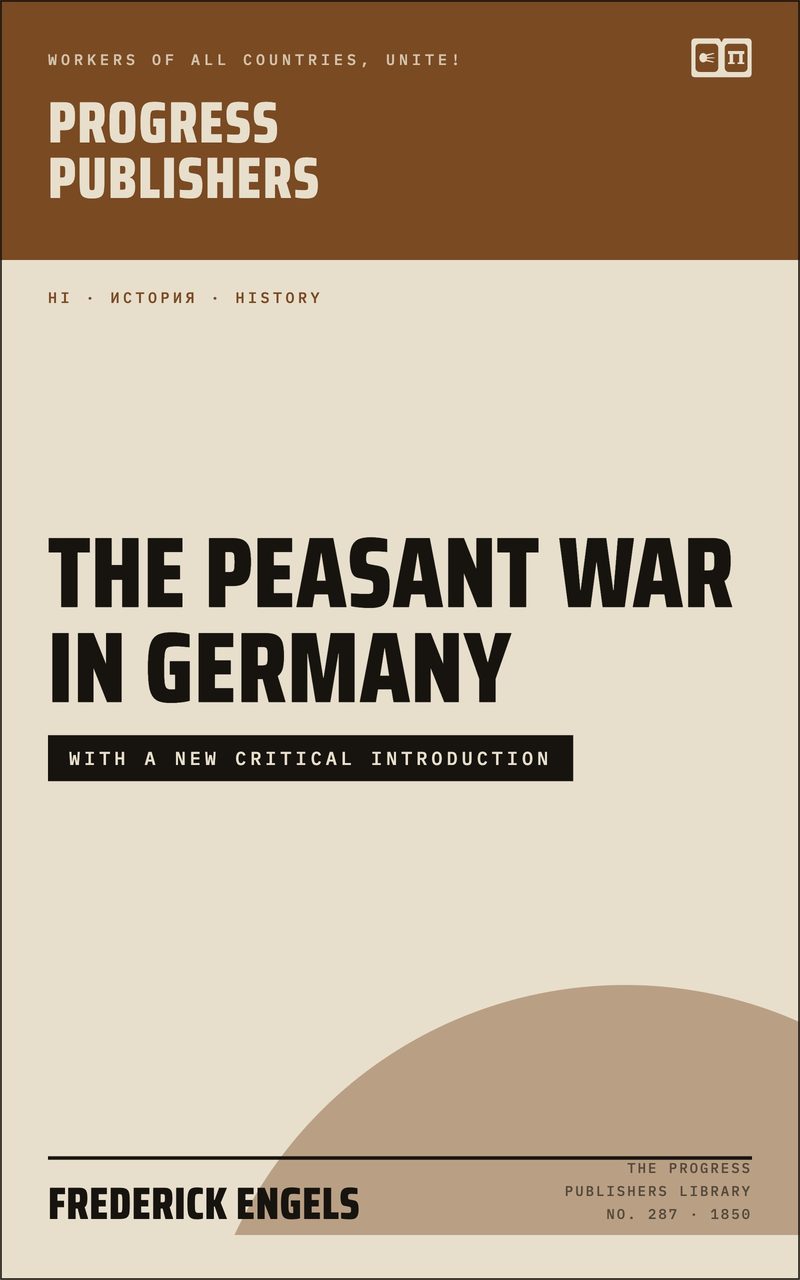
The Peasant War in Germany
Buy
The critical introduction
Written for this edition and published free in Progress Quarterly, Volume I, Number 1.
Read it the whole numberEngels wrote The Peasant War in Germany in London in the summer of 1850 - "while still under the immediate impression of the counter-revolution just then completed", as his preface puts it - with the wounds of the defeated revolution of 1848-49 still open. It is a short, fierce book about a distant event: the great rising of German peasants and plebeians in 1525, which Marx had called "the most radical fact of German history".
What it does supremely well is to read a war fought under religious banners as a war between classes. To the "home-bred historians" Engels mocks, the Reformation was so much "violent theological bickering"; he shows that behind Luther, behind Thomas Muenzer and his millenarian communism, behind the princes and the timid town burghers, stood the hard material interests of a society straining out of feudalism. He sorts the confusion of the age into three great camps - the Catholic reaction, the moderate Lutheran burghers who wanted reform without revolution, and the revolutionary party of peasants and plebeians - and around "the magnificent figure of Thomas Muenzer" he builds a tragedy: the revolutionary who saw further than his class or his century and was broken for it.
From Muenzer's ruin he draws a political lesson of permanent clarity, and it is one of the great sentences of the socialist tradition: "The worst thing that can befall a leader of an extreme party is to be compelled to take over a government in an epoch when the movement is not yet ripe for the domination of the class which he represents."
Engels leaned on the liberal historian Wilhelm Zimmermann for his facts and said so; his originality lay not in the archive but in the reading of it. This edition - Foreign Languages Publishing House, Moscow, 1956, the house that would shortly become Progress Publishers - carries his 1870 preface for the book edition and the long 1874 supplement on the German workers' movement of his own day, so the reader watches Engels both make the argument and, twenty years on, temper it.
New critical introduction by Dmitry Chasovennikov.
| Series | The Progress Publishers Library |
| First published | 1850 |
| ISBN | 978-5-01-900249-8 |
| Pages | 215 |
| Language | English |
| Subject | History |
| Introduction By | Dmitry Chasovennikov |