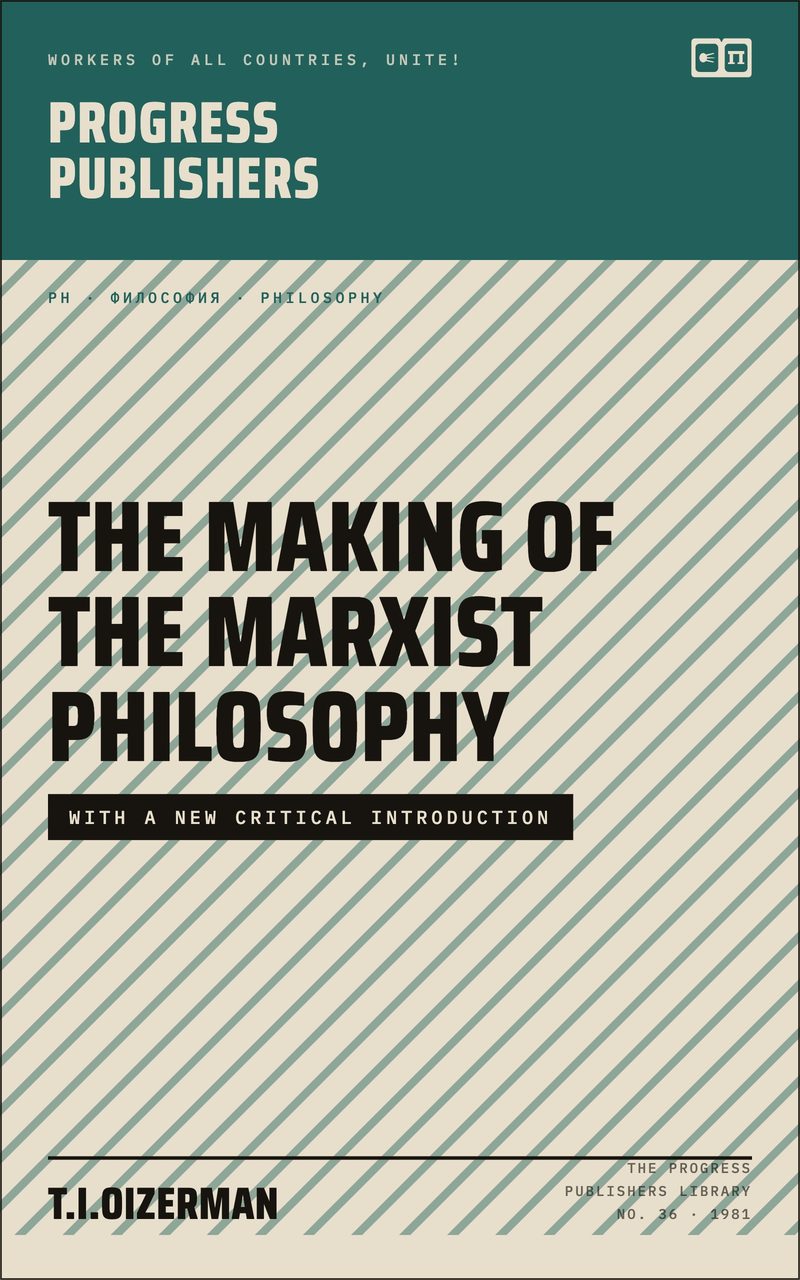
The Making of the Marxist Philosophy
Buy
The critical introduction
Written for this edition and published free in Progress Quarterly, Volume VII, Number 1.
Read it the whole numberA hundred and eighty-five thousand words of close reading on how Marx and Engels became Marx and Engels between 1835 and 1848.
Teodor Oizerman (1914-2017) worked at the Institute of Philosophy, became a full Academician, and was among the best-informed people alive on the formation of Marx's thought. He outlived the Soviet state by twenty-six years and used the time to revise in public a good deal of what he had defended inside it.
The book follows the documents in order: the school essays, the letter to his father of November 1837, the doctoral dissertation on Democritus and Epicurus, the Rheinische Zeitung articles, the Kreuznach notebooks, the Deutsch-Franzosische Jahrbucher, the 1844 Manuscripts, The Holy Family, the Theses on Feuerbach, The German Ideology, The Poverty of Philosophy and the Manifesto. It is philology as much as philosophy, and it is the fullest Soviet treatment of the early Marx in English.
The subject is one of the very few in Soviet philosophy where the thaw genuinely opened something, because the archive was opening at the same time - the new Russian and German editions, the Grundrisse, the fresh text of The German Ideology, and behind all of it the 1844 Manuscripts, in print since 1932 and the property of everybody except the Soviet philosophical establishment for thirty years.
A note on dating: Oizerman says in his first sentence that the first edition appeared in 1962. This is the second Russian edition, whose scholarship stops in the early 1970s, reaching English readers a decade later.
New critical introduction by Dmitry Chasovennikov.
| Series | The Progress Publishers Library |
| First published | 1981 |
| ISBN | 978-5-01-900130-9 |
| Pages | 495 |
| Language | English |
| Subject | Philosophy |
| Introduction By | Dmitry Chasovennikov |
| Translator | Yuri Sdobnikov |