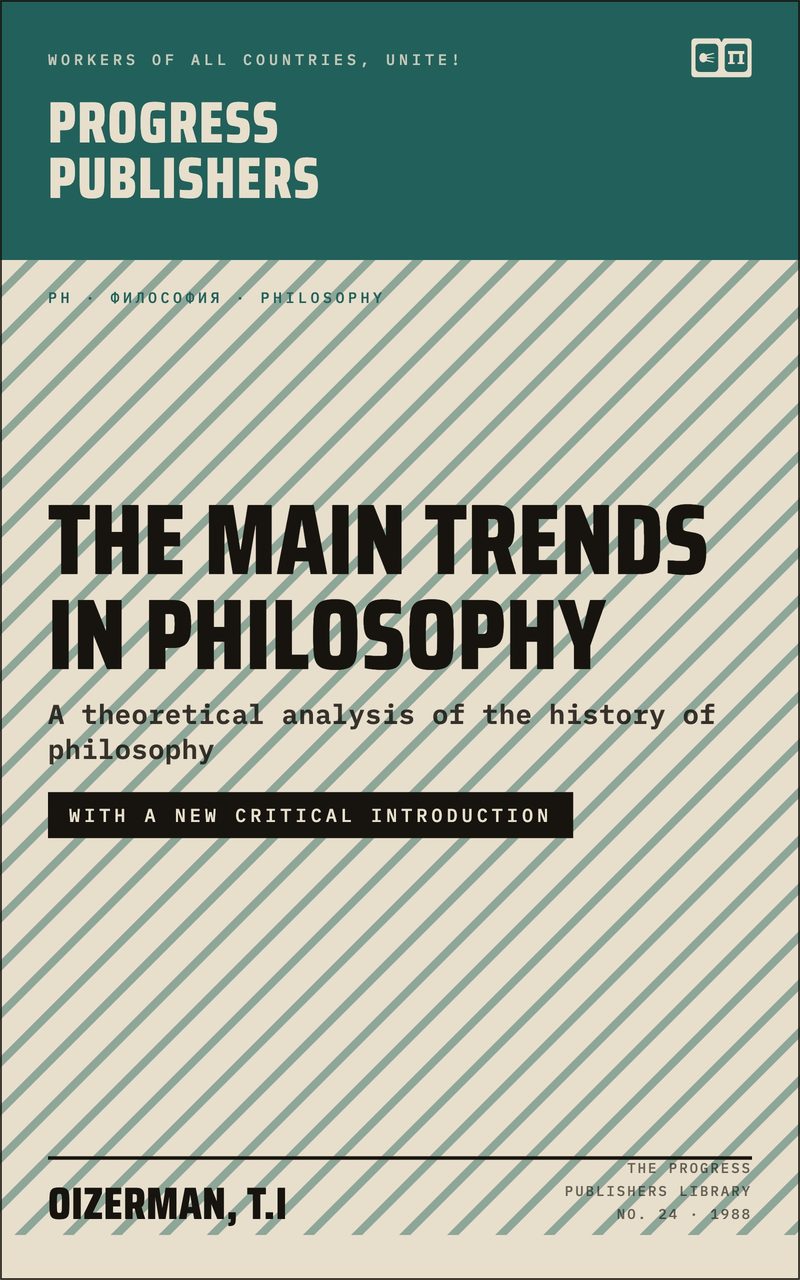
The Main Trends in Philosophy
A theoretical analysis of the history of philosophy
Buy
The critical introduction
Written for this edition and published free in Progress Quarterly, Volume IX, Number 2.
Read it the whole numberMost books on this list were written to be believed. This one was written to be argued with.
Oizerman's thesis is that the division of philosophy into materialism and idealism is not a classificatory convenience imposed by commentators but the real structural fact about the discipline, and that the basic philosophical question - whether nature or spirit is primary - is what generates that division.
Around it he builds a taxonomy of doctrines, schools, currents and trends; a long treatment of scepticism running from Diogenes Laertius to the logical positivists; extended readings of Kant, Hegel, Spinoza and Leibniz; and a running polemic against Husserl, Heidegger, Jaspers, Sartre, Carnap, Russell, Popper and the Yugoslav praxis philosopher Gajo Petrovic. The bibliography runs to 283 numbered items in four languages.
Whatever else it is, it is a book: written by one person, with a case to make, by a man who spent his professional life doing the history of philosophy and who outlived the Soviet state by twenty-six years.
For once the spine is close to right. Oizerman cites the Party programme in its 1986 new edition, a Progress volume of Marx and Engels from the same year, and his own recent book, so the text cannot predate 1986 - though it reads as if finished before the thaw touched it, with no Gorbachev, no perestroika and none of the new vocabulary then rewriting Soviet public language.
New critical introduction by Dmitry Chasovennikov.
| Series | The Progress Publishers Library |
| First published | 1988 |
| ISBN | 978-5-01-900102-6 |
| Pages | 323 |
| Language | English |
| Subject | Philosophy |
| Introduction By | Dmitry Chasovennikov |
| Translator | H. Campbell Creighton |