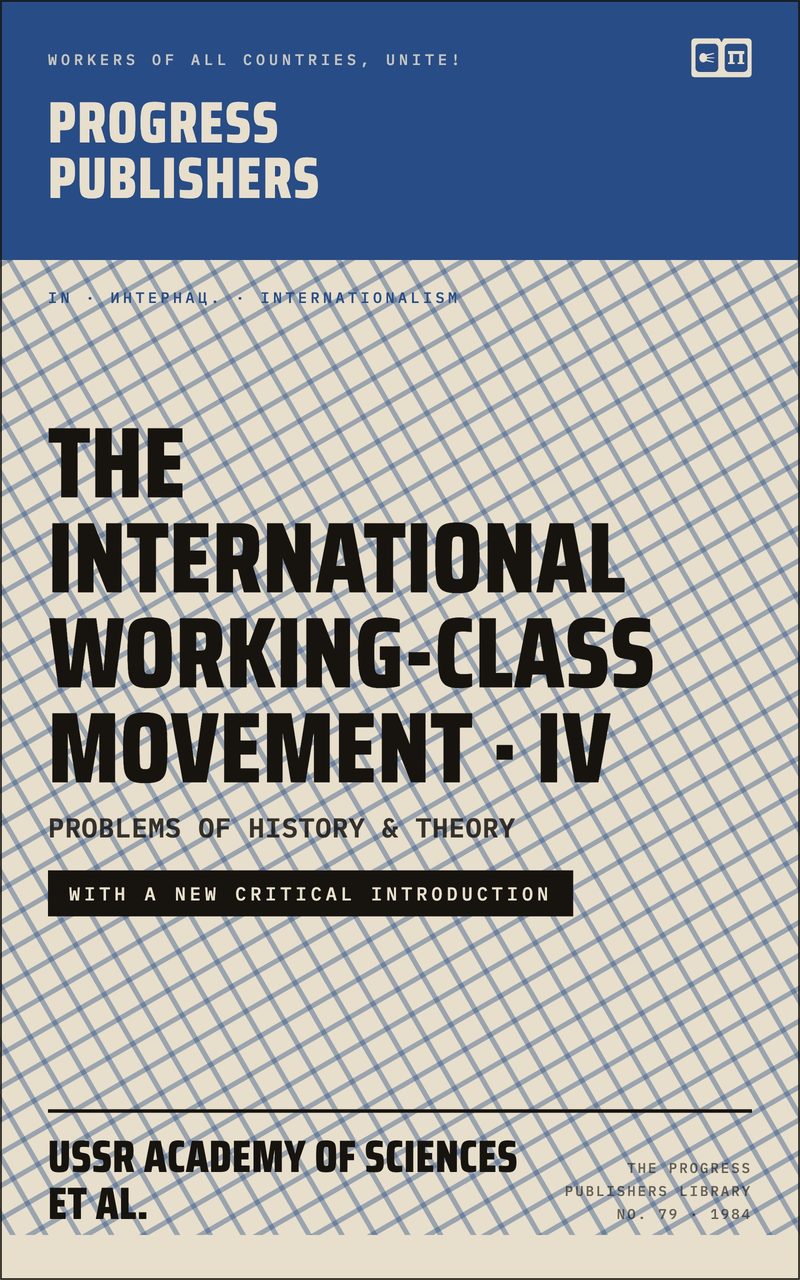
The International Working-Class Movement
Problems of History and Theory, Volume 4
Buy
The critical introduction
Written for this edition and published free in Progress Quarterly, Volume VIII, Number 2.
Read it the whole numberThe volume that covers the years its own tradition found hardest to narrate.
Volume Four takes the story from the October insurrection of 1917 to the collapse of the European revolutionary wave in 1923: the Russian Revolution, Brest-Litovsk, the civil war, the founding of the Communist International, the revolutions in Germany, Austria, Hungary and Finland, Kronstadt, the trade-union controversy and the New Economic Policy.
It is a large collective work prepared under the Academy of Sciences by several dozen named historians, each holding a candidate's or doctor's degree, with contributors listed chapter by chapter under an editorial board headed by V. V. Zagladin. On the German November revolution, the Hungarian Soviet republic, the Finnish civil war and the first four congresses of the Comintern it assembles more detail than any comparable English-language account.
It is also the volume where the series' method is most exposed, because across almost all of these years Trotsky was chairman of the Petrograd Soviet, People's Commissar for Foreign Affairs and then for Military and Naval Affairs, the negotiator at Brest and the builder of the Red Army whose war the book narrates over three hundred pages. Unlike the volume on 1905-17, this one cannot simply omit him. It has to decide, event by event, which Trotsky to admit.
The Russian text closed in 1980 and reached English readers four years later unaltered: Brezhnev is the freshest political horizon, and the Twenty-Sixth Congress of 1981 is nowhere in it.
Volume Four.
New critical introduction by Dmitry Chasovennikov.
| Series | The Progress Publishers Library |
| First published | 1984 |
| ISBN | 978-5-01-900149-1 |
| Pages | 750 |
| Language | English |
| Subject | Internationalism |
| Introduction By | Dmitry Chasovennikov |