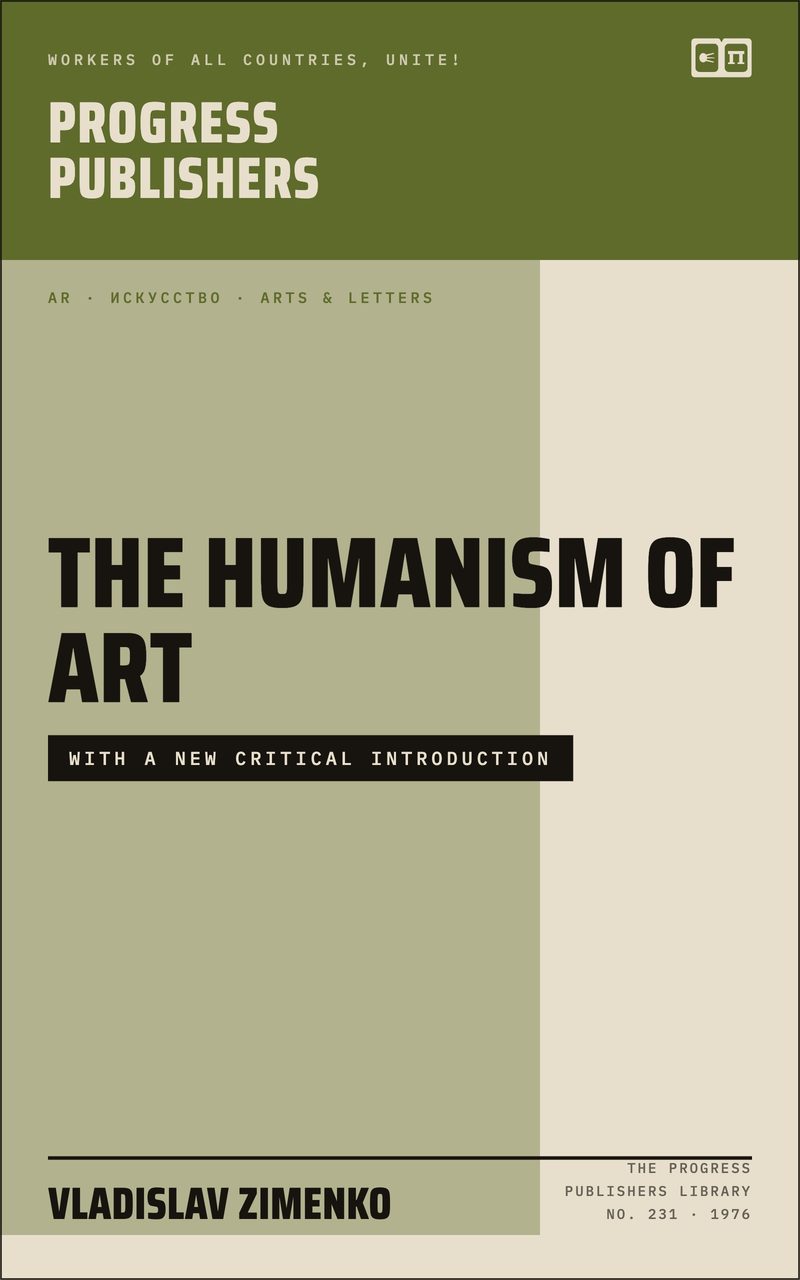
The Humanism of Art
Buy
The critical introduction
Written for this edition and published free in Progress Quarterly, Volume V, Number 1.
Read it the whole numberThe other volumes on aesthetics in this series argue about literature. This one is about painting, and that changes the ground under the whole argument.
When Vladislav Zimenko writes about the humanism of art he means pictures in the first place - Deyneka's parachutists and steel-workers, Plastov's villages, Saryan's Armenia, Korzhev's severe faces. He was editor-in-chief of Iskusstvo, the flagship journal of the Union of Artists' establishment, which makes this the case for the defence written by a man near the centre of the apparatus that decided what Soviet painting was allowed to be.
The argument is a real one and deserves to be met. His target is not a phantom: it is the modernist elevation of the difficult, the private and the illegible over the human and the shared. He quotes Ortega y Gasset's The Dehumanisation of Art accurately and fights it on its merits, and his objection - that art turning its back on the mass of human beings, and on the possibility of being understood by them, has given up something that matters - has a long and respectable history that is not only Soviet. John Berger, from an entirely different politics in the same decade, thought so too.
And Zimenko reads pictures with attention and sometimes with feeling. He is good on Delacroix's Liberty Leading the People, good on Deyneka, and he traces a line of social humanism through Egyptian sculpture, the Renaissance, Rembrandt and Repin.
New critical introduction by Dmitry Chasovennikov.
| Series | The Progress Publishers Library |
| First published | 1976 |
| ISBN | 978-5-01-900182-8 |
| Pages | 242 |
| Language | English |
| Subject | Arts & Letters |
| Introduction By | Dmitry Chasovennikov |
| Translator | Brian Bean |