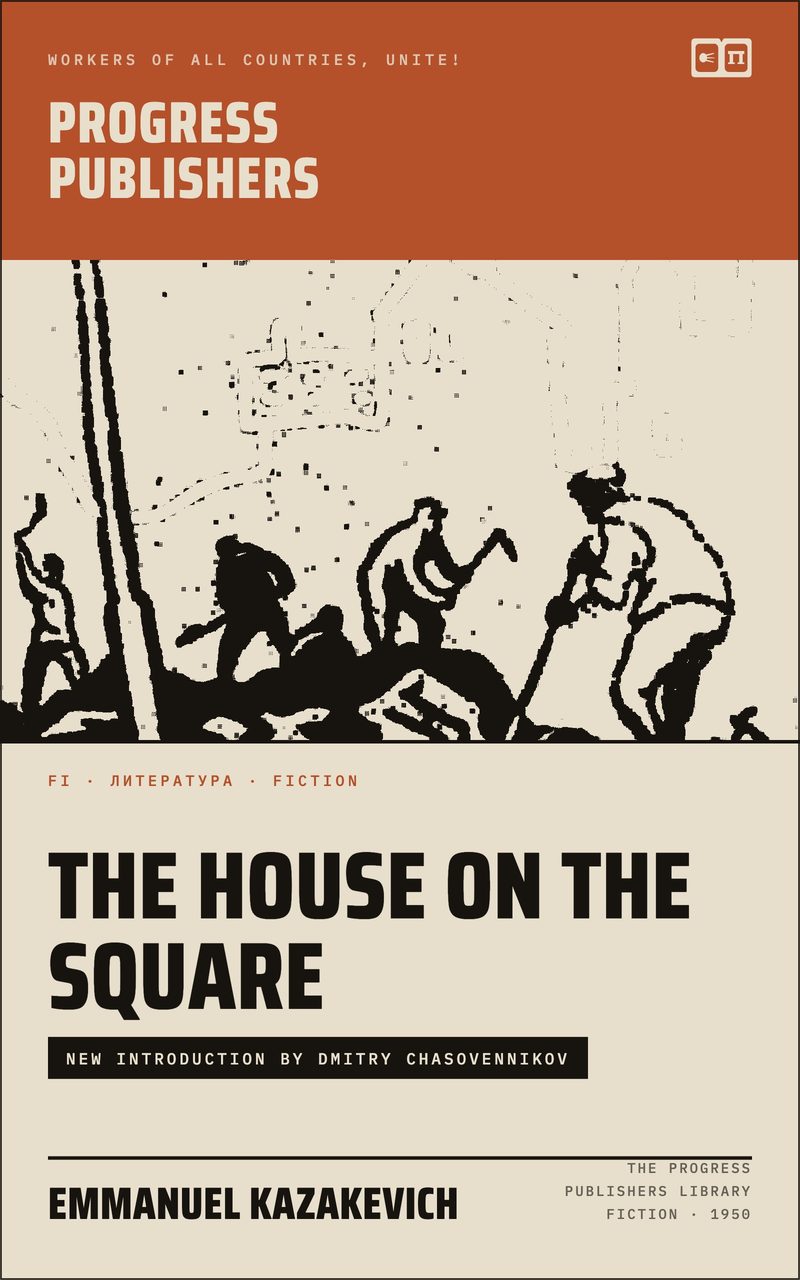
The House on the Square
Buy
The critical introduction
Written for this edition and published free in Progress Quarterly, Volume IX, Number 4.
Read it the whole numberSomewhere in the middle of this novel a Soviet lieutenant-colonel, unable to sleep, writes out fifteen numbered rules for governing a conquered country. He heads the page MEMORANDUM OF A SOVIET COMMANDANT, signs it, and dates it Lauterburg, 1945.
"The commandant is always right inasmuch as he has the army behind him. Hence he must see to it that he is always in the right." "He must see to it that the citizens blame him personally if things go wrong, and credit Moscow for all the good." And the fifth, which is the argument the novel exists to make: that a commandant is a revolutionary because he represents a system brought into being by revolution, and that his duty is therefore to guard the customs of a country not yet ripe for one, in order to rid its people of all fear of revolution.
His friend finds the pad and reads it twice. Lubentsov goes scarlet and snatches it away: "Dash it, you mustn't read that rot!" "It isn't rot."
A political theory of military occupation, set down by a fictional Soviet officer, given in full and then disowned in embarrassment.
The author had been a Yiddish poet before the war, then a divisional reconnaissance chief, then a Russian novelist. This volume tells you none of that, carries no date, and does not name whoever turned its hundred and fifty thousand words into English.
Foreign Languages Publishing House, Moscow, in the Library of Soviet Literature, undated.
New critical introduction by Dmitry Chasovennikov.
| Series | The Progress Publishers Library |
| First published | 1950 |
| ISBN | 978-5-01-900313-6 |
| Pages | 519 |
| Language | English |
| Subject | Fiction |
| Introduction By | Dmitry Chasovennikov |