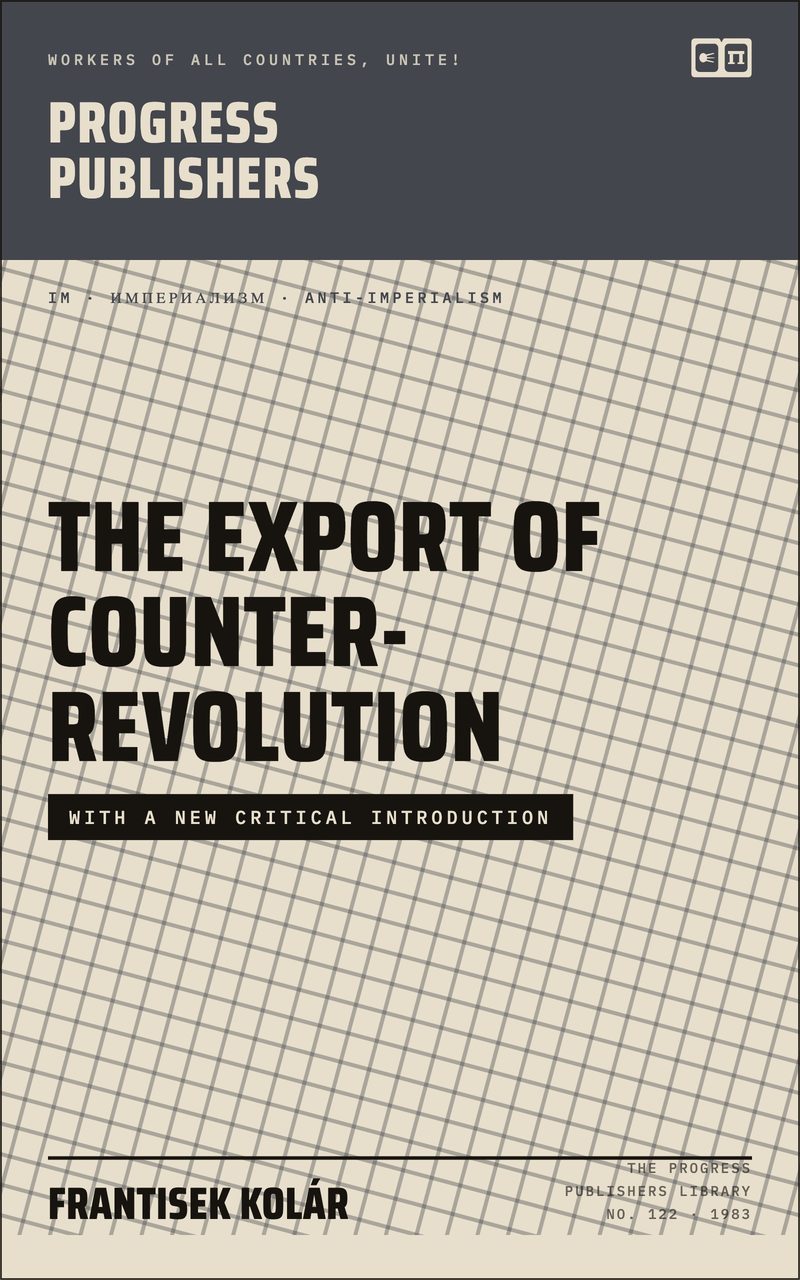
The Export of Counter-Revolution
Buy
The critical introduction
Written for this edition and published free in Progress Quarterly, Volume VII, Number 3.
Read it the whole numberA single idea run across almost five centuries: that revolutions provoke counter-revolutions, and that reactionary classes unable to hold power at home call in help from abroad - through propaganda campaigns, subversion, economic blockade and finally armed invasion.
Frantisek Kolar takes the thesis through the Hussite crusades of the fifteenth century, the coalition of monarchies against the French Revolution, the Russian army that crushed the Hungarian revolution of 1849, the Prussian and Versaillais siege of the Paris Commune, the fourteen-power intervention against Soviet Russia, the abandonment of the Spanish Republic, and then Vietnam, Indonesia, Chile, Nicaragua and Afghanistan. Some three dozen short thematic chapters, briskly written, with an afterword by a Pravda political observer.
The category is a real one and the book is on solid ground for long stretches. Its chapter on the intervention against Soviet Russia is substantially accurate history: Britain, France, the United States, Japan and eleven other states did land troops on Russian soil, arm the White generals and blockade the republic. The chapters on Chile and on Guatemala rest on a record that has only been more fully documented since.
There is no lag to correct here. Its latest events are the martial law imposed in Poland in December 1981 and Reagan's remarks of March 1981 on aid to the Afghan insurgents. This is a book of the Second Cold War written at its coldest.
New critical introduction by Dmitry Chasovennikov, on a true idea held up as a one-way mirror.
| Series | The Progress Publishers Library |
| First published | 1983 |
| ISBN | 978-5-01-900194-1 |
| Pages | 201 |
| Language | English |
| Subject | Anti-Imperialism |
| Introduction By | Dmitry Chasovennikov |
| Translator | Ludmila Lezhneva |