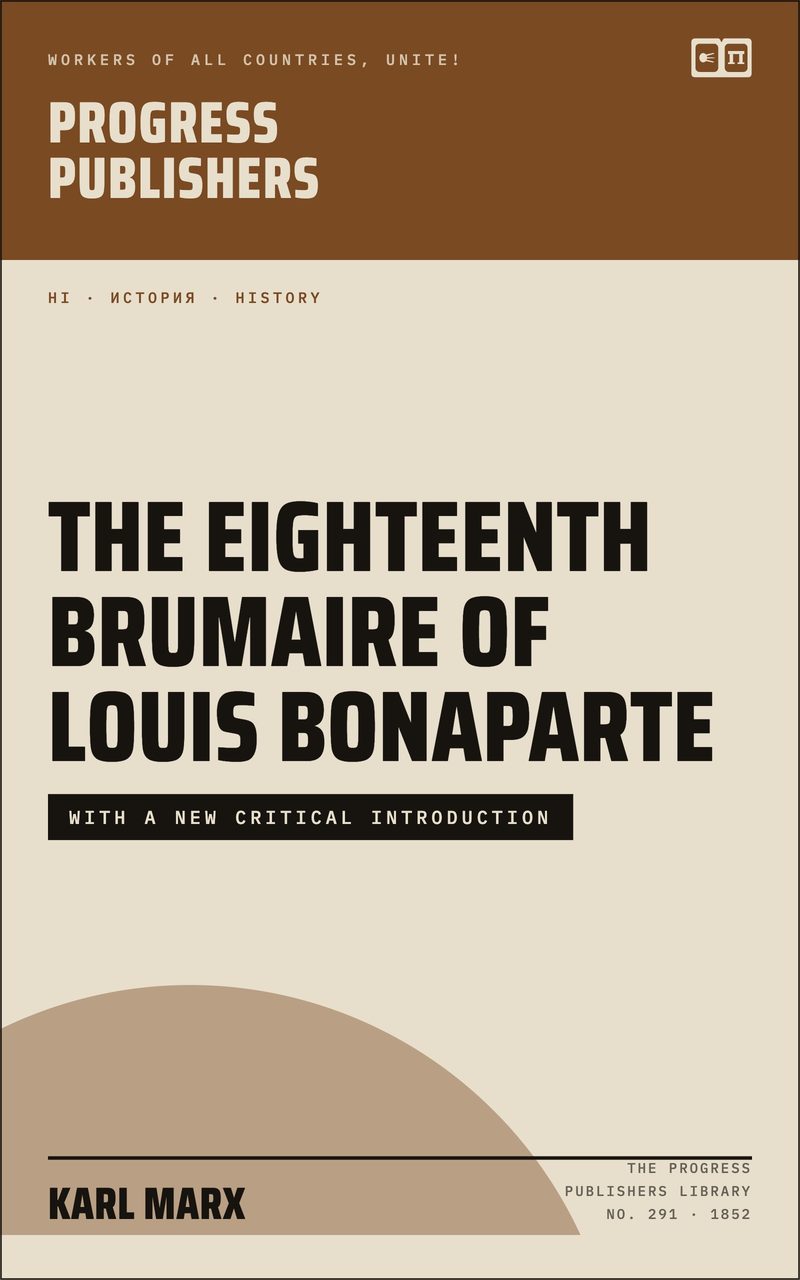
The Eighteenth Brumaire of Louis Bonaparte
Buy
The critical introduction
Written for this edition and published free in Progress Quarterly, Volume I, Number 1.
Read it the whole numberEveryone knows the first sentence, and almost no one reads the book it opens. "Hegel remarks somewhere that all facts and personages of great importance in world history occur, as it were, twice. He forgot to add: the first time as tragedy, the second as farce." A few lines on comes the other line everyone knows - "Men make their own history, but they do not make it just as they please" - and then the image that has outlived the book: "The tradition of all the dead generations weighs like a nightmare on the brain of the living."
The Eighteenth Brumaire is quoted more than it is read, and that is a loss. Between its famous opening and its half-forgotten close Marx does something he never did at this length again: he takes a single shabby political event - the coup by which Louis Bonaparte, nephew of the great Napoleon, made himself dictator of France on 2 December 1851 - and shows the whole machinery of class, state and illusion working underneath it.
He wrote it at white heat in London exile between December 1851 and March 1852, for a little German-American monthly that his friend Joseph Weydemeyer was trying to launch in New York. It was journalism against the clock, and it is the finest thing of its kind ever written. The opening pages are the most balanced statement Marx ever gave of how history is made - neither by great men imposing their will nor by impersonal forces grinding out a predetermined result, but by real people acting under inherited constraints they did not choose. He then applies it without mercy: the revolutionaries of 1848 borrow the costumes of 1793, the bourgeoisie discovers it would rather be ruled than rule, the peasants vote for a name, and a "grotesque mediocrity" walks through the wreckage to a throne.
The famous distinction between bourgeois and proletarian revolutions is here too - the first storming "swiftly from success to success", the second doomed to "recoil ever and anon from the indefinite prodigiousness of their own aims".
The Progress Publishers text, printed from the 1869 edition and checked against 1852 and 1885, with Marx's own Preface of 1869 and Engels's of 1885.
New critical introduction by Dmitry Chasovennikov.
| Series | The Progress Publishers Library |
| First published | 1852 |
| ISBN | 978-5-01-900264-1 |
| Pages | 132 |
| Language | English |
| Subject | History |
| Introduction By | Dmitry Chasovennikov |